

In this short guide, we will cover the following topics for ‘Confiar’ in Spanish:
- What does ‘Confiar’ mean?
- ‘Confiar’ Conjugations
- How to Use ‘Confiar’ in Spanish
- Expressions & Idioms with ‘Confiar’
- Synonyms of ‘Confiar’ in Spanish
What does ‘Confiar’ mean?
In Spanish, ‘confiar’ means ‘to believe’, ‘to trust’ and ‘to have faith’. As a result, this verb is used to express that a person has a strong feeling of confidence and security that something will be done or that someone has the ability to do something right.
- When describing a person encouraging himself or someone else to believe that he can accomplish something, this verb means ‘to believe’.
- To describe that a person relies on someone else to be responsible for something, ‘confiar’ means ‘to trust’, ‘to entrust’ or ‘to confide’.
‘Confiar’ Conjugations
In Spanish, confiar is a regular verb. So, to conjugate most of the tenses you simply need to remove the -AR ending and add the corresponding endings to the verb stem ‘confi’. Below you will find some conjugation charts where you can check how to conjugate this verb.
Indicative
Present tense conjugation
| Person | Conjugation | Translation |
|---|---|---|
| Yo | Confío | I trust |
| Tú | Confías | You trust |
| Él / Ella / Usted | Confía | He/She trusts |
| Nosotros | Confiamos | We trust |
| Vosotros | Confiáis | You trust |
| Ustedes / Ellos / Ellas | Confían | They/You trust |
Preterite tense conjugation
| Person | Conjugation | Translation |
|---|---|---|
| Yo | Confié | I trusted |
| Tú | Confiaste | You trusted |
| Él / Ella / Usted | Confió | He/She trusted |
| Nosotros | Confiamos | We trusted |
| Vosotros | Confiasteis | You trusted |
| Ustedes / Ellos / Ellas | Confiaron | They/You trusted |
Imperfect tense conjugation
| Person | Conjugation | Translation |
|---|---|---|
| Yo | Confiaba | I trusted |
| Tú | Confiabas | You trusted |
| Él / Ella / Usted | Confiaba | He/She trusted |
| Nosotros | Confiábamos | We trusted |
| Vosotros | Confiabais | You trusted |
| Ustedes / Ellos / Ellas | Confiaban | They/You trusted |
Future tense conjugation
To conjugate ‘confiar’ to the future tense you just need to add the corresponding future endings to the infinitive verb.
| Person | Conjugation | Translation |
|---|---|---|
| Yo | Confiaré | I will trust |
| Tú | Confiarás | You will trust |
| Él / Ella / Usted | Confiará | He/She will trust |
| Nosotros | Confiaremos | We will trust |
| Vosotros | Confiaréis | You will trust |
| Ustedes / Ellos / Ellas | Confiarán | They/You will trust |
Conditional tense conjugation
Just like the future, the conditional tense of ‘confiar’ is built by simply adding the conditional endings to confiar (verb in infinitive form).
| Person | Conjugation | Translation |
|---|---|---|
| Yo | Confiaría | I would trust |
| Tú | Confiarías | You would trust |
| Él / Ella / Usted | Confiaría | He/She would trust |
| Nosotros | Confiaríamos | We would trust |
| Vosotros | Confiaríais | You would trust |
| Ustedes / Ellos / Ellas | Confiarían | They/You would trust |
Progressive Tenses
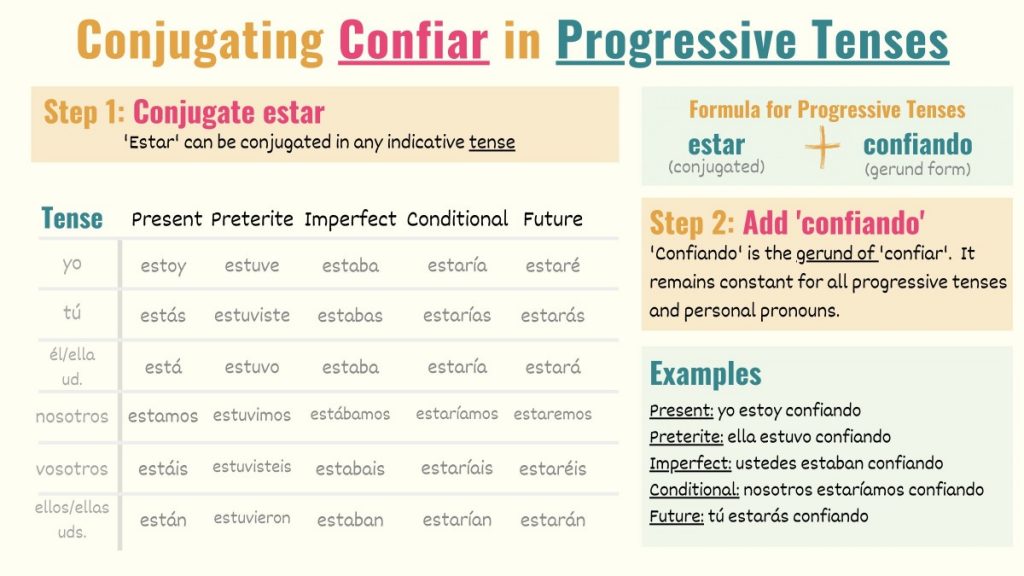
Estoy confiando en tí.
I am trusting you.
Alberto y yo estábamos confiando en aprobar la materia.
Alberto and I were hoping to pass the course.
Perfect Tenses
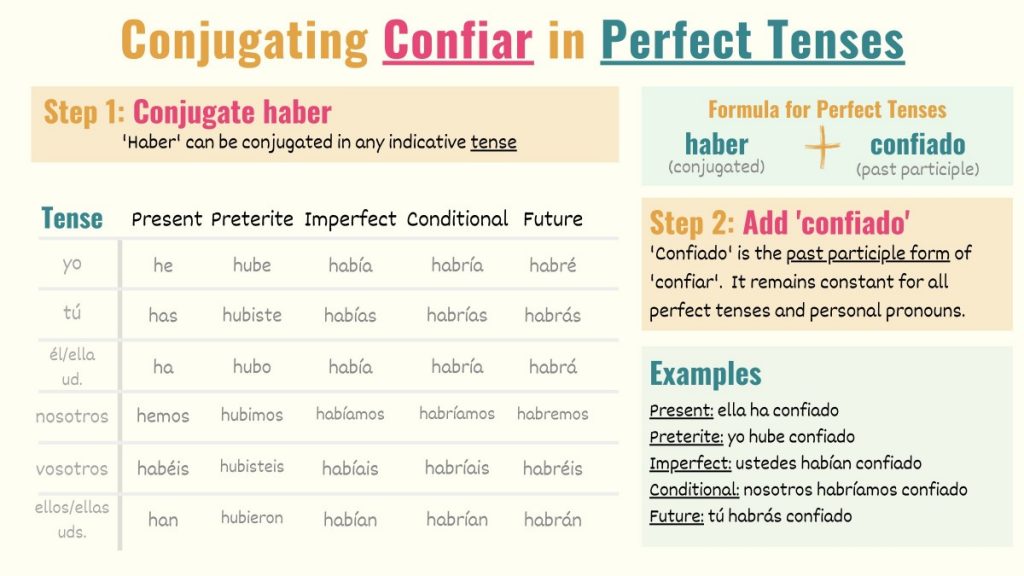
Si hubiera confiado en mí mismo, lo habría hecho bien.
If I had trusted myself, I would have done well.
Habíamos confiado en que terminarías tu tarea, pero ni siquiera has empezado.
We had hoped you would finish your homework, but you haven’t even started.
Confiar Subjunctive Conjugations
Present subjunctive conjugation
| Person | Conjugation | Translation |
|---|---|---|
| Yo | Confíe | To trust |
| Tú | Confíes | To trust |
| Él / Ella / Usted | Confíe | To trust |
| Nosotros | Confiemos | To trust |
| Vosotros | Confiéis | To trust |
| Ustedes / Ellos / Ellas | Confíen | To trust |
Imperfect subjunctive conjugations
| Person | Conjugation | Translation |
|---|---|---|
| Yo | Confiara | I trusted |
| Tú | Confiaras | You trusted |
| Él / Ella / Usted | Confiara | He/She trusted |
| Nosotros | Confiáramos | We trusted |
| Vosotros | Confiarais | You trusted |
| Ustedes / Ellos / Ellas | Confiaran | They/You trusted |
Perfect subjunctive
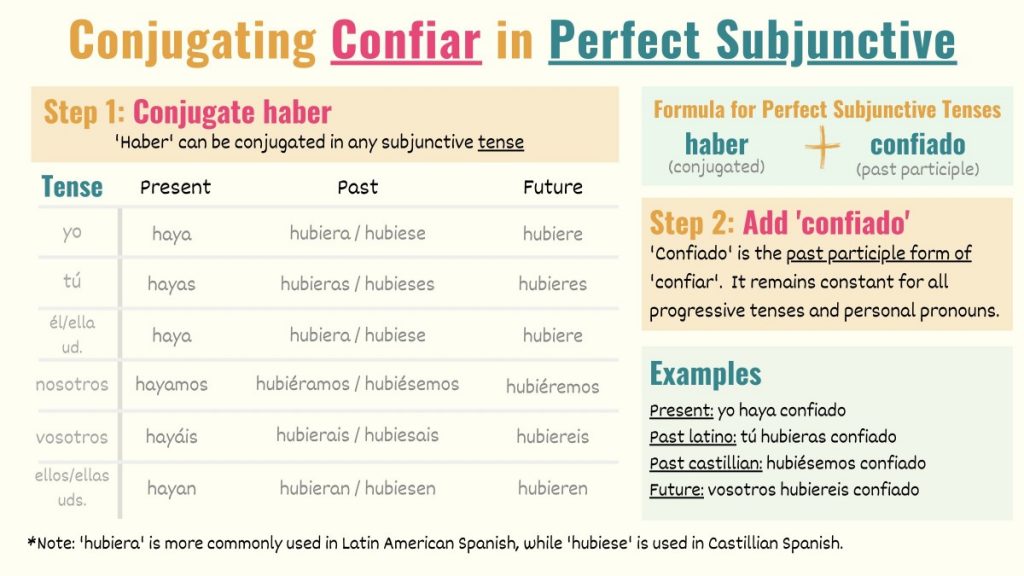
Ojalá no les hubiera confiado mi dinero.
I wish I hadn’t entrusted you with my money, guys.
No hubiera confiado en que llegarías puntual a nuestra cita.
I wouldn’t have trusted you to be on time for our appointment.
Imperative
Imperative conjugation
| Person | Conjugation | Translation |
|---|---|---|
| Tú | Confía | Trust |
| Usted | Confíe | Trust |
| Nosotros | Confiemos | Let’s trust |
| Vosotros | Confiad | Trust |
| Ustedes | Confíen | Trust |
[‘Confiar’ in imperative] + [complement]
Confiemos en que todo saldrá bien.
Let’s trust that everything will be okay.
Por favor, confía en mí. Te estoy diciendo la verdad.
Please, trust me. I’m telling you the truth.
No + [‘confiar’ in present subjunctive] + [complement]
No confíes en él.
Don’t trust him.
Oigan, no se confíen, el examen sí está difícil.
Hey, don’t be overconfident, the test is actually hard.
How to Use ‘Confiar’ in Spanish with Examples
There are two main uses for the verb ‘confiar’ in Spanish:
- Expressing confidence or trust
- To talk about giving a responsibility to someone else
In the section below, I’ll explain to you in detail each one of these meanings and I’ll provide examples and phrase structures so you can start applying them into your daily conversations.
Expressing confidence or trust
‘Confiar’ is used when talking about a sense of confidence or faith in yourself, in someone else, or any religious entity. In this context, it can also be used to talk about expectations and can be translated as ‘to trust’, ‘to believe’ or ‘to have faith’.
[‘Confiar’ conjugated] + en + (que) + [complement]
Yo confío en que todo saldrá bien.
I believe that everything will be fine.
Nosotros confiamos plenamente en Dios.
We fully believe in God.
Confío en que las universidades abrirán pronto.
I have faith that the universities will open soon.
Its reflexive form, ‘confiarse’, is used for expressing overconfidence that mostly leads to negative outcomes. So, in this case, confiarse means ‘to be overconfident’ or ‘to count on it’. Since this is a reflexive verb, don’t forget to add the proper reflexive pronoun.
[Reflexive pronoun] + [‘confiar’ conjugated] + [complement]
Me confié y llegué tarde.
I was overconfident and I arrived late.
No se confíen o van a perder.
Don’t be overconfident or you’ll lose.
Normalmente el autobús llega puntual, pero no te confíes.
Usually, the bus arrives on time, but don’t count on it.
Nuestro equipo perdió la final porque nos confíamos.
Our team lost the finals because we were overconfident.
To talk about giving a responsibility to someone else
A common way to apply the verb ‘confiar’ is when it comes to relying on someone else for something important. In Spanish, people frequently use this verb when talking about trusting someone with secrets and responsibilities. It can be translated as ‘to entrust’ or ‘to confide’.
[Indirect object pronoun] + [‘confiar’ conjugated] +[complement]
Le confié mi mayor secreto.
I confided my biggest secret to him.
Me confió sus ahorros de vida.
She entrusted her life savings to me.
Te confiamos esta tarea porque sabemos que eres muy capaz.
We entrust you with this task because we know that you are very capable.
Take note: In Spanish, it’s also common to use the noun ‘confianza’ to express that we trust someone. In this case, we use terms such as ‘ser de confianza’ or ‘ser de fiar’ as synonyms of ‘be reliable’ or ‘be trustworthy’.
Javier y Maria son personas de confianza.
Javier and María are trustworthy people.
Confiar Expressions & Idioms
No confiar ni en Dios is an expression that people commonly use for expressing that they don’t trust anyone. Its direct translation is ‘to not even trust God’.
No confiar ni en la propia sombra is another idiom for expressing that people don’t trust anyone. Its direct translation is ‘to not even trust your own shadow’.
Confiar ciegamente is used when expressing a strong feeling of trust and no doubts in someone or something. Its translation is ‘to trust blindly’.
Confiar en la palabra de alguien is used when suggesting that a person is totally trustworthy; both in what he says, and in what he does. Its translation is ‘to take somebody’s word’.
Synonyms of ‘Confiar’ in Spanish
Encargar could be translated as ‘to ask’ or ‘to request’. It is used to talk about requesting other people to take care of something for you.
Fiarse also means ‘to trust’ and we usually use this verb to express that we trust someone. However, fiarse is more common in Castilian Spanish.
Creer means ‘to believe’ and, in some cases, it can be used to express your confidence in something or someone.
Contar can be used as a synonym of ‘confiar’ when describing that you trust something to happen or someone to do something. In this context, ‘contar’ is close in meaning to ‘bank on’.
Related Resources:
How to Conjugate Reflexive Verbs: many Spanish learners struggle to understand and conjugate reflexive verbs properly. Since these verbs are very common in Spanish, you should get comfortable with their conjugation rules.