

In this short guide, we will cover the following topics for ‘Aprobar’ in Spanish:
- What does ‘Aprobar’ mean?
- ‘Aprobar’ Conjugations
- How to Use ‘Aprobar’ in Spanish
- Expressions & Idioms with ‘Aprobar’
- Synonyms of ‘Aprobar’ in Spanish
What does ‘Aprobar’ mean?
Definition – ‘Aprobar’ means to approve or to pass. As a result, we use this verb to express that something or someone is good or sufficient. Additionally, aprobar also describes that a person successfully completed a test or course.
The meaning of this verb changes depending on the context. Here are some definitions that will help you understand how to use it.
- When talking about agreeing or accepting something or someone, ‘aprobar’ is translated as ‘to approve’.
- If referring to passing a course or test, it means ‘to pass’.
‘Aprobar’ Conjugations
Overall, ‘aprobar’ is a regular verb in Spanish. However, in order to make the pronunciation easier, this verb has some irregularities in the present indicative, present subjunctive and imperative.
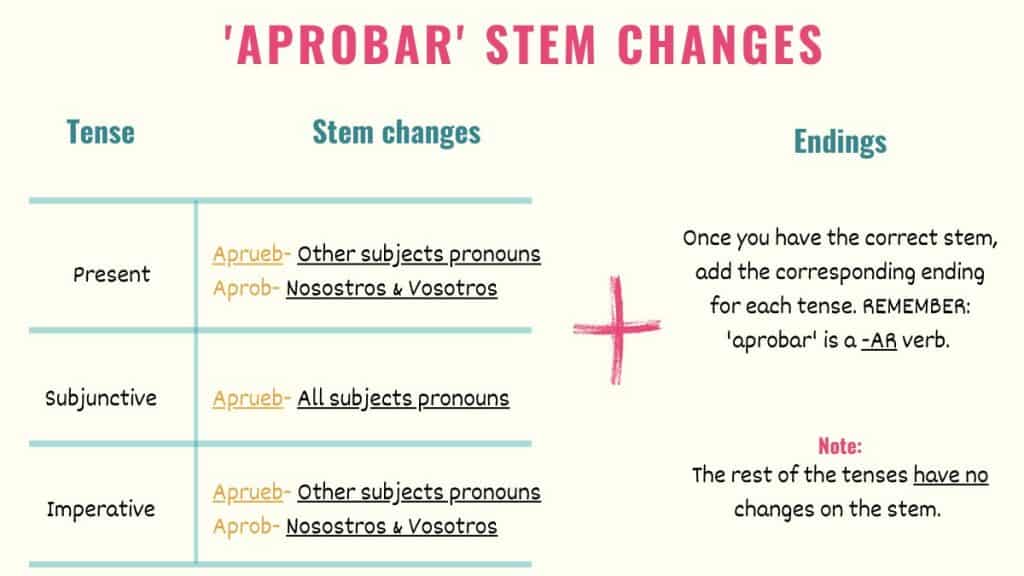
Although this might sound overwhelming, in the following conjugation charts I’ll provide you with descriptions that will help you understand when and how to deal with these irregularities.
Indicative
Present tense conjugation
To conjugate aprobar in the present tense, we use two stems. The regular stem ‘aprob’ is used when conjugating nosotros and vosotros. The rest of the subjects will work with the irregular stem ‘aprueb’.
| Person | Conjugation | Translation |
|---|---|---|
| Yo | apruebo | I approve |
| Tú | apruebas | You approve |
| Él / Ella / Usted | aprueba | He/She approve |
| Nosotros | aprobamos | We approve |
| Vosotros | aprobáis | You approve |
| Ustedes / Ellos / Ellas | aprueban | They/You approve |
Preterite tense conjugation
In the preterite tense, aprobar is a regular verb. This means that the stem you use to conjugate will not change.
| Person | Conjugation | Translation |
|---|---|---|
| Yo | aprobé | I approved |
| Tú | aprobaste | You approved |
| Él / Ella / Usted | aprobó | He/She approved |
| Nosotros | aprobamos | We approved |
| Vosotros | aprobasteis | You approved |
| Ustedes / Ellos / Ellas | aprobaron | They/You approved |
Imperfect tense conjugation
| Person | Conjugation | Translation |
|---|---|---|
| Yo | aprobaba | I approved |
| Tú | aprobabas | You approved |
| Él / Ella / Usted | aprobaba | He/She approved |
| Nosotros | aprobábamos | We approved |
| Vosotros | aprobabais | You approved |
| Ustedes / Ellos / Ellas | aprobaban | They/You approved |
Future tense conjugation
The future tense of aprobar is created by attaching the corresponding endings (underlined in the table below) to the verb in the infinitive form. So, instead of a stem, start with aprobar as a whole.
| Person | Conjugation | Translation |
|---|---|---|
| Yo | aprobaré | I will approve |
| Tú | aprobarás | You will approve |
| Él / Ella / Usted | aprobará | He/She will approve |
| Nosotros | aprobaremos | We will approve |
| Vosotros | aprobaréis | You will approve |
| Ustedes / Ellos / Ellas | aprobarán | They/You will approve |
Conditional tense conjugation
| Person | Conjugation | Translation |
| Yo | aprobaría | I would approve |
| Tú | aprobarías | You would approve |
| Él / Ella / Usted | aprobaría | He/She would approve |
| Nosotros | aprobaríamos | We would approve |
| Vosotros | aprobaríais | You would approve |
| Ustedes / Ellos / Ellas | aprobarían | They/You would approve |
Progressive Tenses
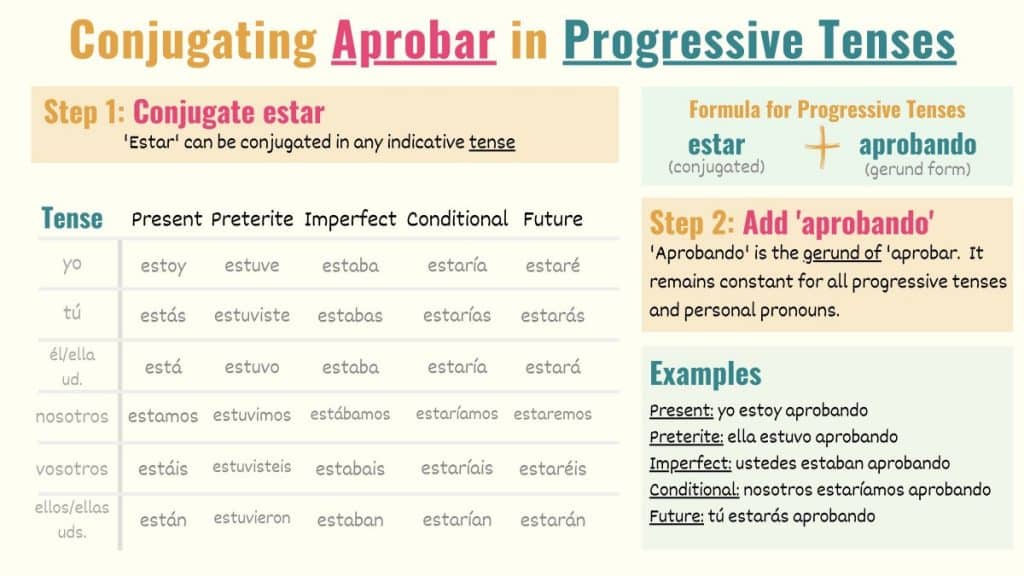
Estamos evaluando y aprobando las próximas vacunas.
We’re testing and approving the next vaccines.
Perfect Tenses
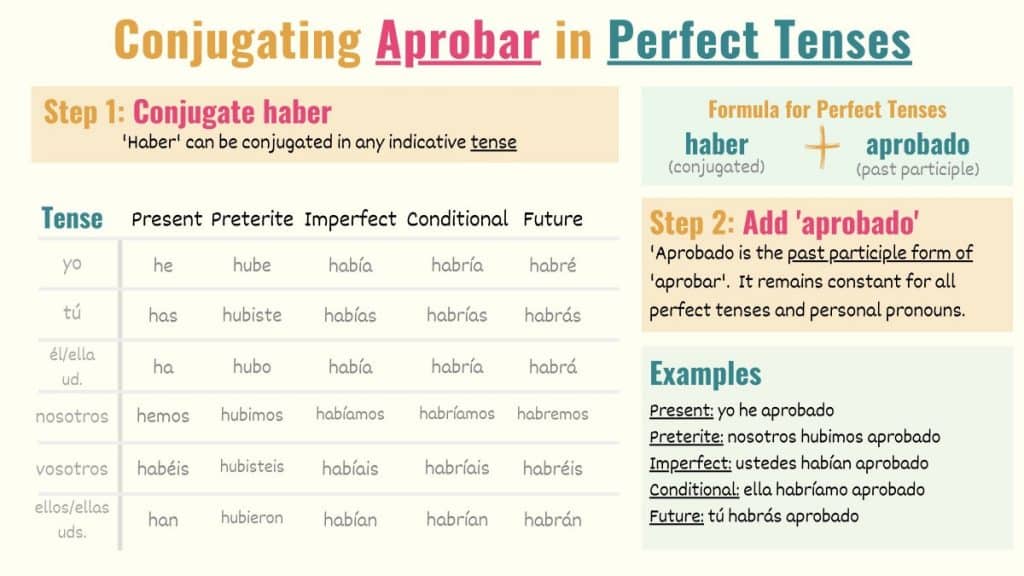
La última vacuna no ha sido aprobada en Norteamérica.
The last vaccine hasn’t been approved in North America.
Aprobar Subjunctive Conjugations
Present subjunctive conjugation
In the present subjunctive, ‘aprobar’ uses its regular stem ‘aprob’ for nosotros and vosotros; while you’ll need to use the irregular stem ‘aprueb’ for the rest of the subjects.
| Person | Conjugation | Translation |
|---|---|---|
| Yo | apruebe | I approve |
| Tú | apruebes | You approve |
| Él / Ella / Usted | apruebe | He/She approves |
| Nosotros | aprobemos | We approve |
| Vosotros | aprobéis | You approve |
| Ustedes / Ellos / Ellas | aprueben | They/You approve |
Imperfect subjunctive conjugations
| Person | Conjugation | Translation |
|---|---|---|
| Yo | Aprobara / aprobase | I approved |
| Tú | Aprobaras / aprobases | You approved |
| Él / Ella / Usted | Aprobara / aprobase | He/She approved |
| Nosotros | Aprobáramos / aprobásemos | We approved |
| Vosotros | Aprobarais / aprobaseis | You approved |
| Ustedes / Ellos / Ellas | Aprobaran / aprobasen | They/You approved |
Perfect subjunctive
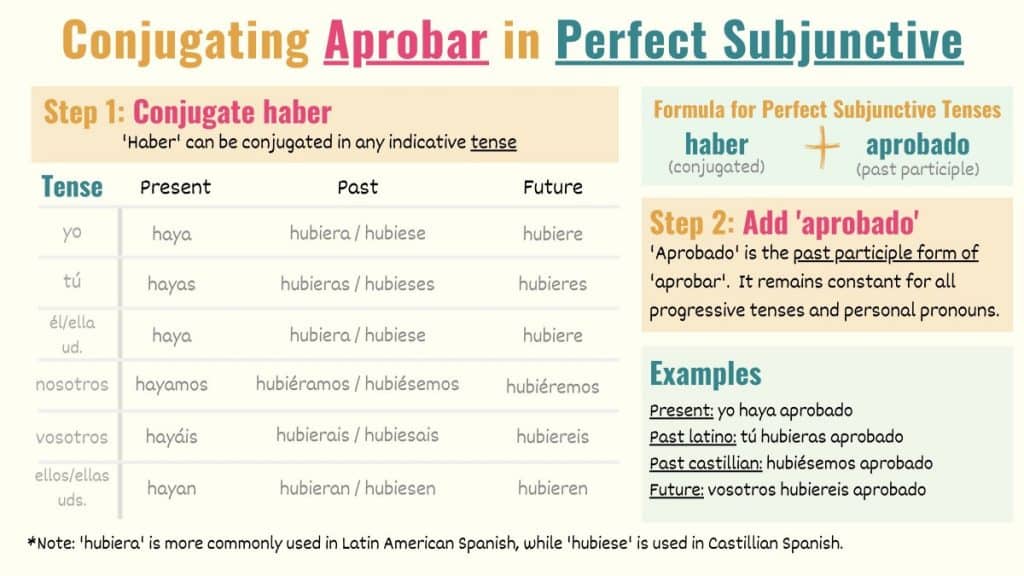
Ojalá tu hermano haya aprobado su examen.
I hope your brother passed his exam.
Imperative
Imperative conjugation
Just like the present subjunctive conjugation, aprobar in the imperative tense uses two stems. ‘Aprob’ is only applied for nosotros and vosotros. On the other hand, ‘aprueb’ is used for tú and ustedes.
| Person | Conjugation | Translation |
|---|---|---|
| Tú | aprueba | You approve |
| Nosotros | aprobemos | We approve |
| Vosotros | aprobad | You approve |
| Ustedes | aprueben | They/You approve |
[‘Aprobar’ in imperative] + [complement]
Aprueben su examen o tendrán problemas.
Pass your test or you will be in trouble.
Aprobemos el presupuesto de marketing.
Let’s approve the budget for marketing.
When using the negative imperative (i.e. telling someone not to do something), use the appropriate present subjunctive form of ‘aprobar’ instead. Here’s the phrase structure and some examples:
No + [‘aprobar’ present subjunctive] + complement
No apruebes ese tipo de conductas irrespetuosas.
Do not condone such disrespectful behavior.
Por favor, no aprueben el uso de armas.
Please, do not approve the use of guns.


How to Use ‘Aprobar’ in Spanish with Examples
There are two main uses of the verb ‘aprobar’ in Spanish:
- To say ‘to approve’
- When explaining that you passed a test or course
In the sections below, I’ll provide you with a few examples and descriptions of how to use this verb in Spanish. Make sure you use the phrase structure as guidance to build your own examples.
To say ‘to approve’
In Spanish, we use the verb ‘aprobar’ to agree on an opinion or to describe that someone considers that something is right or good enough. As a result, in this context, ‘aprobar’ means ‘to approve’.
[‘Aprobar’ conjugated] + [determiner] + [noun]
El entrenador aprobó el desempeño del corredor.
The coach approved the runner’s performance.
Mi hermana no aprueba el mal comportamiento de sus hijos.
My sister does not approve of her children’s bad behavior.
El comité aprobó nuestro proyecto.
The committee approved our project.
¿Crees que nos aprueben el préstamo que pedimos?
Do you think they’ll approve the loan that we asked for?
Talking about passing a course or test
Another use of the verb ‘aprobar’ in Spanish is when describing that a person passed a test or a course. In this case, ‘aprobar’ is translated as ‘to pass’ or ‘to approve’. This meaning is usually applied in learning environments, but it can also be used when talking about passing a standardized test or benchmark.
[Aprobar conjugated] + (definite article) + [noun]
Aprobé el examen de admisión, en agosto empiezan mis clases.
I passed the admission exam, and my classes start in August.
Todos aprobamos el curso de español para principiantes.
We all passed the Spanish course for beginners.
Si no estudiamos, no aprobaremos matemáticas.
If we don’t study, we won’t pass Maths.
La nueva Range Rover Sport pasó la prueba de emisiones.
The new Range Rover Sport passed the emissions test.
Aprobar Expressions & Idioms
Here we have a few expressions in Spanish that use the verb ‘aprobar’. Take a look at the definition and translation in English so you understand when to apply it. The examples show you how to conjugate it along with other prepositions and nouns.
Aprobar por los pelos: This expression means to achieve something by a small margin or to barely reach something. It can be translated as ‘to pass by the skin of your teeth’ or ‘to barely pass’.
Aprobar de panzazo: In Spanish, this expression is also used when someone barely passes an exam or manages to achieve something. It can be translated as ‘to pass by the skin of your teeth.
Synonyms of ‘Aprobar’ in Spanish
Pasar: Although this is the direct translation of ‘to pass’, ‘pasar’ is a more casual way to express that someone passes a test or course.
Admitir: When talking about someone who agrees or accepts something as satisfactory, this Spanish verb can be used instead of ‘aprobar’. It is translated as ‘to admit’.
Aceptar: If we are speaking about allowing, consenting or agreeing to something, this verb can be used instead of ‘aprobar’. It is the translation of ‘to accept’.
Permitir: In case we are talking about agreeing or accepting something, ‘aprobar’ can be substituted for this verb. It is the translation of ‘to allow’ or ‘to permit’.