

In this short guide, we will cover the following topics for ‘Doler’ in Spanish:
- What does ‘Doler’ mean?
- ‘Doler’ Conjugations
- How to Use ‘Doler’ in Spanish
- Difference between doler and herir in Spanish
- Synonyms of ‘Doler’ in Spanish
What does ‘Doler’ mean?
In Spanish, ‘doler’ is a verb that expresses physical and emotional pain. As a result, it can be translated as ‘to hurt’ or ‘to ache’.
‘Doler’ Conjugations
‘Doler’ is a verb with spelling changes. This means that the ‘o’ in the stem ‘dol’ will change to ‘ue’ (‘duel’) for some of the tenses and subjects.
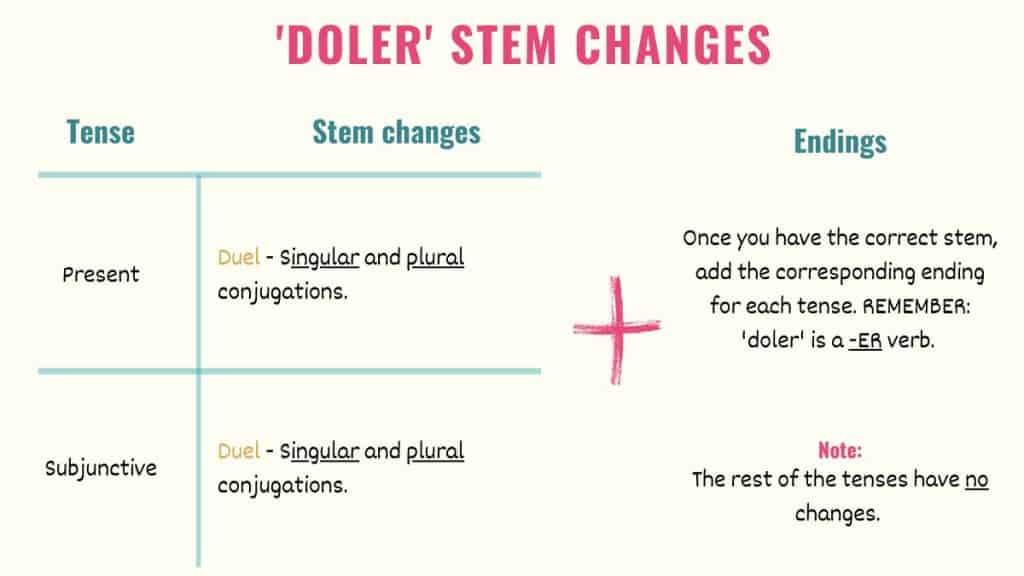
How do you conjugate the verb doler in Spanish?
The conjugation of ‘doler’ depends on the thing that causes the pain or the place where the person is experiencing the pain. As a result, all the conjugations will be in the third person singular or plural. As a pronominal verb, ‘doler’ works with indirect pronouns to point out who is in pain.
Le duele la pierna.
His leg hurts.
Nos duele que estés triste.
It hurts us that you are sad.
A Chase le duelen las rodillas.
Chase’s knees hurt.
Hace mucho que no me dolía la garganta.
My throat hasn’t hurt in a long time.
If you check the examples above, you’ll notice that the verb is conjugated based on the thing that hurts. So, since rodillas is a plural object, doler needs to follow a plural conjugation.
Indicative
Present tense conjugation
To conjugate ‘doler’ to the present tense, you’ll need to use the regular stem ‘duel’. Overall, these are the two conjugations that you need for this tense.
| Person | Conjugation | Translation |
|---|---|---|
Indirect Object Pronoun | Duele | Hurt / Hurts |
| Duelen | Hurt / Hurts |
Preterite tense conjugation
| Person | Conjugation | Translation |
|---|---|---|
Indirect Object Pronoun | Dolió | Hurt |
| Dolieron | Hurt |
Imperfect tense conjugation
| Person | Conjugation | Translation |
|---|---|---|
Indirect Object Pronoun | Dolía | Hurt |
| Dolían | Hurt |
Future tense conjugation
Since ‘doler’ is a regular verb in the future tense, to conjugate it to this tense, you’ll simply add the third person singular and plural endings to the verb in the infinitive form.
| Person | Conjugation | Translation |
|---|---|---|
Indirect Object Pronoun | Dolerá | Will hurt |
| Dolerán | Will hurt |
Conditional tense conjugation
To conjugate ‘doler’ to the conditional tense, you’ll work with the verb in its infinitive form. So, you just need to add the third person singular or plural endings to this verb.
| Person | Conjugation | Translation |
|---|---|---|
Indirect Object Pronoun | Dolería | Would hurt |
| Dolerían | Would hurt |
Progressive Tenses
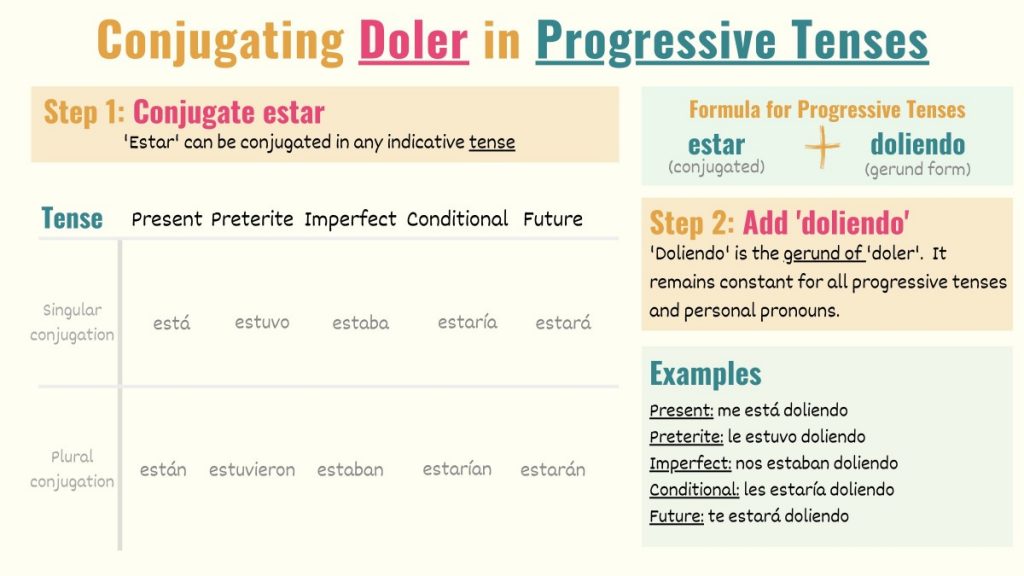
Me está doliendo el brazo.
My arm is hurting.
Toda la semana le estuvo doliendo la panza.
Her belly was hurting all week.
Perfect Tenses
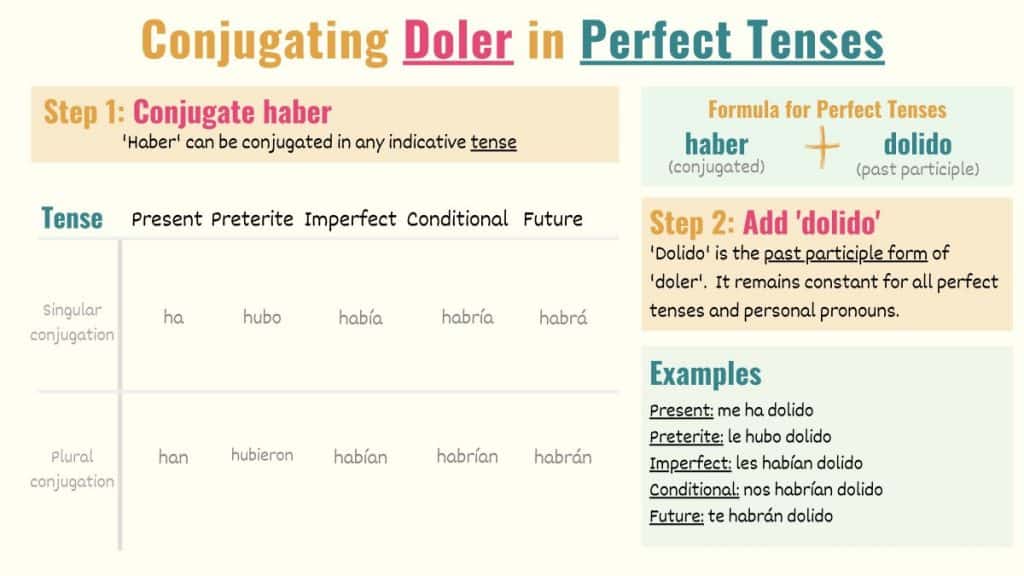
Nunca me había dolido tanto una ruptura.
A breakup had never hurt me so much.
Si te hubieran puesto anestesia, no te habría dolido.
If they had put you under anesthesia, it wouldn’t have hurt.
Doler Subjunctive Conjugations
Present subjunctive conjugation
Notice that, in the subjunctive mood, ‘doler’ is irregular. This means that you’ll work with the stem ‘duel’.
| Person | Conjugation | Translation |
|---|---|---|
Indirect Object Pronoun | Duela | To hurt |
| Duelan | To hurt |
Imperfect subjunctive conjugations
| Person | Conjugation | Translation |
|---|---|---|
Indirect Object Pronoun | Doliera / Doliese | Hurt |
| Dolieran / Doliesen | Hurt |
Perfect subjunctive
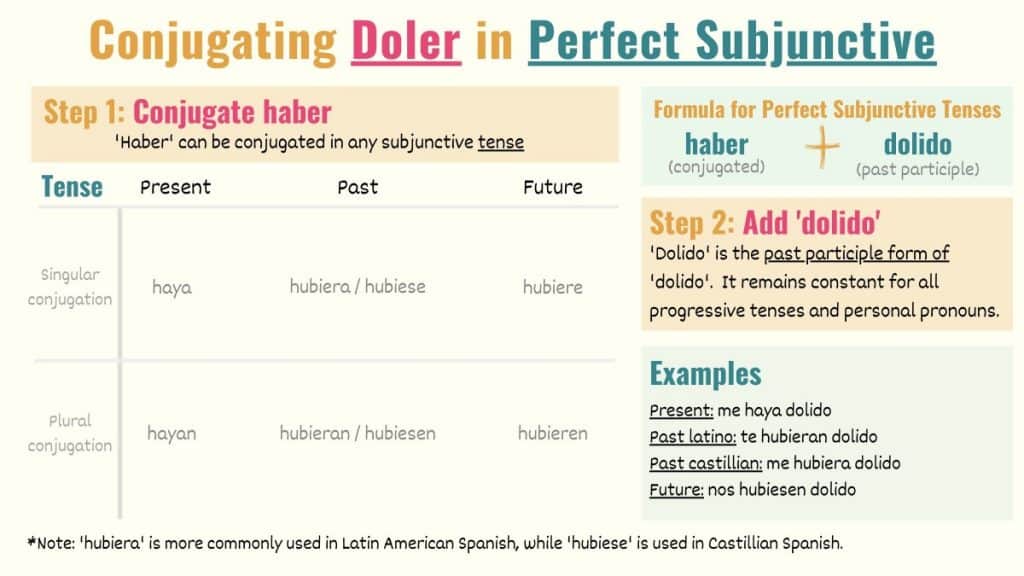
¿Crees que le haya dolido la caída?
Do you think the fall hurt him?
Imperative
Imperative conjugation
The verb ‘doler’ is practically never conjugated to the imperative form as it would sound a little off. Think about it, you cannot order someone to feel pain…


How to Use ‘Doler’ in Spanish with Examples
In Spanish, the verb ‘doler’ is used to talk about things that produce pain, so there are a lot of contexts where it can be applied. Below are some examples and more in-depth explanations of how to use this verb.
To express pain
As mentioned at the beginning of this article, ‘doler’ expresses physical and emotional pain. As a result, it can be used to talk about regrets, being offended and feeling sad, among other things. It can be translated as ‘to hurt’ or ‘to ache’.
[Indirect object pronoun] + [‘doler’ conjugated] + (adverb) + [complement]
¿Te dolió mucho?
Did it hurt a lot?
Me duele la cabeza.
My head hurts.
Me duele que tengas que irte.
It hurts me that you have to go.
A mi mamá le duelen mucho las rodillas.
My mom’s knees hurt a lot.
Me duele mucho no haberme despedido de mi abuela.
It hurts me a lot not to have said goodbye to my grandmother.
Take Note: Doler en el alma is an expression that describes a profound emotional pain. So, you can use it when you need to describe a lot of pain. ‘Doler en el alma’ is close in meaning to ‘to hurt one’s heart’ or ‘to break one’s heart’.
Difference between doler and herir in Spanish
In Spanish, ‘doler’ and ‘herir’ are very similar verbs. However, they have different meanings. ‘Doler’ is used to talk about feeling pain and can be translated as ‘to hurt’ or ‘to ache’, whereas ‘herir’ is used to talk about things or people causing harm to someone. ‘Herir’ means ‘to injure’ or ‘to wound’.
As mentioned before, ‘doler’ is a verb that describes someone’s experience of physical or emotional pain, so it’s used to refer to a sense of discomfort and ache.
Duele mucho.
It hurts a lot.
Del uno al diez, ¿cuánto te duele?
From one to ten, how much does it hurt?
The verb ‘herir’ refers to the action of causing pain or damage to someone else. When talking about physical harm, it’s a synonym of ‘to injure’ or ‘to wound’. But when talking about emotional damage, it can be translated as ‘to hurt’. Sometimes it needs direct object pronouns, unlike ‘doler’ which uses indirect pronouns.
La bala lo hirió.
The bullet wounded him.
El asaltante hirió a siete personas.
The robber wounded seven people.
Tus palabras me hirieron.
Your words hurt me.
Synonyms of ‘Doler’ in Spanish
Molestar is a verb often used to talk about physical pain and being offended. It can be translated as ‘to bother’, ‘to hurt’ and ‘to take offense’.
Lastimar also translates as ‘to hurt’ and can be used in the same contexts as ‘doler’.