In this short guide, we will cover the following topics for ‘enseñar’ in Spanish:
- What does ‘Enseñar’ mean?
- ‘Enseñar’ Conjugations
- How to Use ‘Enseñar’ in Spanish
- Expressions & Idioms with ‘Enseñar’
- Synonyms of ‘Enseñar’ in Spanish
What does ‘Enseñar’ mean?
Definition – ‘Enseñar’ can be used to describe that someone is explaining or communicating their knowledge to another person. It could also mean that a person is showing an object or making you look at something. Depending on the context, ‘enseñar’ means ‘to teach’ or ‘to show’.
- If talking about teaching or sharing knowledge with another person, ‘enseñar’ means ‘to teach‘.
- When describing that someone is exhibiting or displaying, ‘enseñar’ is translated as ‘to show’ or ‘to display’.
‘Enseñar’ Conjugations
‘Enseñar’ is a regular ‘-ar’ verb. This means you’ll only need to add the corresponding endings to the stem ‘enseñ’. Keep in mind that for the future and conditional tense you’ll work with the verb as a whole.
Indicative
Present tense conjugation
| Person | Conjugation | Translation |
|---|---|---|
| Yo | Enseño | I teach |
| Tú | Enseñas | You teach |
| Él / Ella / Usted | Enseña | He/She teaches |
| Nosotros | Enseñamos | We teach |
| Vosotros | Enseñáis | You teach |
| Ustedes / Ellos / Ellas | Enseñan | They/You teach |
Preterite tense conjugation
| Person | Conjugation | Translation |
|---|---|---|
| Yo | Enseñé | I taught |
| Tú | Enseñaste | You taught |
| Él / Ella / Usted | Enseñó | He/She taught |
| Nosotros | Enseñamos | We taught |
| Vosotros | Enseñasteis | You taught |
| Ustedes / Ellos / Ellas | Enseñaron | They/You taught |
Imperfect tense conjugation
| Person | Conjugation | Translation |
|---|---|---|
| Yo | Enseñaba | I taught |
| Tú | Enseñabas | You taught |
| Él / Ella / Usted | Enseñaba | He/She taught |
| Nosotros | Enseñábamos | We taught |
| Vosotros | Enseñabais | You taught |
| Ustedes / Ellos / Ellas | Enseñaban | They/You taught |
Future tense conjugation
As you can see, to conjugate this verb to the future tense, you’ll need to add the corresponding endings to its infinitive form.
| Person | Conjugation | Translation |
|---|---|---|
| Yo | Enseñaré | I will teach |
| Tú | Enseñarás | You will teach |
| Él / Ella / Usted | Enseñará | He/She will teach |
| Nosotros | Enseñaremos | We will teach |
| Vosotros | Enseñaréis | You will teach |
| Ustedes / Ellos / Ellas | Enseñarán | They/You will teach |
Conditional tense conjugation
| Person | Conjugation | Translation |
|---|---|---|
| Yo | Enseñaría | I would teach |
| Tú | Enseñarías | You would teach |
| Él / Ella / Usted | Enseñaría | He/She would teach |
| Nosotros | Enseñaríamos | We would teach |
| Vosotros | Enseñaríais | You would teach |
| Ustedes / Ellos / Ellas | Enseñarían | They/You would teach |
Progressive Tenses
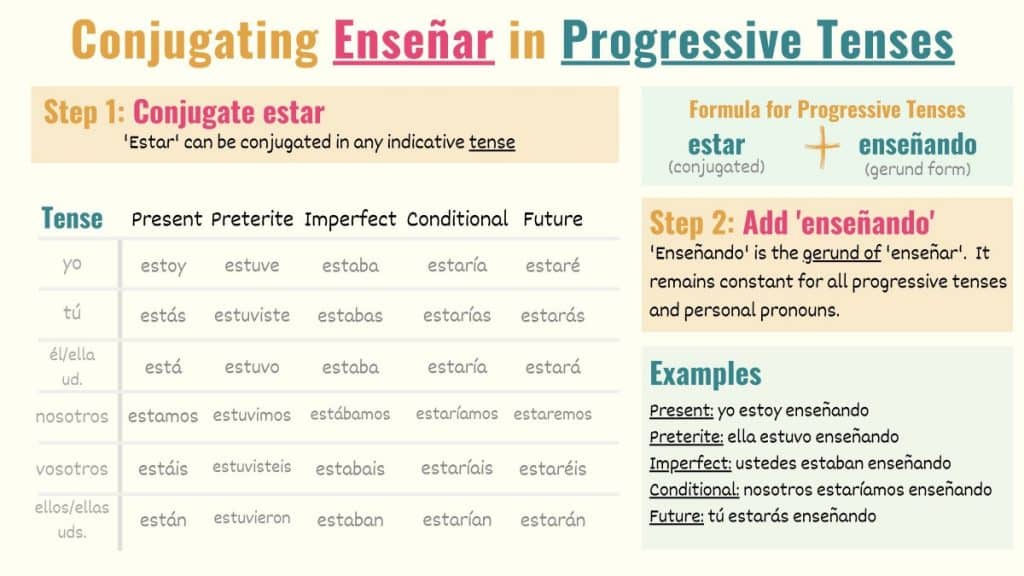
Mi mamá está enseñando a mi hermano a ir al baño.
My mom is teaching my little brother to go to the bathroom.
Mañana, estaremos enseñando esta casa.
Tomorrow, we will be showing this house.
Perfect Tenses
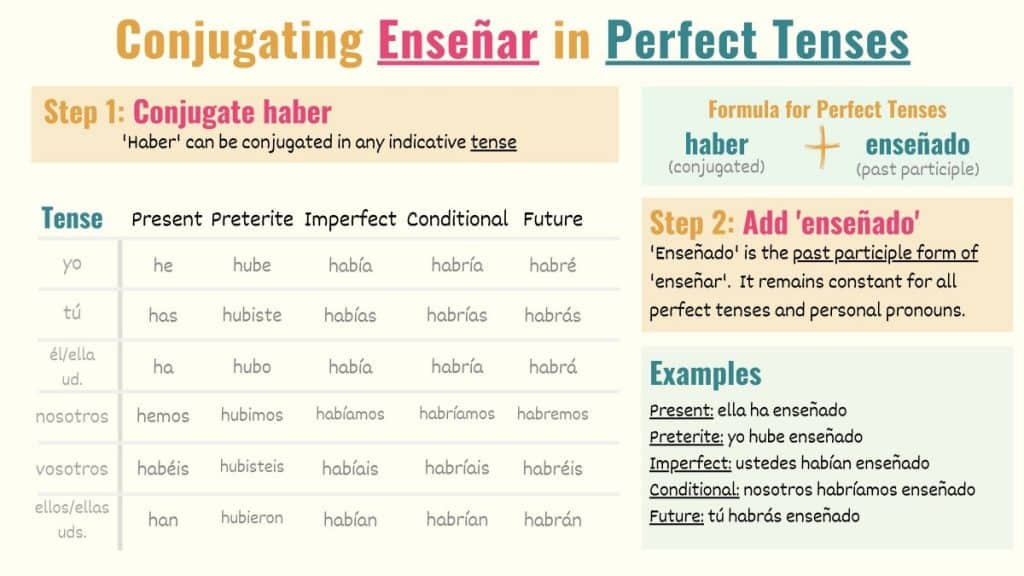
¿No les he enseñado a no hablar con extraños?
Haven’t I taught you not to talk to strangers?
Mi papá todavía no nos ha enseñado a manejar.
My dad hasn’t taught us how to drive yet.
Enseñar Subjunctive Conjugations
Present subjunctive conjugation
| Person | Conjugation | Translation |
|---|---|---|
| Yo | Enseñe | To teach |
| Tú | Enseñes | To teach |
| Él / Ella / Usted | Enseñe | To teach |
| Nosotros | Enseñemos | To teach |
| Vosotros | Enseñéis | To teach |
| Ustedes / Ellos / Ellas | Enseñen | To teach |
Imperfect subjunctive conjugations
| Person | Conjugation | Translation |
|---|---|---|
| Yo | Enseñara / Enseñase | I taught |
| Tú | Enseñaras / Enseñases | You taught |
| Él / Ella / Usted | Enseñara / Enseñase | He/She taught |
| Nosotros | Enseñáramos / Enseñásemos | We taught |
| Vosotros | Enseñareis / Enseñaseis | You taught |
| Ustedes / Ellos / Ellas | Enseñaran / Enseñasen | They/You taught |
Perfect subjunctive
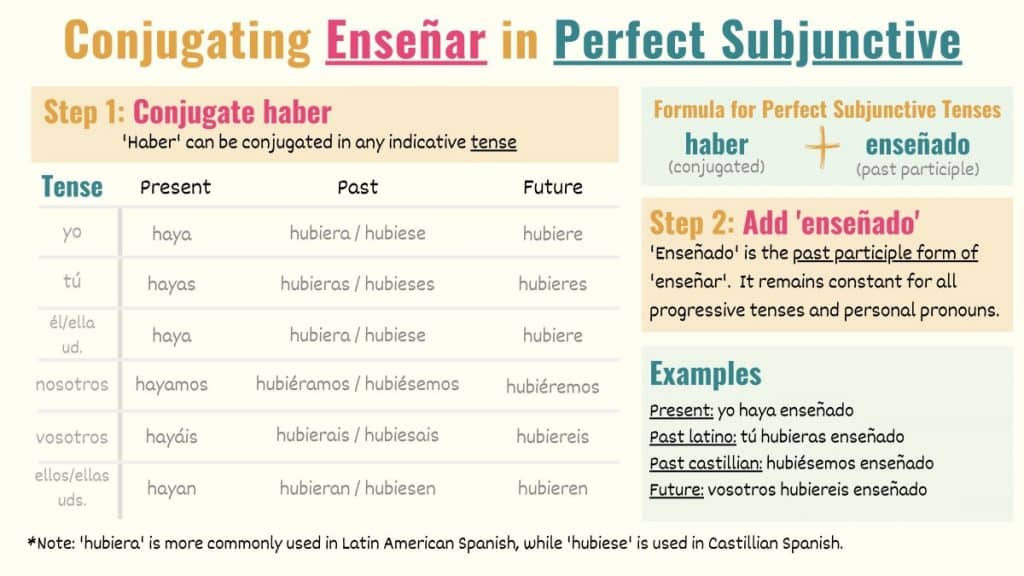
Espero que no le hayas enseñado esto a Betty.
I hope you haven’t shown this to Betty.
Ojalá me hubieras enseñado el mensaje antes de borrarlo.
I wish you had shown me the text before you deleted it.
Imperative
Imperative conjugation
The stem for the imperative form of this verb is ‘enseñ’ but keep in mind that to conjugate this verb in its negative imperative form, tú and vosotros follow the present subjunctive conjugation preceded by the word No.
| Person | Conjugation | Translation |
|---|---|---|
| Tú | Enseña | Teach |
| Nosotros | Enseñemos | Let’s teach |
| Vosotros | Enseñad | Teach |
| Ustedes | Enseñen | Teach |
[‘Enseñar’ in imperative form] + [indirect pronoun] + [complement]
Enséñame a bailar.
Teach me how to dance.
Hija, enséñale a tu tía dónde están los vasos.
Daughter, show your aunt where the glasses are.
No + [‘enseñar’ in present subjunctive] + [noun]
No enseñes tu contraseña.
Don’t show your password.
No le enseñen sus juguetes nuevos a su hermana.
Don’t show your new toys to your sister.
How to Use ‘Enseñar’ in Spanish with Examples
In Spanish, there are two ways to use the verb ‘enseñar’:
- To talk about teaching skills
- To explain that someone is showing or displaying something
In the next sections, I’ll explain in more depth how you can use this verb through examples and phrase structures.
To talk about teaching a skill or a topic
When talking about someone making another person learn something, ‘enseñar’ can be translated as ‘to teach’. Notice that with this meaning ‘enseñar’ is frequently used as a pronominal verb which means that, depending on what you want to express, you’ll need to use either an indirect object pronoun or a reflexive pronoun.
[Indirect pronoun] + [‘enseñar conjugated’] + [complement]
El maestro nos enseñó a multiplicar.
The teacher taught us how to multiply.
Mi hermano me enseñó a andar en bici.
My brother taught me how to ride a bike.
Sus padres les enseñaron buenos modales.
Their parents taught them good manners.
If instead, you want to talk about the subjects that a person teaches, you can use the following structure:
(Noun) + [‘enseñar conjugated’] + [complement]
Ella enseña francés en la Universidad de California.
She teaches French at the University of California.
Alexa enseña español e italiano.
Alexa teaches Spanish and Italian.
Take Note: When talking about an action that a person performs upon themselves we can use reflexive pronouns. So, if you are self-taught, you could use ‘enseñarse’ to talk about the things that you learned on your own.
Subject + [reflexive pronoun] + [verb conjugated]
Yo mismo me enseñé a cocinar.
I taught myself how to cook.
To describe that someone is showing something
‘Enseñar’ can also be used to describe that someone is showing or exposing something so it can be seen by others. In this case, it can be translated as ‘to show’ or ‘to display’ and it’s usually followed by a noun that describes the object that the person is exhibiting.
[Indirect pronoun] + [‘enseñar conjugated’] + [determiner] + [noun]
Vanesa me enseñó su vestido de novia.
Vanesa showed me her wedding dress.
Te enseñaré mi álbum de fotografías.
I’ll show you my photo album.
Un compañero me enseñó la escuela.
A classmate showed me the school.
Enseñar Expressions & Idioms
In Spanish, there are many idioms and expressions that contain the verb enseñar. Some of the most common include:
Enseñar el cobre: This expression is used when talking about someone showing a flaw or a negative aspect of themselves. A close translation could be ‘to show one’s true colors’ or ‘to show one’s real self’.
Enseñar los dientes: It is used when talking about a person making a threat or defending themselves against another person. It’s literal translation is ‘to show one’s teeth’ but the closest expression in English is ‘to get your claws out’.
Synonyms of ‘Enseñar’ in Spanish
Mostrar: This is a slightly more formal way to say ‘to show’. It is used to describe someone exhibiting something.
Educar: The direct translation is ‘to educate’. This word can be used in an academic context or as a synonym of ‘to raise’.
Explicar: This verb is used to describe someone clarifying something or making us understand a topic. It means ‘to explain’.