

In this short guide, we will cover the following topics for ‘Andar’ in Spanish:
- What does ‘Andar’ mean?
- ‘Andar’ Conjugations
- How to Use ‘Andar’ in Spanish
- Expressions & Idioms with ‘Andar’
- Synonyms of ‘Andar’ in Spanish
What does ‘Andar’ mean?
Definition – ‘Andar’ means ‘to walk’, ‘to be‘ or ‘to go’. In other words, andar expresses that someone is moving or walking from one place to another. In other contexts, this verb is used to describe a person’s feelings and states of mind, or to express that a device is operating or functioning.
In Spanish, ‘andar’ has different meanings. Below is a list of the most common situations where you can apply ‘andar’ as well as their corresponding English translation.
- When talking about someone moving or walking, andar means ‘to go’ or ‘to walk’.
- If we are referring to someone who is pursuing another person or something, it is used as ‘to go after’.
- If describing the actions that someone is performing, the translation is ‘to be’ or ‘to do’.
- When talking about someone’s feelings, it is used as ‘to be’ or ‘to feel’.
- If expressing that something is working, it is translated as ‘to run’, ‘to work’ or ‘to function’.
Learning Spanish?
Join the Tell Me In Spanish community and get a copy of my step-by-step Spanish Learner’s Roadmaps and tricky synonyms & vocab cheat sheets.
‘Andar’ Conjugations
In Spanish, the verb ‘andar’ is a regular verb in most tenses. However, it is irregular in both the preterite and imperfect subjunctive tenses. In these tenses, the verb will change its stem.
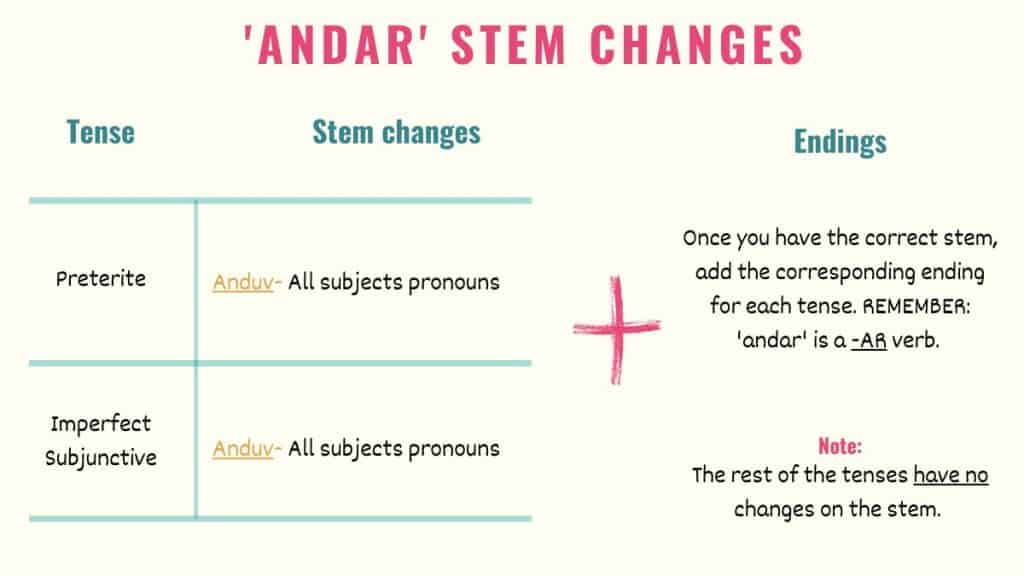
Although this might seem challenging, in the following tables I’ll show you how to conjugate andar in Spanish.
Indicative
Present tense conjugation
| Person | Conjugation | Translation |
|---|---|---|
| Yo | ando | I walk |
| Tú | andas | You walk |
| Él / Ella / Usted | anda | He/She walks |
| Nosotros | andamos | We walk |
| Vosotros | andáis | You walk |
| Ustedes / Ellos / Ellas | andan | They/You walk |
Preterite tense conjugation
Andar is irregular in the preterite tense. In this tense, the stem changes to anduv-. To build the preterite tense, just add the corresponding endings for this tense.
| Person | Conjugation | Translation |
|---|---|---|
| Yo | anduve | I walked |
| Tú | anduviste | You walked |
| Él / Ella / Usted | anduvo | He/She walked |
| Nosotros | anduvimos | We walked |
| Vosotros | anduvisteis | You walked |
| Ustedes / Ellos / Ellas | anduvieron | They/You walked |
Imperfect tense conjugation
| Person | Conjugation | Translation |
|---|---|---|
| Yo | andaba | I walked |
| Tú | andabas | You walked |
| Él / Ella / Usted | andaba | He/She walked |
| Nosotros | andábamos | We walked |
| Vosotros | andabais | You walked |
| Ustedes / Ellos / Ellas | andaban | They/You walked |
Future tense conjugation
To conjugate andar in the future tense, simply add the underlined endings to the verb in infinitive form.
| Person | Conjugation | Translation |
|---|---|---|
| Yo | andaré | I will walk |
| Tú | andarás | You will walk |
| Él / Ella / Usted | andará | He/She will walk |
| Nosotros | andaremos | We will walk |
| Vosotros | andaréis | You will walk |
| Ustedes / Ellos / Ellas | andarán | They/You will walk |
Conditional tense conjugation
Add the conditional endings to its infinitive form. So, instead of working with a stem, you’ll just attach the proper ending to andar.
| Person | Conjugation | Translation |
|---|---|---|
| Yo | andaría | I would walk |
| Tú | andarías | You would walk |
| Él / Ella / Usted | andaría | He/She would walk |
| Nosotros | andaríamos | We would walk |
| Vosotros | andaríais | You would walk |
| Ustedes / Ellos / Ellas | andarían | They/You would walk |
Progressive Tenses
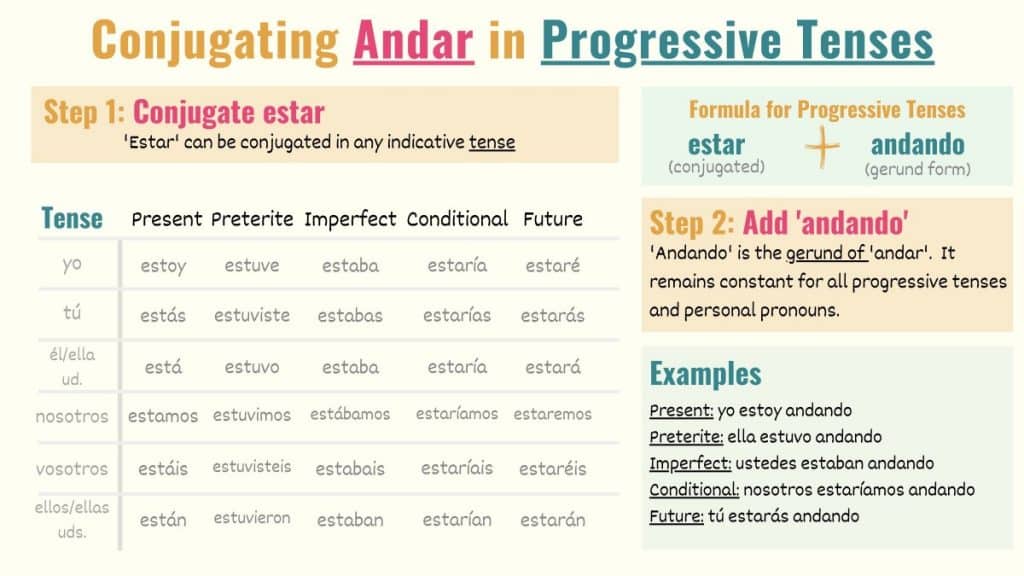
Perfect Tenses
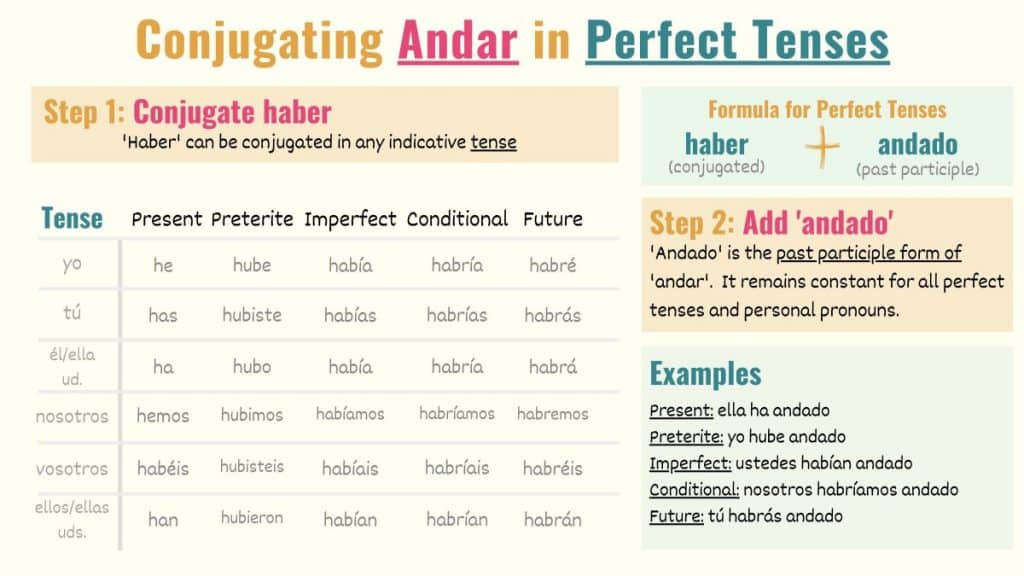
Disculpa que no te contestáramos, hemos andado muy ocupados.
Sorry that we didn’t get back to you, we’ve been very busy.
Nunca había andado por este parque.
I’ve never walked in this park.
Andar Subjunctive Conjugations
Present subjunctive conjugation
| Person | Conjugation | Translation |
|---|---|---|
| Yo | ande | I walk |
| Tú | andes | You walk |
| Él / Ella / Usted | ande | He/She walks |
| Nosotros | andemos | We walk |
| Vosotros | andéis | You walk |
| Ustedes / Ellos / Ellas | anden | They/You walk |
Imperfect subjunctive conjugations
Like the preterite tense, to conjugate andar to the imperfect subjunctive, we’ll use the stem ‘anduv’. Then, the imperfect subjunctive endings are added to this stem.
| Person | Conjugation | Translation |
|---|---|---|
| Yo | anduviera / anduviese | I walked |
| Tú | anduvieras / anduvieses | You walked |
| Él / Ella / Usted | anduviera / anduviese | He/She walked |
| Nosotros | anduviéramos / anduviésemos | We walked |
| Vosotros | anduvierais / anduvieseis | You walked |
| Ustedes / Ellos / Ellas | anduvieran / anduviesen | They/You walked |
Perfect subjunctive
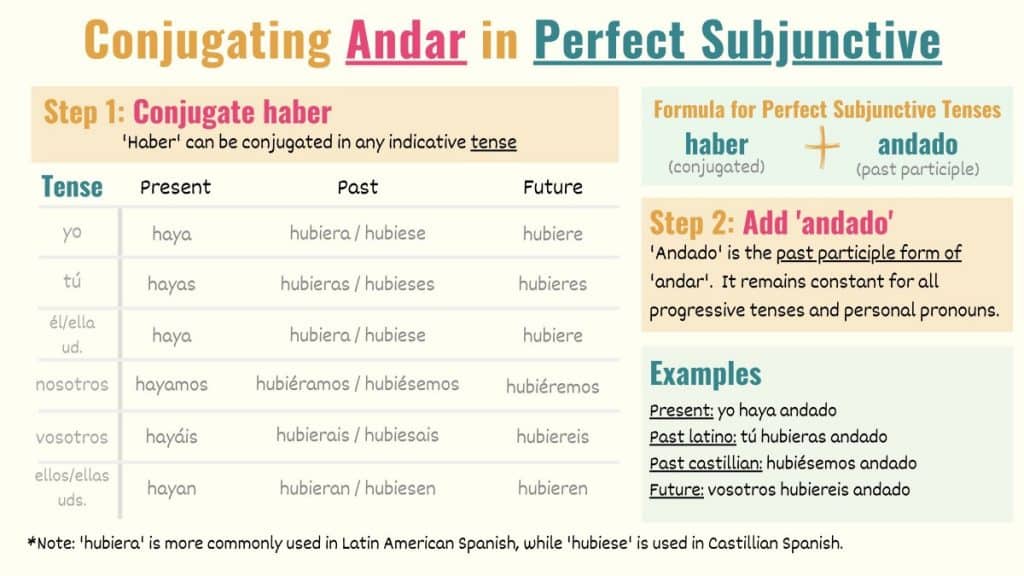
Si hubieras andando con cuidado, no te habrías lastimado.
If you had walked carefully, you would have not hurt yourself.
Imperative
Imperative conjugation
| Person | Conjugation | Translation |
|---|---|---|
| Tú | anda | Walk |
| Nosotros | andemos | Let’s walk |
| Vosotros | andad | Walk |
| Ustedes | anden | Walk |
Below are some phrase structures and examples on how to build both affirmative and negative imperative tenses. Use the imperative forms of ‘andar’ shown in the table above for affirmative sentences. To use it in its negative imperative form, use the present subjunctive tense instead.
[Verb conjugated in imperative] + [complement]
¡Anda con cuidado! El piso está mojado.
Walk carefully! The floor is wet.
Por favor, andemos por este lado de la calle.
Please, let’s walk on this side of the street.
No + [verb in present subjunctive]
No andes en la calle a esa hora, es peligroso.
Do not walk on the street at that hour, it is dangerous.
¡Niños, no anden caminando descalzos!
Kids, don’t walk barefoot! Put your shoes on!
How to Use ‘Andar’ in Spanish with Examples
There are five main uses of the verb ‘andar’ in Spanish:
- To say ‘to go’ or ‘to walk’
- Describing that someone is going after someone or something
- Describing the actions that a person is performing
- Talking about feelings or states of mind
- Expressing that a machine or device works
To say ‘to go’ or ‘to walk’
Translated as ‘to go’ or ‘to walk’, in Spanish, andar is used when speaking of travelling on foot. Here are some examples and a phrase structure that you can use to apply this meaning.
Notice that when talking about places, andar can be also used as a synonym of ‘to be’ as a way to express a person’s location.
[‘Andar’ conjugated] + [preposition] + [place]
Anduvimos en el parque el fin de semana.
We walked in the park during the weekend.
Clara andaba en el centro cuando le llamé.
Clara was downtown when I called her.
Andaré cerca de tu casa, quizá podamos vernos
I will be near your place, maybe we can meet up.
Take Note: In Spanish, andar can also be used to talk about the means of transportation that a person is using. In order to use it in this context, we use the preposition ‘en’ to introduce the transport that we’re referring to. Notice that in this case ‘andar’ means ‘to ride’, ‘to take’ or ‘to be’.
[‘Andar’ conjugated] + en + [means of transportation]
Hoy no puedo pasar por ti, ando en camión.
Today I can’t pick you up, I took the bus.
Andar en bicicleta me permite llegar más rápido a mi trabajo.
Riding my bike allows me to get to work faster.
Describing that someone is ‘going after’ someone or something
In Spanish, andar can also be used to express that a person is pursuing something or someone. To use it for this meaning, you need to use the preposition tras. In this context, ‘andar’ means ‘to go after’.
[‘Andar’ conjugated] + tras + [determiner] + [noun]
La policía andaba tras el ladrón.
Police were after the thief.
Andan tras las personas que dañaron el automóvil.
Mirna goes after the people who damaged the car.
Elizabeth andaba tras el puesto de gerente.
Elizabeth was going after the manager position.
Describing the actions that a person is performing
As established before, in some contexts, ‘andar’ can be used as a synonym of ‘to be’. In these situations, it’s common to use this verb to describe the actions that a person is doing. Below are some examples and the structure that you can follow:
[‘Andar’ conjugated] + [verb in gerund] + [complement]
Lina y Fernando anduvieron trabajando en el jardín.
Lina and Fernando were working in the garden.
Nina andaba corriendo en el jardín.
Nina was running around in the garden.
Anduve cocinando toda la mañana.
I was cooking all morning.
Take Note: Notice that with this meaning you’re using the verb ‘andar’ to build the Spanish progressive tense. In other words, we use this tense to refer to actions that are happening at the moment of speaking.
Describing feelings or states of mind
In Spanish, ‘andar’ can be used in more casual situations to describe or talk about a person’s feelings, mood or state of mind. In this context ‘andar’ is translated as ‘to be’. Below is a phrase structure that you can use:
[‘Andar’ conjugated] + [adjective]
Andaba preocupada por su situación económica.
She was worried about her financial situation.
Andaba interesado en comprar una casa.
He was interested in buying a house.
¿Cómo has andado desde del accidente?
How have you been doing since the accident?
Take Note: Notice that, in order to describe that feeling, you need to work with adjectives.
Expressing that a machine or device works
Another use of this verb in Spanish is when we want to say that some mechanism is working or about a machine that is running. In this case, its meaning is ‘to work’ or ‘to run’.
[Noun + [‘andar’ conjugated] + [complement]
El reloj no anda, debe ser la batería.
The watch is not working, it must be the battery.
El auto no anda, se dañaron las bujías.
The car does not run, the spark plugs are damaged.
La conexión no anda bien , está lloviendo demasiado.
The connection is not working properly, it is raining too much.
Andar Expressions & Idioms
Below are some common idioms and expressions with ‘andar’ that you can use in real world conversation.
Andar a ciegas: This is an expression used to indicate that a person acts without reflection or knowledge. It is translated as ‘to go blind’ or ‘to go blindly’.
Andar con pies de plomo: In Spanish, ’andar con pies de plomo’ means that a person needs to be careful when dealing with a certain situation. It can be translated as ‘gingerly’ or ‘to tread carefully’.
Andar de volada(o): This informal expression is used to express that a person is flirting with someone. It can be translated as ‘to be flirty’ or ‘to flirt. Keep in mind that ‘hacer algo de volada’ means to do something really fast.
Ándale: One of the uses of ‘ándale’ is to encourage someone to do something. It can be translated as ‘come on’ or ‘let’s go’.
Andar con alguien: This expression is used to describe that two people are dating. It is translated as ‘to date someone’.
Synonyms of ‘Andar’ in Spanish
Caminar: When talking about someone who is walking from one place to another, we can use this verb instead of ‘andar’. It is the direct translation of ‘to walk’.
Ir: In Spanish, this verb is also used when referring to a person going from one place to another. It is translated as ‘to go’.
Ser/Estar: If we are speaking about a person who is in a certain state, situation, mood, or place, we can use these verbs instead of ‘andar’. Additionally, ‘estar’ can be used instead of ‘andar’ when describing a person’s location. Both verbs are translated as ‘to be’.
Funcionar: When referring to a machine that is working or functioning, you can use ‘funcionar’ instead of ‘andar’. It is the direct translation of ‘to function’.
Sentirse: When speaking about someone’s feelings, this verb can be used as a synonym for ‘andar’. Notice that ‘sentirse’ only refers to feelings and physical states. As a result, it can be translated as ‘to feel’ or ‘to be’.
Related Resources
Andar de volada in Spanish
What does ‘ándale’ mean in Spanish?