
In this short guide, we will cover the following topics for the verb ‘celebrar’ in Spanish:
- What does ‘Celebrar’ mean?
- ‘Celebrar’ Conjugations
- How to Use ‘Celebrar’ in Spanish
- Expressions & Idioms with ‘Celebrar’
- Synonyms of ‘Celebrar’ in Spanish
What does ‘Celebrar’ mean?
Definition – In Spanish, celebrar means to celebrate or to hold some event such as a meeting, ceremony, show, birthday, etc. This verb is also used to express that a person is showing or expressing happiness for some favorable outcome.
In a more formal context, celebrar describes that a historical or personal event is being commemorated or celebrated.
Although it’s mainly translated as ‘to celebrate’, depending on the context, celebrar could have some additional translations:
- When talking about celebrating or showing happiness for a certain result, celebrar means ‘to celebrate’.
- When talking about carrying out events, it is translated as ‘to celebrate’ or ‘to hold’.
- When referring to commemorating or remembering an event, ‘to celebrate’ or ‘to commemorate’.
‘Celebrar’ Conjugations
‘Celebrar’ is a regular verb in Spanish. Therefore, in order to conjugate this verb, you’ll need to use the stem ‘celebr’ and add the proper ending for each tense. In the conjugation charts below we’ve underlined all the endings that you need to ease for each case.
Indicative
Present tense conjugation
| Person | Conjugation | Translation |
|---|---|---|
| Yo | celebro | I celebrate |
| Tú | celebras | You celebrate |
| Él / Ella / Usted | celebra | He/She celebrates |
| Nosotros | celebramos | We celebrate |
| Vosotros | celebrais | You celebrate |
| Ustedes / Ellos / Ellas | celebran | They/You celebrate |
Preterite tense conjugation
| Person | Conjugation | Translation |
|---|---|---|
| Yo | celebré | I celebrated |
| Tú | celebraste | You celebrated |
| Él / Ella / Usted | celebró | He/She celebrated |
| Nosotros | celebramos | We celebrated |
| Vosotros | celebrasteis | You celebrated |
| Ustedes / Ellos / Ellas | celebraron | They/You celebrated |
Imperfect tense conjugation
| Person | Conjugation | Translation |
|---|---|---|
| Yo | celebraba | I celebrated |
| Tú | celebrabas | You celebrated |
| Él / Ella / Usted | celebraba | He/She celebrated |
| Nosotros | celebrábamos | We celebrated |
| Vosotros | celebrábais | You celebrated |
| Ustedes / Ellos / Ellas | celebraban | They/You celebrated |
Future tense conjugation
If you want to construct both the conditional and future tenses in Spanish, you need to use the infinitive form ‘celebrar’. Then, make sure to add the proper endings for each subject.
| Person | Conjugation | Translation |
|---|---|---|
| Yo | celebraré | I will celebrate |
| Tú | celebrarás | You will celebrate |
| Él / Ella / Usted | celebrará | He/She will celebrate |
| Nosotros | celebraremos | We will celebrate |
| Vosotros | celebraréis | You will celebrate |
| Ustedes / Ellos / Ellas | celebrarán | They/You will celebrate |
Conditional tense conjugation
| Person | Conjugation | Translation |
|---|---|---|
| Yo | celebraría | I would celebrate |
| Tú | celebrarías | You would celebrate |
| Él / Ella / Usted | celebraría | He/She would celebrate |
| Nosotros | celebraríamos | We would celebrate |
| Vosotros | celebraríais | You would celebrate |
| Ustedes / Ellos / Ellas | celebrarían | They/You would celebrate |
Progressive Tenses
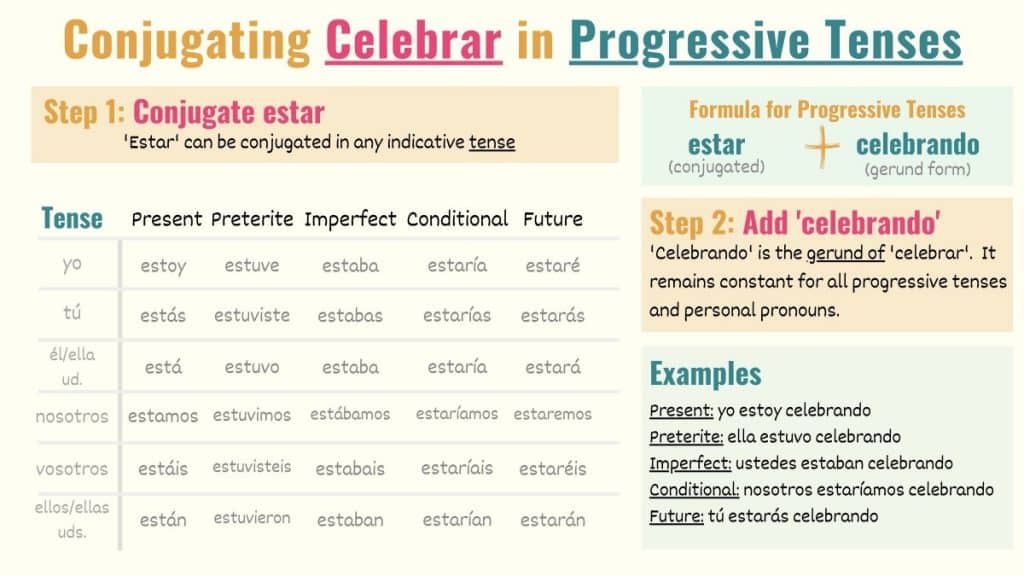
Estamos celebrando en el bar, te esperamos aquí
We’re celebrating in the bar, we wait for you here
Perfect Tenses
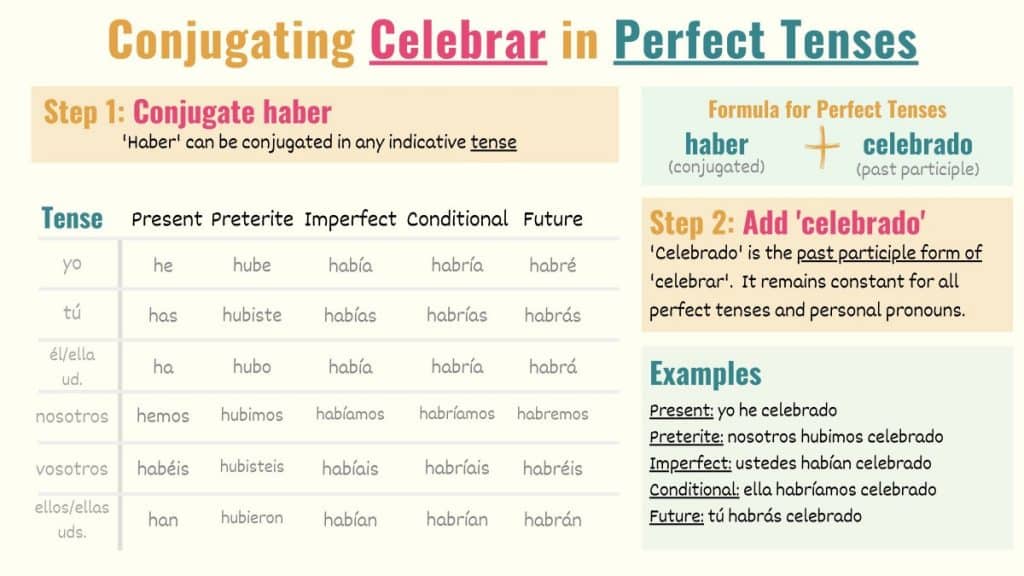
Pensé que ya habíamos celebrado tu cumpleaños
I thought we had already celebrated your birthdays
Celebrar Subjunctive Conjugations
Present subjunctive conjugation
As a regular verb, celebrar doesn’t have any irregularities in the subjunctive mood. As a result, you’ll keep using the stem celebr and add the corresponding ending.
| Person | Conjugation | Translation |
|---|---|---|
| Yo | celebre | To celebrate |
| Tú | celebres | To celebrate |
| Él / Ella / Usted | celebre | To celebrate |
| Nosotros | celebremos | To celebrate |
| Vosotros | celebréis | To celebrate |
| Ustedes / Ellos / Ellas | celebren | To celebrate |
Imperfect subjunctive conjugations
| Person | Conjugation | Translation |
|---|---|---|
| Yo | celebrara / celebrase | I celebrated |
| Tú | celebraras / celebrases | You celebrated |
| Él / Ella / Usted | celebrara / celebrase | He/She celebrated |
| Nosotros | celebráramos / celebrásemos | We celebrated |
| Vosotros | celebrarais / celebraseis | You celebrated |
| Ustedes / Ellos / Ellas | celebraran / celebrasen | They/You celebrated |
Perfect subjunctive
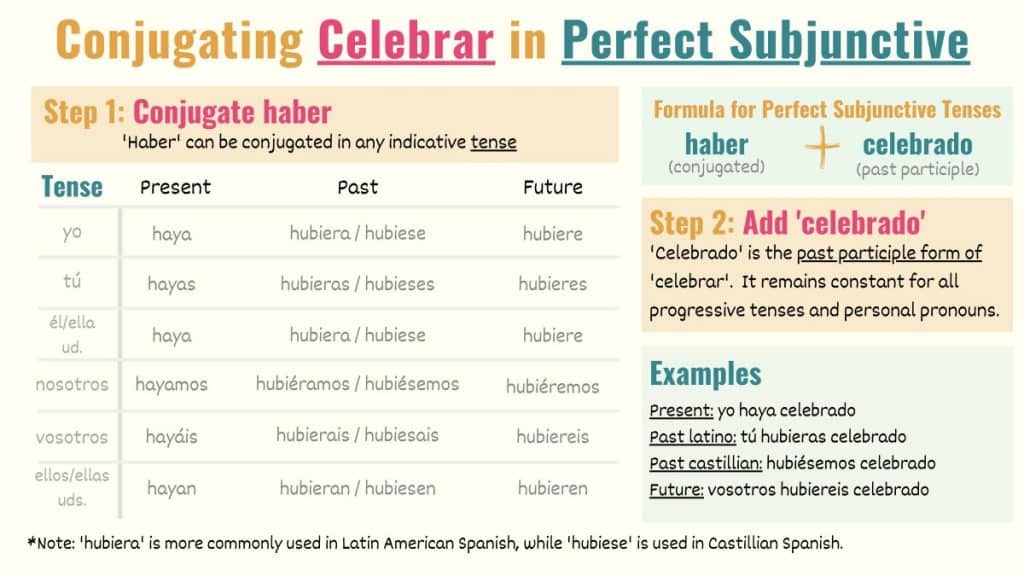
Ojalá hubiéramos celebrado en tu casa
I wish we had celebrated in your house
Si hubiéramos celebrado Navidad, hubiéramos comido pavo
If we had celebrated Christmas, we would have eaten turkey
Imperative
Imperative conjugation
For the Spanish imperative conjugation, notice that we use different endings for most of the subjects. Nosotros, ustedes, usted and vosotros follow the present subjunctive conjugation, while tú just removes the ‘s’ from the indicative present conjugation ‘celebras’.
| Person | Conjugation | Translation |
|---|---|---|
| Tú | celebra | You celebrate |
| Nosotros | celebremos | We celebrate |
| Vosotros | celebréis | You celebrate |
| Ustedes | celebren | They/You celebrate |
[Celebrar conjugated in imperative] + (determiner) + [noun]
¡Celebremos tu cumpleaños la semana que viene!
Let’s celebrate your birthday next week!
Do not forget that you can create the negative imperative by following this formula:
No + [‘celebrar’ in present subjunctive] + [complement]
No celebren tu cumpleaños hoy, no estaré disponible todo el día.
Do not celebrate your birthday today, I won’t be available all day.
How to Use ‘Celebrar’ in Spanish with Examples
In Spanish, there are three main contexts where you can use celebrar :
- To talk about celebrating or showing happiness for a certain result
- To talk about celebrating or holding events
- When talking about commemorating something
Below are some examples that will allow you to understand the different uses of this verb. I’ve provided you with formulas and examples, so you’ll know how to apply this verb properly.
Showing happiness for a favorable result
In Spanish, we can use the verb ‘celebrar’ as a way to express that people are showing happiness or are celebrating as a result of a favorable result they were waiting for. In this context, ‘celebrar’ means to celebrate. Below there are some examples that you can use:
[Celebrar conjugated] + (determiner) + [complement]
Las porristas celebraron la anotación.
The cheerleaders celebrated the touchdown.
Estamos celebrando que conseguimos nuevos clientes.
We’re celebrating that we got new clients.
La semana que viene celebraremos nuestra nueva casa.
Next week we will celebrate our new house.
Take Note: Pay attention to example #2. If the thing that you are celebrating is an action (getting new clients), you need to use ‘que’ and a second verb that describes what action is that.
Talk about celebrating events
In Spanish, the verb ‘celebrar’ is used when talking about carrying out meetings or performing activities with a social gathering and enjoyable event. As a result, in this context, ‘celebrar’ is usually translated as ‘to hold (an event)’ or ‘to celebrate’.
[Celebrar conjugated] + (determiner) + [event]
Celebramos el cumpleaños de Julia en mi casa.
We celebrated Julia’s birthday at my house.
Celebren mañana, hoy no estaré disponible en todo el día.
Celebrate tomorrow, I will not be available all day today.
¡Celebremos tu graduación en la playa!
Let’s celebrate your graduation at the beach!
When talking about commemorating something
In addition to talking about holding or celebrating a social event, celebrar is also used in Spanish when talking about recalling, commemorating and showing respect for historical dates or characters.
Notice that in order to apply this meaning to the verb and context, you’ll need to use the pronoun se in front of the conjugated verb.
Se + [‘celebrar’ conjugated] + [definite article] + [noun]
La próxima semana se celebrará el día del padre.
Next week father’s day will be celebrated.
Ayer se celebró el Día Internacional de la Mujer.
International Women’s Day was celebrated yesterday.
El 15 de septiembre se celebra la Independencia de México.
Mexico’s Independence Day is commemorated on September 15.
Celebrar Expressions & Idioms
There are a few expressions with the verb celebrar that you can learn in order to improve both your command of this verb as well as your vocabulary.
Celebrar una fiesta: This expression is used when talking about meetings or parties. It is translated as ‘to throw a party’, ‘to celebrate with a party’.
Celebrar a una persona: In Spanish, this expression is used when celebrating a person’s birthday or some achievement.
Synonyms of ‘Celebrar’ in Spanish
Festejar: When talking about conducting meetings or another event, this verb can be used instead of ‘celebrar’ in a more casual way. As a direct synonym, ‘festejar’ also means to celebrate.
Tener lugar: If we are talking about holding an event or activity, this expression can be used instead of ‘celebrar’. It is translated as ‘to take place’.
Conmemorar: In a formal context, this verb is used when talking about remembering historical events or prominent people. It is translated as ‘to commemorate’.
Llevar a cabo: If we want to say that an event was performed or something was carried out, we can use this verb as a synonym of ‘celebrar’. It means ‘to carry out’.
Realizar: When talking about performing or carrying out parties or social activities, this verb is another way to say that something was celebrated. It can be translated as ’to make’, ‘to perform’, ‘to carry out’.