

In this short guide, we will cover the following topics for ‘Despedir’ in Spanish:
- What does ‘despedir’ mean?
- ‘Despedir’ Conjugations
- How to Use ‘Despedir’ in Spanish
- Synonyms of ‘Despedir’ in Spanish
What does ‘Despedir’ mean?
Definition – In Spanish, ‘despedir’ is used to talk about farewells, dismissals or the substances that an object is releasing. It is most commonly translated as ‘to say goodbye’, ‘to fire’ and, in some cases, ‘to emit’ or ‘to give off’.
- If referring to a farewell, ‘despedir’ means ‘to say goodbye’.
- In a workplace environment, it means ‘to fire’.
- When talking about smells and substances, ‘despedir’ can be translated as ‘to give off’, ‘to release’ or ‘to emit’.
‘Despedir’ Conjugations
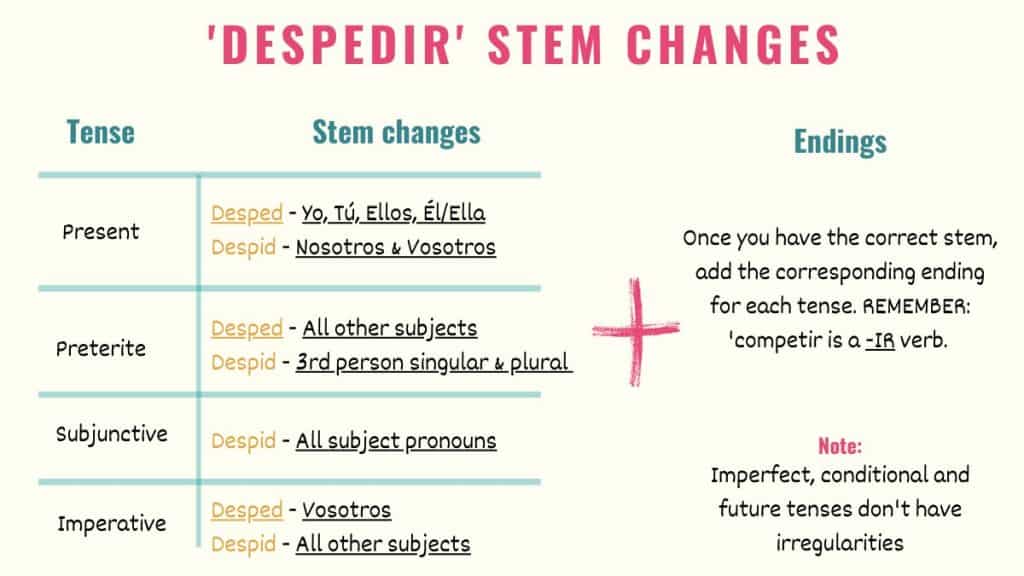
‘Despedir’ is an irregular verb. This means that depending on the subject and the tense, you’ll have to change the letter ‘e’ for an ‘i’. To put it another way, for pronunciation purposes, some subjects and tenses will use the irregular ‘despid’.
Take Note: Notice that ‘despedir’ is formed with the prefix ‘des’ and the verb ‘pedir’. This means that the conjugations for ‘despedir’ will be exactly the same as ‘pedir’.
Yo pedí un helado.
I ordered an ice cream.
Despedí a mi secretaria.
I fired my secretary.
Indicative
Present tense conjugation
To conjugate ‘despedir’ to the present tense, we’ll need to keep in mind some irregularities. Notice that for ‘nosotros’ and ‘vosotros’, we’ll use the regular stem ‘desped’ while for the rest of the subjects you’ll use despid.
| Person | Conjugation | Translation |
|---|---|---|
| Yo | Despido | I fire |
| Tú | Despides | You fire |
| Él / Ella / Usted | Despide | He/She fires |
| Nosotros | Despedimos | We fire |
| Vosotros | Despedís | You fire |
| Ustedes / Ellos / Ellas | Despiden | They/You fire |
Preterite tense conjugation
To conjugate ‘despedir’ to the preterite tense, we’ll use the stem ‘despid’ for the third person singular and the third person plural while for the rest we’ll use ‘desped’.
| Person | Conjugation | Translation |
|---|---|---|
| Yo | Despedí | I fired |
| Tú | Despediste | You fired |
| Él / Ella / Usted | Despidió | He/She fired |
| Nosotros | Despedimos | We fired |
| Vosotros | Despedisteis | You fired |
| Ustedes / Ellos / Ellas | Despidieron | They/You fired |
Imperfect tense conjugation
| Person | Conjugation | Translation |
|---|---|---|
| Yo | Despedía | I fired |
| Tú | Despedías | You fired |
| Él / Ella / Usted | Despedía | He/She fired |
| Nosotros | Despedíamos | We fired |
| Vosotros | Despedíais | You fired |
| Ustedes / Ellos / Ellas | Despedían | They/You fired |
Future tense conjugation
Notice that in the future tense, ‘despedir’ is regular. This means that to conjugate to this tense, you’ll need to add the future endings to the verb in the infinitive form.
| Person | Conjugation | Translation |
|---|---|---|
| Yo | Despediré | I will fire |
| Tú | Despedirás | You will fire |
| Él / Ella / Usted | Despedirá | He/She will fire |
| Nosotros | Despediremos | We will fire |
| Vosotros | Despediréis | You will fire |
| Ustedes / Ellos / Ellas | Despedirán | They/You will fire |
Conditional tense conjugation
| Person | Conjugation | Translation |
|---|---|---|
| Yo | Despediría | I would fire |
| Tú | Despedirías | You would fire |
| Él / Ella / Usted | Despediría | He/She would fire |
| Nosotros | Despediríamos | We would fire |
| Vosotros | Despediríais | You would fire |
| Ustedes / Ellos / Ellas | Despedirían | They/You would fire |
Progressive Tenses
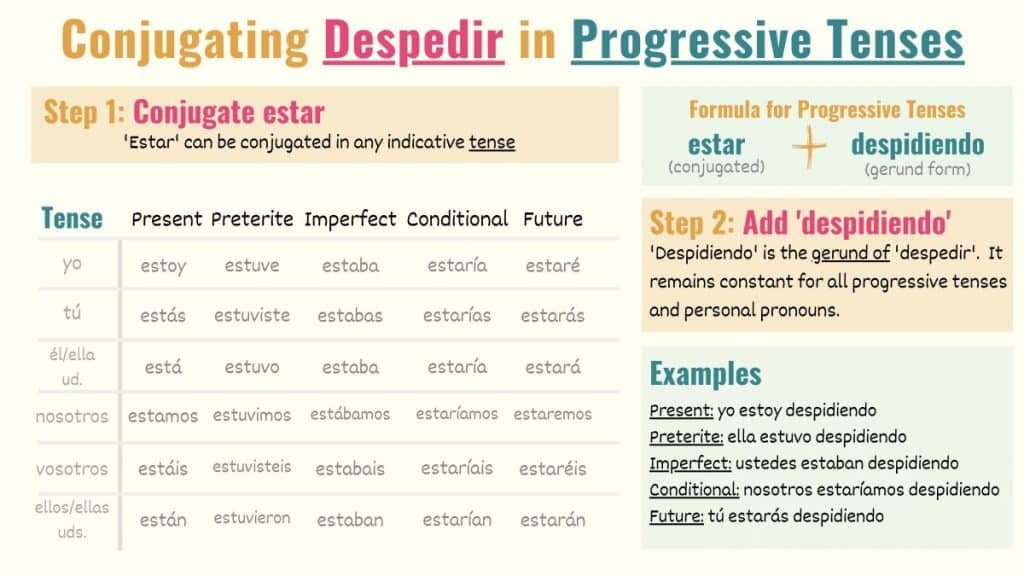
Sandra colgó el teléfono mientras estaba despidiéndome de ella.
Sandra hung up the phone while I was saying goodbye to her.
La alcantarilla está despidiendo un olor desagradable.
The drain is giving off an unpleasant smell.
Perfect Tenses
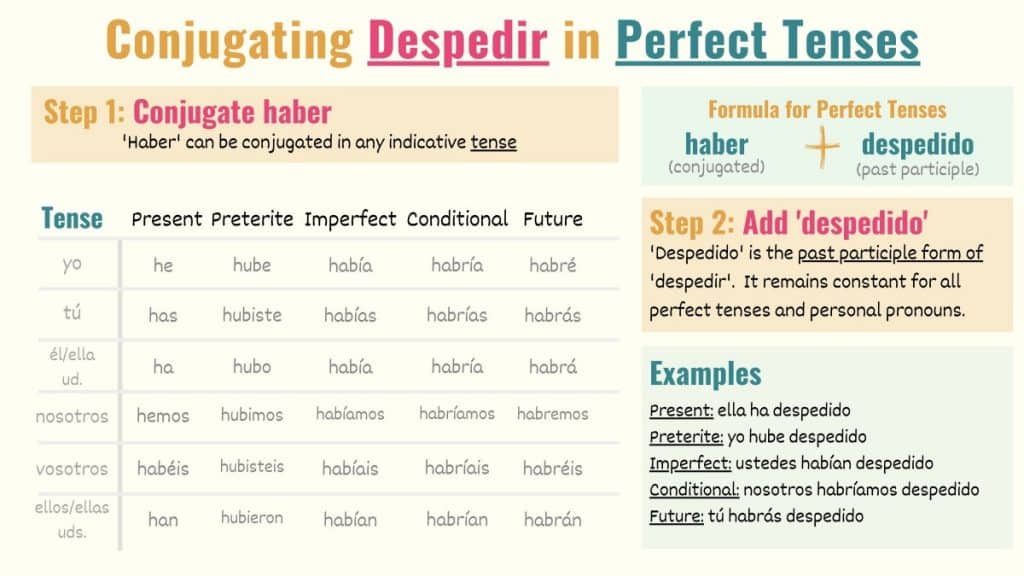
Si hubiera tenido tiempo, me habría despedido de ti.
If I had had the time, I would have said goodbye to you.
¿No te has despedido de Hilda?
Haven’t you said goodbye to Hilda?
Despedir Subjunctive Conjugations
Present subjunctive conjugation
‘Despedir’ in the present subjunctive is completely irregular. So, to make the pronunciation easier, you’ll need to use the irregular stem ‘despid’ and add the proper endings for each subject.
| Person | Conjugation | Translation |
|---|---|---|
| Yo | Despida | To fire |
| Tú | Despidas | To fire |
| Él / Ella / Usted | Despida | To fire |
| Nosotros | Despidamos | To fire |
| Vosotros | Despidáis | To fire |
| Ustedes / Ellos / Ellas | Despidan | To fire |
Imperfect subjunctive conjugations
| Person | Conjugation | Translation |
|---|---|---|
| Yo | Despidiera / Despidiese | I fired |
| Tú | Despidieras / Despidieses | You fired |
| Él / Ella / Usted | Despidiera / Despidiese | He/She fired |
| Nosotros | Despidiéramos / Despidiésemos | We fired |
| Vosotros | Despidierais / Despidieseis | You fired |
| Ustedes / Ellos / Ellas | Despidieran / Despidiesen | They/You fired |
Perfect subjunctive
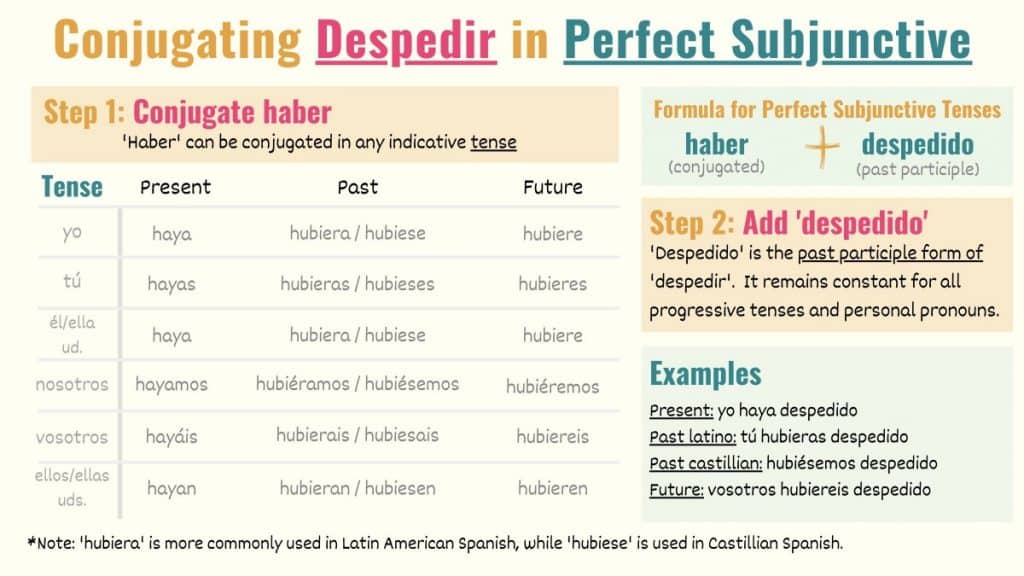
Espero que no lo hayan despedido de su nuevo trabajo.
I hope they haven’t fired him from his new job.


Imperative
Imperative conjugation
The stem for the imperative form of ‘despedir’ for vosotros is ‘desped’ while the rest of the subjects use ‘despid’. However, to conjugate this verb in its negative imperative form, tú and vosotros follow the present subjunctive conjugation (despidas/despidáis). You’ll only need to add the word No before the verb.
| Person | Conjugation | Translation |
|---|---|---|
| Tú | Despide | Fire |
| Nosotros | Despidamos | Let’s fire |
| Vosotros | Despedid | Fire |
| Ustedes | Despidan | Fire |
[‘Despedir’ in imperative form] + [indirect pronoun] + de + [noun]
Niños, despídanse de sus abuelos.
Kids, say goodbye to your grandparents.
Si Laura no entrega resultados en una semana, despídela.
If Laura doesn’t deliver results in one week, fire her.
[No] + [‘despedir’ in present subjunctive] + a + [noun]
No despidas a tus empleados.
Do not fire your employees.
Todavía no se despidan, Carly no está lista.
Don’t say goodbye just yet, Carly is not ready.
How to Use ‘Despedir’ in Spanish with Examples
There are several meanings and ways to use the verb ‘despedir’:
- To describe that a person is saying goodbye
- To talk about dismissing an employee
- As a synonym of ‘to give off’
Through the examples and phrase structures provided in the sections below, you’ll have a better understanding of how to use this verb and you’ll be able to build your own sentences.
To describe that a person is saying goodbye
In Spanish, when talking about farewells, ‘despedir’ expresses that a person is saying goodbye to someone or something. So, in this situation, this verb is translated as ‘to say goodbye’. Notice that, in this context, ‘despedir’ works as a Spanish reflexive or reciprocal verb.
[Reciprocal pronoun] + [‘despedir’ conjugated in plural form]
Nos despedimos por teléfono.
We said goodbye on the phone.
Los anfitriones se despidieron de los invitados.
The hosts said goodbye to the guests.
If you pay attention to the examples below, you’ll notice that the act of saying goodbye is occurring between two people (it’s a reciprocal action). However, if you want to express that someone is saying goodbye to another person, you’ll use a reflexive pronoun and the following structure:
[Reflexive pronoun] +[‘despedir’ conjugated] de + [noun]
Me despediré de mi hermana antes de que se vaya.
I’m going to say goodbye to my sister before she leaves.
Carlos y Blanca no se despidieron de nadie.
Carlos and Blanca didn’t say goodbye to anyone.
¿Te despediste de tus abuelitos, hijo?
Did you say goodbye to your grandparents, son?
To talk about dismissing an employee
When talking about a workplace environment, ‘despedir’ can be translated as ‘to fire’ or ‘to dismiss’. Below there are some examples and common phrase structures to create sentences with this meaning.
[Direct object pronoun] + [‘despedir’ conjugated] + [complement]
Te despedirán si sigues llegando tarde.
They will fire you if you keep being late.
Escuché que la despidieron porque no respetó el presupuesto.
I heard that they fired her because she didn’t respect the budget.
If instead of using a pronoun you want to specify the person person that was or will be fired, you can use this phrase structure:
(Noun) +[‘despedir’ conjugated] + [preposition ‘a’] + [noun]
La empresa despidió a varios empleados.
The company fired several employees.
El gerente despidió a Joshua.
The manager fired Joshua.
Expressing that a device is releasing substances
In Spanish, the verb ‘despedir’ can also be used to talk about the smells and substances that a device expels. In this context, ‘despedir’ can be translated as ‘to give off’, ‘to release’ or ‘to emit’.
(Noun) + [‘despedir’ conjugated] + [complement]
El perfume de esa chica despedía un olor floral.
That girl’s perfume gave off a floral scent.
Esa pizza despide un aroma delicioso.
That pizza gives off a delicious smell.
Los autobuses viejos despiden muchos gases.
Old buses emit a lot of gases.
Synonyms of ‘Despedir’ in Spanish
Decir adiós: The direct translation is ‘to say goodbye’. As a result, it can be used in the same situations as ‘despedir’, but ‘decir adiós’ is slightly more casual than this verb.
Echar: Depending on the context, ‘echar’ can be translated as ‘to kick out’ or ‘to emit’. It can be used to talk about someone being forced to leave a place or a job but also about emissions of things like gas and smoke.
Correr: ‘Correr’ can be translated as ‘to fire’, but keep in mind that it is used in more informal contexts.
Related Resources
13 Ways to Say Goodbye in Spanish