
In this short guide, we will cover the following topics for ‘esperar’ in Spanish:
- What does ‘Esperar’ mean?
- ‘Esperar’ Conjugations
- How to Use ‘Esperar’ in Spanish
- Expressions & Idioms with ‘Esperar’
- Synonyms of ‘Esperar’ in Spanish
What does ‘Esperar’ mean?
Definition – In Spanish, esperar means ‘to wait’, ‘to hold’ and ‘to hope’. As a result, this verb is used to express that a person is waiting for someone or for something to happen. In other situations, ‘esperar’ can also be used to talk about a person’s hopes, expectations or desires.
Depending on the situation in which it is being used, ‘esperar’ has different meanings in Spanish. Below, you’ll find the different situations where you can use this verb as well as their corresponding translation.
- When describing that a person is waiting for something or someone, this verb means ‘to wait’.
- When used to talk about expectations, desires and hopes, ‘esperar’ means ‘to hope’ or ‘to expect’.
‘Esperar’ Conjugations
In Spanish, esperar is a regular verb. In other words, to conjugate most of the tenses, you’ll need to remove the ending -AR and add the corresponding endings to the verb stem ‘esper-’.
Below there are some conjugation charts where you can check the endings that you need to add to conjugate the most important Spanish tenses.
Indicative
Present tense conjugation
| Person | Conjugation | Translation |
|---|---|---|
| Yo | espero | I wait |
| Tú | esperas | You wait |
| Él / Ella / Usted | espera | He/She waits |
| Nosotros | esperamos | We wait |
| Vosotros | esperáis | You wait |
| Ustedes / Ellos / Ellas | esperan | They/You wait |
Preterite tense conjugation
| Person | Conjugation | Translation |
|---|---|---|
| Yo | esperé | I waited |
| Tú | esperaste | You waited |
| Él / Ella / Usted | esperó | He/She waited |
| Nosotros | esperamos | We waited |
| Vosotros | esperastéis | You waited |
| Ustedes / Ellos / Ellas | esperaron | They/You waited |
Imperfect tense conjugation
| Person | Conjugation | Translation |
|---|---|---|
| Yo | esperaba | I waited |
| Tú | esperabas | You waited |
| Él / Ella / Usted | esperaba | He/She waited |
| Nosotros | esperábamos | We waited |
| Vosotros | esperábais | You waited |
| Ustedes / Ellos / Ellas | esperaban | They/You waited |
Future tense conjugation
As a regular verb, the future tense of ‘esperar’ is conjugated by adding the proper endings (underlined in the table below) to the verb in infinitive form.
| Person | Conjugation | Translation |
|---|---|---|
| Yo | esperaré | I will wait |
| Tú | esperarás | You will wait |
| Él / Ella / Usted | esperará | He/She will wait |
| Nosotros | esperaremos | We will wait |
| Vosotros | esperaréis | You will wait |
| Ustedes / Ellos / Ellas | esperarán | They/You will wait |
Conditional tense conjugation
Just like future, to conjugate ‘esperar’ to the conditional tense, you’ll need to add the corresponding endings to the infinitive verb.
| Person | Conjugation | Translation |
|---|---|---|
| Yo | esperaría | I would wait |
| Tú | esperarías | You would wait |
| Él / Ella / Usted | esperaría | He/She would wait |
| Nosotros | esperaríamos | We would wait |
| Vosotros | esperaríais | You would wait |
| Ustedes / Ellos / Ellas | esperarían | They/You would wait |
Progressive Tenses
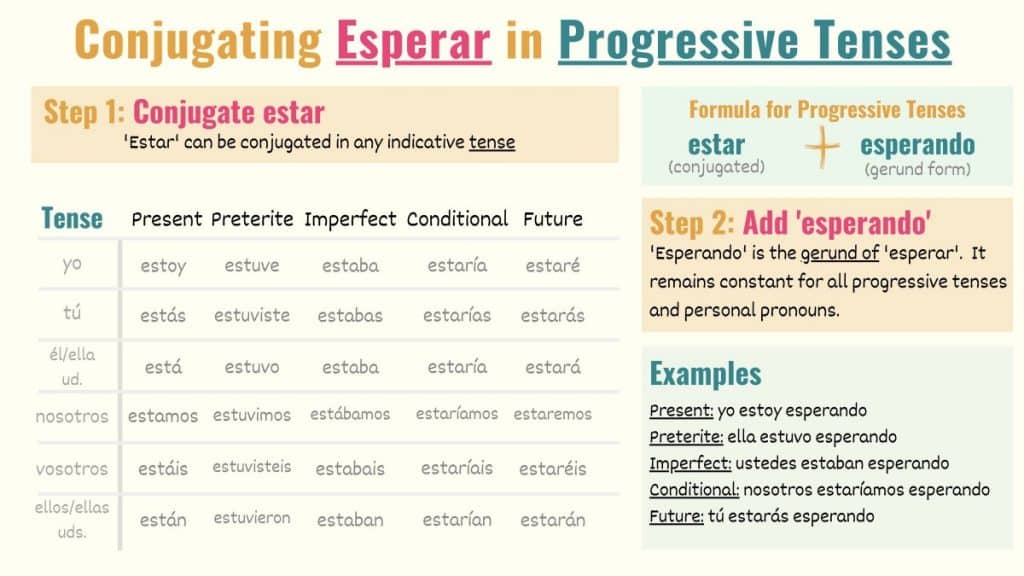
Anna, te estamos esperando en el bar.
Anna, we’ve been waiting for you in the bar.
Durante mucho tiempo estuve esperando este ascenso.
I was waiting for this promotion for a long time.
Perfect Tenses
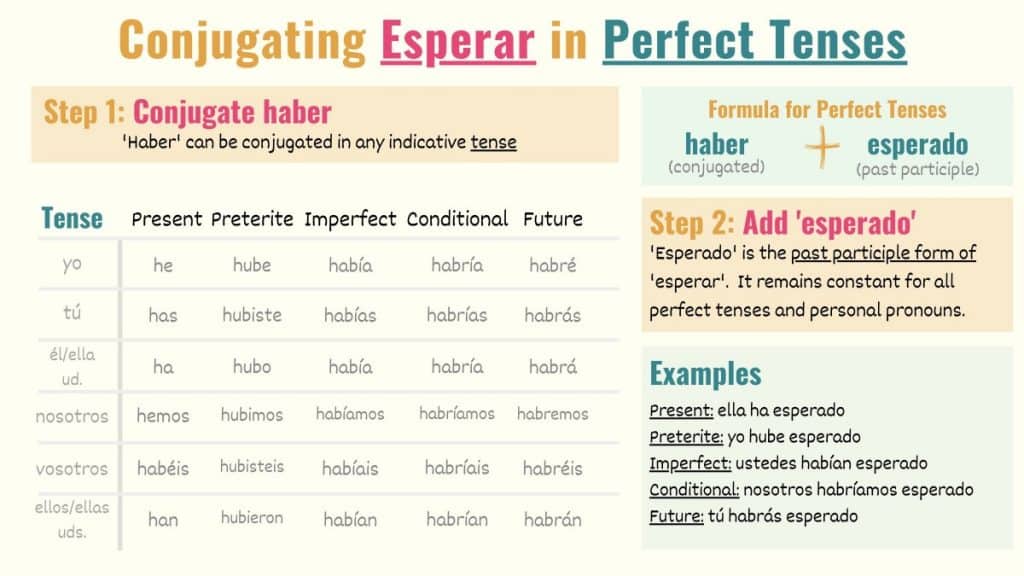
He estado esperando el camión por veinte minutos.
I have been waiting for the bus for 20 minutes.
¿Cuánto tiempo has estado esperando?
How long have you been waiting?
Esperar Subjunctive Conjugations
Present subjunctive conjugation
| Person | Conjugation | Translation |
|---|---|---|
| Yo | espere | I wait |
| Tú | esperes | You wait |
| Él / Ella / Usted | espere | He/She waits |
| Nosotros | esperemos | We wait |
| Vosotros | esperéis | You wait |
| Ustedes / Ellos / Ellas | esperen | They/You wait |
Imperfect subjunctive conjugations
| Person | Conjugation | Translation |
|---|---|---|
| Yo | esperara / esperase | I waited |
| Tú | esperaras / esperases | You waited |
| Él / Ella / Usted | esperara / esperase | He/She waited |
| Nosotros | esperáramos / esperásemos | We waited |
| Vosotros | esperarais / esperaseis | You waited |
| Ustedes / Ellos / Ellas | esperaran / esperasen | They/You waited |
Perfect subjunctive
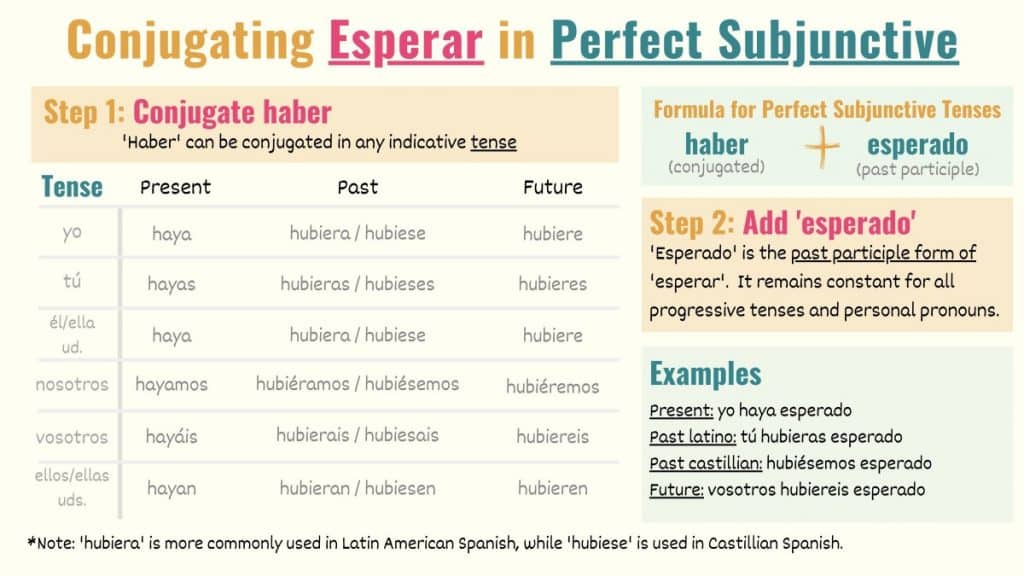
Perdón que haya llegado tarde, ojalá no hayas esperado mucho.
I’m sorry to be late, I hope you haven’t waited too long.


Imperative
Imperative conjugation
| Person | Conjugation | Translation |
|---|---|---|
| Tú | espera | Wait |
| Nosotros | esperemos | Let’s wait |
| Vosotros | esperad | Wait |
| Usted/ Ustedes | espera / esperen | Wait |
Here are some examples of how to give both negative and positive commands with ‘esperar’. Notice that to tell people what to do, you’ll use the conjugation in the table above.
[‘Esperar’ in imperative] + [complement]
¡Espérenme! Ya casi estoy lista.
Wait for me! I’m almost ready.
Chicos, esperad a que el semáforo se ponga en rojo.
Guys, wait for the light to turn red.
If instead you need to tell people what not to do, you’ll need to follow the present subjunctive conjugation for ‘esperar’.
No + [‘esperar’ in present subjunctive] + [complement]
Veré si puedo ayudarte, pero no esperes nada.
I’ll see if I can help you, but don’t expect anything.
Oigan, no me esperen, voy a llegar tarde.
Hey guys, don’t wait for me, I’ll be late.
How to Use ‘Esperar’ in Spanish with Examples
In Spanish, the verb ‘esperar’ has two main meanings:
- Describing that a person is waiting for someone or something
- Talking about hopes and expectations
In the sections below, I’ll describe to you in more detail the different situations where you can use ‘esperar’ in Spanish. Additionally, I’ll provide you with examples and phrase structures that you use to start implementing this verb into your conversations.
Describe that a person is waiting for someone or something
As the direct translation of ‘to wait’, in Spanish, ‘esperar’ is used to describe that someone is waiting for a person or for something to happen. Below there are some examples and phrase structures that you can use in each case.
[Direct object pronoun]+ [esperar conjugated] + (complement)
¿Quieres que te espere?
Do you want me to wait for you?
Si no llegan temprano, no los esperaremos.
If you don’t arrive early, we will not wait for you.
Clara te esperó durante dos horas.
Clara waited for you for two hours.
Ya casi llego, espérame cinco minutos.
I’m almost there, wait for me for five minutes.
If instead of referring to waiting for a person, you want to use ‘esperar’ to talk about waiting for an action or event to happen, you need to use the following phrase structure.
[Esperar conjugated] + a + que + [noun] + [verb in subjunctive]
Esperaré a que el programa se acabe.
I’ll wait until the show is over.
Luisa y yo esperamos a que dejara de llover.
Luisa and I waited for the rain to stop.
¿Crees que si espero a que mi papá me lleve a la escuela llegaré tarde?
Do you think that if I wait for dad to take me to school would I be late?
Talking about hopes and expectations
A very common use of the verb esperar is to talk about a person’s expectations, wishes, hopes or dreams. As a result, in this context, ‘esperar’ means ‘to hope’ or ‘to expect’. Notice that for this case, there are two main structures that you can use:
When talking about the hopes or expectations that someone has for other people or that rely on someone or something’s behavior, we use the following structure.
[Esperar conjugated] + que + [verb in subjunctive]
Espero que tengas un buen día.
I hope you have a nice day.
Esperábamos que pudiera ayudarnos.
We hoped that you could help us.
Andrea espera que deje de llover pronto.
Andrea hopes that it stops raining soon.
Mi mamá espera que mi papá le compre esa blusa.
My mom expects my dad to buy her that blouse.
If instead you want to express the hopes or expectations that you have for yourself, you’ll use the following structure.
[Esperar conjugated] + [verb in infinitive]
No esperaba verte aquí.
I didn’t expect to see you here.
Claudia espera conseguir ese trabajo.
Claudia expects to get this job.
Yo no esperaba encontrar mi dinero.
I didn’t expect to find my money.
Take Note: When talking about hopes, dreams, desires and expectations in Spanish, notice that we either use the subjunctive or an infinitive verb. Usually, the verb in infinitive expresses expectations or hopes that depend on ourselves.
Esperar Expressions & Idioms
Below are some popular idioms and expressions with ‘esperar’ that will help you be able to communicate your ideas in a more precise way.
Esperar sentado: This idiom expresses that someone is or might be waiting for something that won’t likely happen. Usually, ‘esperar sentado’ implies some kind of irony or mockery for the person that is waiting. This expression can be translated as ‘don’t hold your breath’ or ‘ it ain’t gonna happen’.
Esperar lo peor: In Spanish, ‘esperar lo peor’ is used to express that a person expects the worst from a situation. This expression can be used in both formal and informal contexts, and it can be translated as ‘to expect for the worst’.
Ser de esperar: As the direct translation of ‘to be expected’, ‘ser de esperar’ is used to express that a result, action or behavior was previsible or expected to happen.
Synonyms of ‘Esperar’ in Spanish
Ojalá: In Spanish, ‘ojalá’ is a synonym of ‘esperar’ when talking about someone’s wishes or dreams. This word only works with verbs conjugated to the subjunctive and it can be translated as ‘to hope so’ or ‘hopefully.
Aguardar: It is a more formal way to express that someone is waiting either for something to happen or for another person. Given that ‘aguardar’ is also translated as ‘to wait’, you could use it as a synonym for ‘esperar’ in more formal situations.
Desear: ‘Desear’ is another verb that is used in Spanish to either describe someone’s wishes and hopes. As a synonym of ‘esperar’, ‘desear’ means ‘to wish’.
Confiar: Although it has multiple meanings, ‘confiar’ can be used as a synonym of ‘esperar’ when talking about someone’s hopes or expectations. With this meaning, ‘confiar’ is translated as ‘to trust that’.