

In this short guide, we will cover the following topics for ‘meter’ in Spanish:
- What does ‘Meter’ mean?
- ‘Meter’ Conjugations
- How to Use ‘Meter’ in Spanish
- Expressions & Idioms with ‘Meter’
- Synonyms of ‘Meter’ in Spanish
What does ‘Meter’ mean?
In Spanish, ‘meter’ refers to putting something or someone inside a thing or a place. It can also be used to describe that a person is getting involved in a certain circumstance and it can be informally used to talk about what people do for a living.
- When talking about someone or something being placed inside, ‘meter’ means ‘to put’, ‘to get in’ or ‘to go in’.
- To express that a person is implicated in a situation or with someone else, ‘meter’ means ‘to get involved’ or ‘to meddle in’.
- When talking about people’s jobs or occupations, ‘meter’ means ‘to become’ or ‘to start’.
‘Meter’ Conjugations
‘Meter’ is a regular verb. This means that, in order to conjugate it, you’ll need to remove the -ER ending and add the appropriate endings to the stem ‘met’. Keep in mind that to conjugate to the future and conditional tenses you’ll only need to add the proper endings to the verb in its infinitive form.
Indicative
Present tense conjugation
| Person | Conjugation | Translation |
|---|---|---|
| Yo | Meto | I put |
| Tú | Metes | You put |
| Él / Ella / Usted | Mete | He/She puts |
| Nosotros | Metemos | We put |
| Vosotros | Metéis | You put |
| Ustedes / Ellos / Ellas | Meten | They/You put |
Preterite tense conjugation
| Person | Conjugation | Translation |
|---|---|---|
| Yo | Metí | I put |
| Tú | Metiste | You put |
| Él / Ella / Usted | Metió | He/She put |
| Nosotros | Metimos | We put |
| Vosotros | Metisteis | You put |
| Ustedes / Ellos / Ellas | Metieron | They/You put |
Imperfect tense conjugation
| Person | Conjugation | Translation |
|---|---|---|
| Yo | Metía | I put |
| Tú | Metías | You put |
| Él / Ella / Usted | Metía | He/She put |
| Nosotros | Metíamos | We put |
| Vosotros | Metíais | You put |
| Ustedes / Ellos / Ellas | Metían | They/You put |
Future tense conjugation
| Person | Conjugation | Translation |
|---|---|---|
| Yo | Meteré | I will put |
| Tú | Meterás | You will put |
| Él / Ella / Usted | Meterá | He/She will put |
| Nosotros | Meteremos | We will put |
| Vosotros | Meteréis | You will put |
| Ustedes / Ellos / Ellas | Meterán | They/You will put |
Conditional tense conjugation
| Person | Conjugation | Translation |
|---|---|---|
| Yo | Metería | I would put |
| Tú | Meterías | You would put |
| Él / Ella / Usted | Metería | He/She would put |
| Nosotros | Meteríamos | We would put |
| Vosotros | Meteríais | You would put |
| Ustedes / Ellos / Ellas | Meterían | They/You would put |
Progressive Tenses
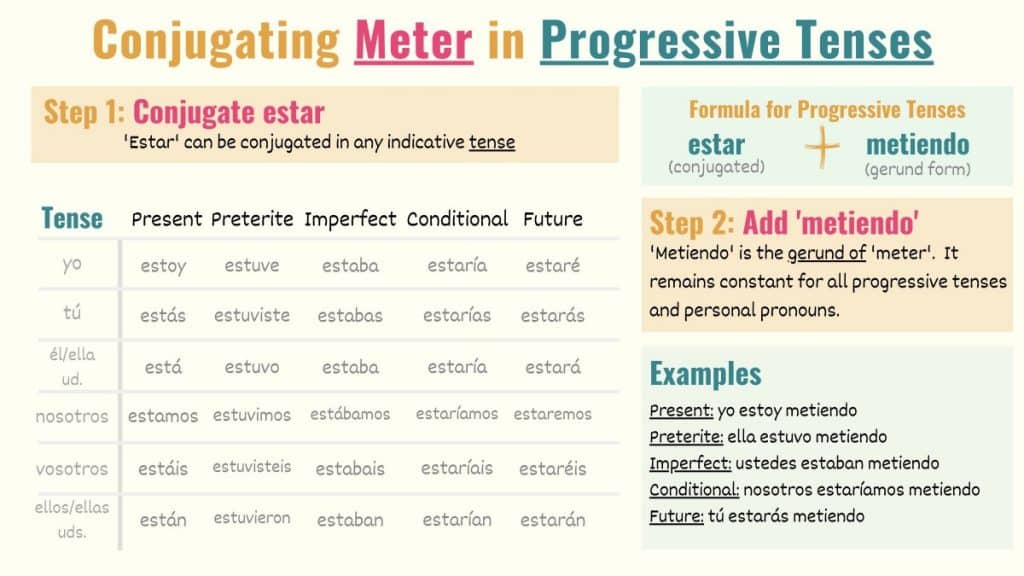
Estoy metiendo la ropa en la lavadora.
I’m putting the laundry in the washing machine.
Perfect Tenses
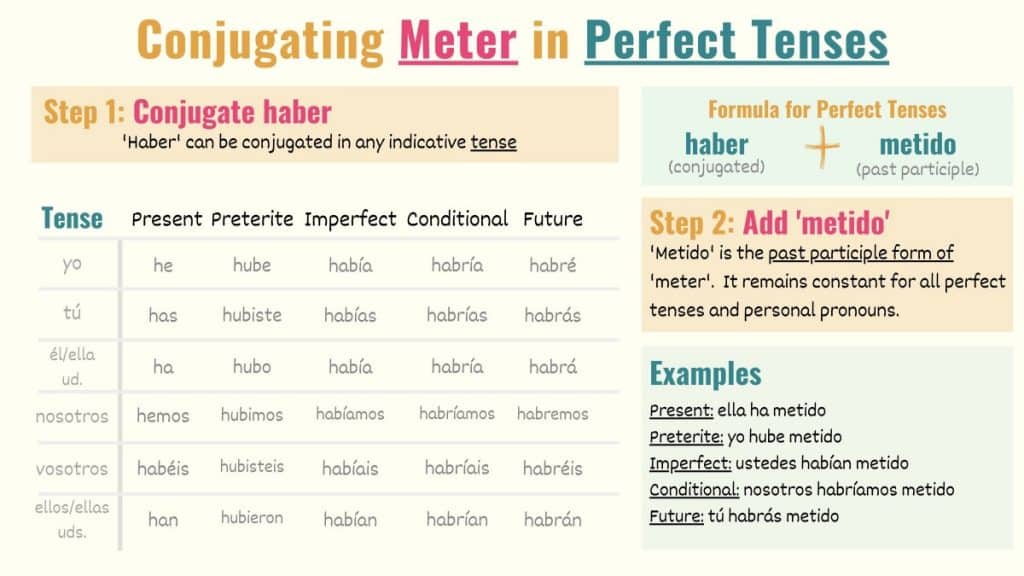
¿Por qué no has metido las sobras al refri?
Why haven’t you put the leftovers in the fridge?
Mi hija nunca se ha metido en problemas.
My daughter has never been in trouble.
Meter Subjunctive Conjugations
Present subjunctive conjugation
| Person | Conjugation | Translation |
|---|---|---|
| Yo | Meta | To put |
| Tú | Metas | To put |
| Él / Ella / Usted | Meta | To put |
| Nosotros | Metamos | To put |
| Vosotros | Metáis | To put |
| Ustedes / Ellos / Ellas | Metan | To put |
Imperfect subjunctive conjugations
| Person | Conjugation | Translation |
|---|---|---|
| Yo | Metiera / Metiese | I put |
| Tú | Metieras / Metieses | You put |
| Él / Ella / Usted | Metiera / Metiese | He/She put |
| Nosotros | Metiéramos / Metiésemos | We put |
| Vosotros | Metierais / Metieseis | You put |
| Ustedes / Ellos / Ellas | Metieran / Metiesen | They/You put |
Perfect subjunctive
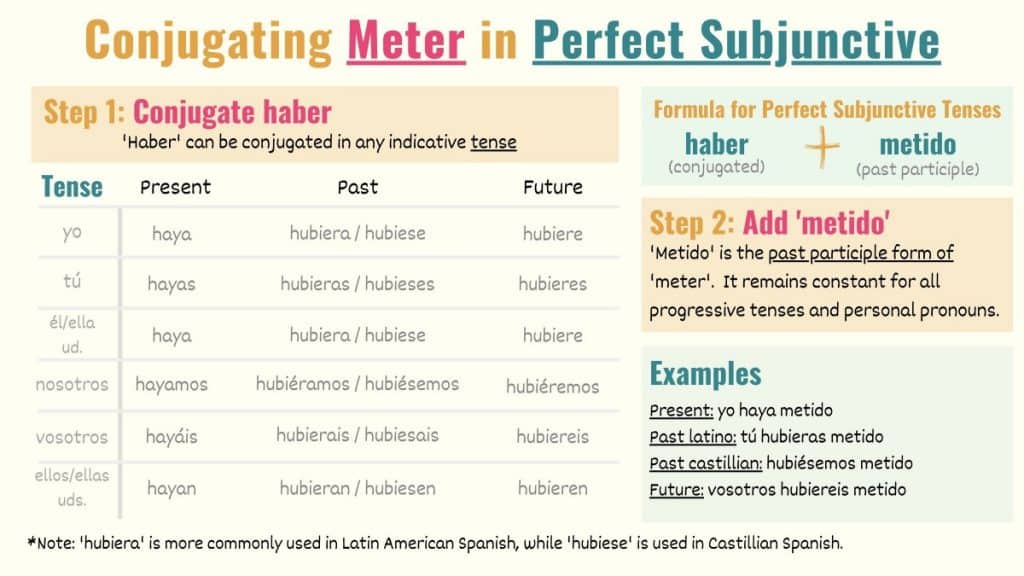
Ojalá que Gabriel haya metido la ropa a la secadora.
I hope that Gabriel put the clothes in the dryer.
Si hubieran metido sus cosas, no se habrían mojado.
If you had put your things inside, they wouldn’t have gotten wet.
Imperative
Imperative conjugation
Remember that to conjugate to the negative imperative, all subjects will follow the present subjunctive conjugation.
| Person | Conjugation | Translation |
|---|---|---|
| Tú | Mete | Put |
| Nosotros | Metamos | Let’s put |
| Vosotros | Meted | Put |
| Ustedes | Metan | Put |
[‘Meter’ imperative] + [complement]
Ya métete a la casa.
Get in the house now.
Mete la comida al refri.
Put the food into the fridge.
No + [‘meter’ in present subjunctive] + [complement]
No metas la mano a la pecera.
Don’t put your hand in the fish tank.
Alicia, no metas a tu hermano a la alberca.
Alicia, don’t put your brother into the pool.
How to Use ‘Meter’ in Spanish with Examples
There are several ways in which you can use the verb ‘meter’. Here are the most common ones:
- To talk about putting something inside a place
- Expressing that someone is getting involved in a situation
- Talking about occupations
I’ve added some examples in the sections below to help you have a better understanding of the different ways in which you can apply ‘meter’.
To talk about putting something inside a place
When talking about people or objects being placed on the inside of a certain space or enclosure, ‘meter’ means ‘to put’, ‘to get in’, ‘get into’ or ‘to go in’. In this context, ‘meter’ is frequently used as a reflexive verb, so, in some cases, you’ll need to add reflexive pronouns.
[‘Meter’ conjugated] + [definite article] + [noun] + [complement]
¿Metiste el pastel al horno?
Did you put the cake in the oven?
Anoche no metí el carro a la cochera.
I didn’t put the car in the garage last night.
¿Quién metió mis zapatos al bote de basura?
Who put my shoes into the garbage can?
[Reflexive pronoun] + [‘meter’ conjugated] + [complement]
Carlos se metió a su cuarto.
Carlos went into his room.
El gato se metió debajo de la cama.
The cat crawled under the bed.
Take note: In Spanish, ‘meter’ can also be used to describe that someone is generating a psychological or emotional response to another person. In this context, it will also be translated as ‘to put’ or ‘to give’.
[Indirect object pronoun] + [‘meter’ conjugated] + [complement]
Nuestro jefe nos mete mucha presión.
Our boss puts a lot of pressure on us.
Me metiste un gran susto.
You gave me a big scare.
Expressing that someone is getting involved in a situation
To express that a person has or will get involved in a situation, ‘meter’ can be translated as ‘to get into’. In this context, ‘meter’ usually has a negative connotation and it can also be translated as ‘to meddle in’ or ‘to stick your nose in’.
[Reflexive pronoun] + [‘meter’ conjugated] + en + [complement]
Vanessa se metió en un asunto muy delicado.
Vanessa got into a very delicate matter.
No te metas en temas controversiales.
Do not get into controversial topics.
Alonso se metió en un ambiente muy peligroso.
Alonso got into a very dangerous environment.
No te metas en mi vida.
Don’t meddle in my life.
If instead someone else te metió into a situation, then, you’ll need to use a direct object pronoun instead of a reflexive one.
[Direct object pronoun] + [‘meter’ conjugated] + en + [complement]
Francisco lo metió en muchos problemas.
Francisco got him into a lot of trouble.
Tu hermano me metió en problemas con tu papá.
Your brother got me into trouble with your dad.
Talking about occupations
In conversational Spanish, ‘meter’ can also be used as an informal way to talk about a person’s occupation. In this case, we use this verb to describe that a person just started with a new profession. So, with this meaning, ‘meter’ means ‘to start’ or ‘to become’.
[Reflexive pronoun] + [‘meter’ conjugated] + [complement]
Paula se metió a trabajar a una tienda de música.
Paula started working at a music store.
Emma se metió de mesera.
Emma started working as a waitress.
Me metí a estudiar medicine.
I started studying medicine.
Meter Expressions & Idioms
Meter un gol is an expression mainly used in sports and it means ‘to score a goal’.
Meter la pata is used to express that someone made a mistake. It can be translated as ‘to put your foot in it’ or ‘to mess things up’.
Meter cizaña refers to creating conflicts and enmities on purpose. It means ‘to sow discord’ or ‘to cause trouble’.
Synonyms of ‘Meter’ in Spanish
Insertar is the direct translation of ‘to insert’. It is not as common as ‘meter’.
Poner means ‘to put’. Unlike ‘meter’, poner can also be used to describe that an object is being placed on a surface.
Introducir translates as ‘to introduce’. It’s a more formal term and most commonly used in instructions.
Entrar is the direct translation of ‘to enter’. It can be used the same way as ‘meter’ but it’s more frequently used to talk about people.
Related Resource:
Difference Between ‘Poner’ and ‘Meter’ in Spanish