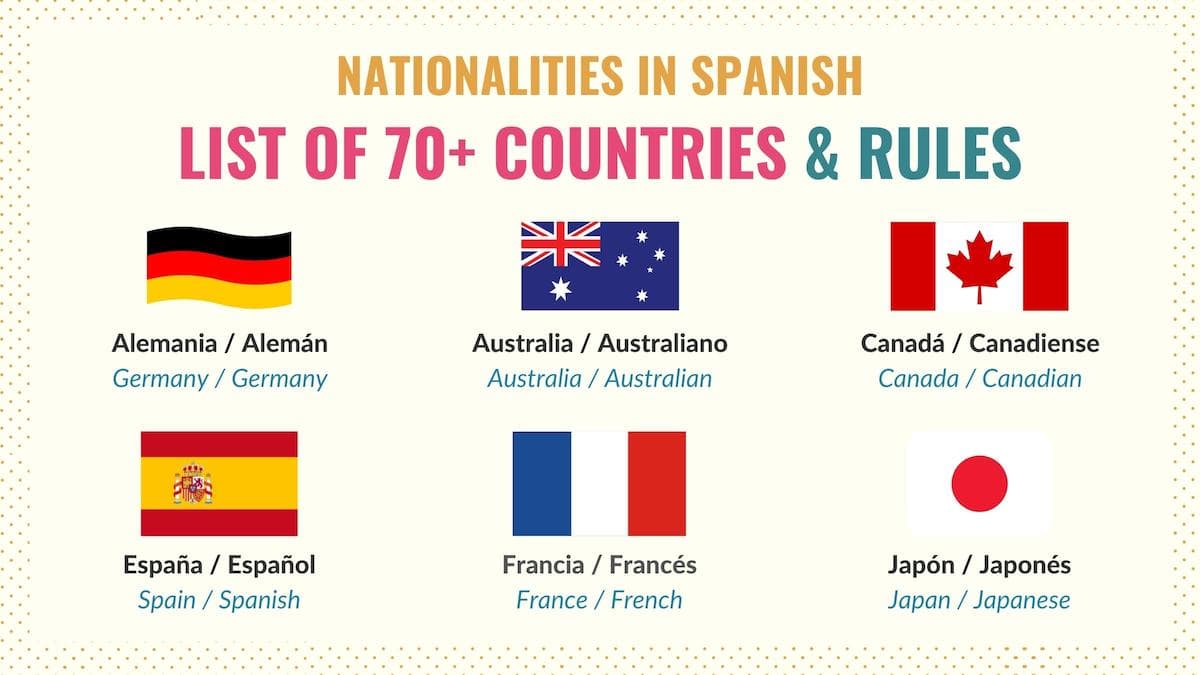
Nationalities in Spanish are basic adjectives that allow you to express where something or someone is from. In short, adjectives of nationality are an important part of your vocabulary. So, to help you master this set of words, in this guide, we’ll cover:
- List of Countries & Nationalities in Spanish
- Rules for Nationalities in Spanish
- Bonus: Asking Someone About Their Nationality
- Downloadable PDF
Countries & Nationalities in Spanish
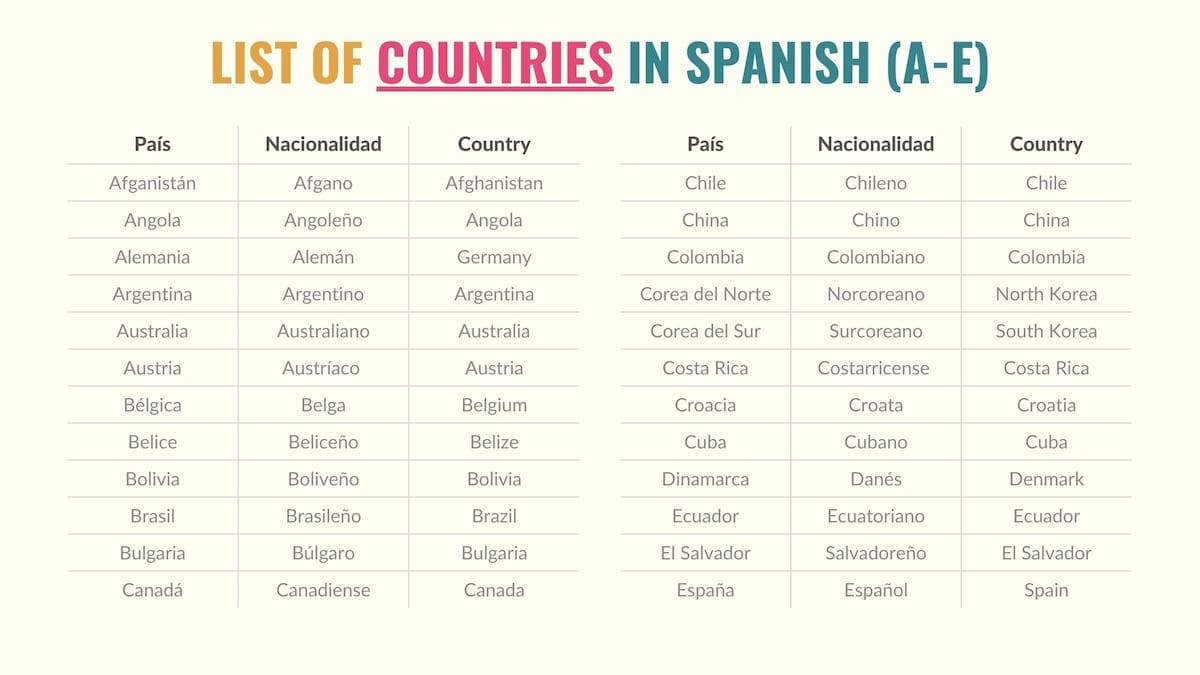
Below is a list of 70 countries and their corresponding nationalities in Spanish.
Note: This is not an exhaustive list. However, I’ve included a fair portion of countries to represent how nationalities in Spanish work.
| Country in Spanish | Nationality | Country in English |
|---|---|---|
| Afganistán | Afgano | Afghanistan |
| Angola | Angoleño | Angola |
| Alemania | Alemán | Germany |
| Argentina | Argentino | Argentina |
| Australia | Australiano | Australia |
| Austria | Austríaco | Austria |
| Bélgica | Belga | Belgium |
| Belice | Beliceño | Belize |
| Bolivia | Boliveño | Bolivia |
| Brasil | Brasileño | Brazil |
| Bulgaria | Búlgaro | Bulgaria |
| Canadá | Canadiense | Canada |
| Chile | Chileno | Chile |
| China | Chino | China |
| Colombia | Colombiano | Colombia |
| Corea del Norte | Norcoreano | North Korea |
| Corea del Sur | Surcoreano | South Korea |
| Costa Rica | Costarricense | Costa Rica |
| Croacia | Croata | Croatia |
| Cuba | Cubano | Cuba |
| Dinamarca | Danés | Denmark |
| Ecuador | Ecuatoriano | Ecuador |
| El Salvador | Salvadoreño | El Salvador |
| España | Español | Spain |
| Estados Unidos | Estadounidense | United States |
| Escocia | Escocés | Scotland |
| Egipto | Egipcio | Egypt |
| Etiopía | Etíope | Ethiopia |
| Finlandia | Finlandés | Finland |
| Francia | Francés | France |
| Groelandía | Groenlandés | Greenland |
| Guatemala | Guatemalteco | Guatemala |
| Grecia | Griego | Greece |
| Haití | Haitiano | Haiti |
| Honduras | Hondureño | Honduras |
| Hungría | Húngaro | Hungary |
| India | Indio | India |
| Inglaterra | Inglés | England |
| Irán | Iraní | Iran |
| Irak | Iraquí | Irak |
| Irlanda | Irlandés | Ireland |
| Islandia | Islandés | Iceland |
| Israel | Israelí | Israel |
| Italia | Italiano | Italy |
| Jamaica | Jamaicano / Jamaiquino | Jamaica |
| Japón | Japonés | Japan |
| Líbano | Libanés | Lebanon |
| Marruecos | Marroquí | Morocco |
| Malta | Maltés | Malta |
| México | Mexicano | Mexico |
| Mónaco | Monegasco | Monaco |
| Nicaragua | Nicaragüense | Nicaragua |
| Noruega | Noruego | Norway |
| Nueva Zelanda | Neozelandés | New Zealand |
| República Checa | Checo | Czech Republic |
| República Dominicana | Dominicano | Dominican Republic |
| Rusia | Ruso | Russia |
| Países Bajos | Neerlandés | Netherlands |
| Pakistán | Pakistaní | Pakistan |
| Panamá | Panameño | Panama |
| Paraguay | Paraguayo | Paraguay |
| Perú | Peruano | Peru |
| Polonia | Polaco | Poland |
| Portugal | Portugués | Portugal |
| Puerto Rico | Puertorriqueño | Puerto Rico |
| Suecia | Sueco | Sweden |
| Suiza | Suizo | Switzerland |
| Tailandia | Tailandés | Thailand |
| Turquía | Turco | Turkey |
| Uruguay | Uruguayo | Uruguay |
| Venezuela | Venezolano | Venezuela |
| Vietnam | Vietnamita | Vietnam |
Rules for Nationalities in Spanish
In addition to the vocabulary, you must also know certain rules to correctly apply adjectives of nationality in Spanish. You’ll find these rules in the following sections.
Do you capitalize nationalities in Spanish?
Unlike English, nationalities in Spanish are not capitalized unless they are used to start a sentence or are part of a proper noun. Since they are proper nouns, the name of countries must always be capitalized.
Here are some examples so you can see the capitalization rules of adjectives of nationality:
James es inglés y Andrea colombiana.
James is English, and Andrea is Colombian.
El nombre oficial de México es Estados Unidos Mexicanos.
The official name of Mexico is the United Mexican States.
Male and female nationalities
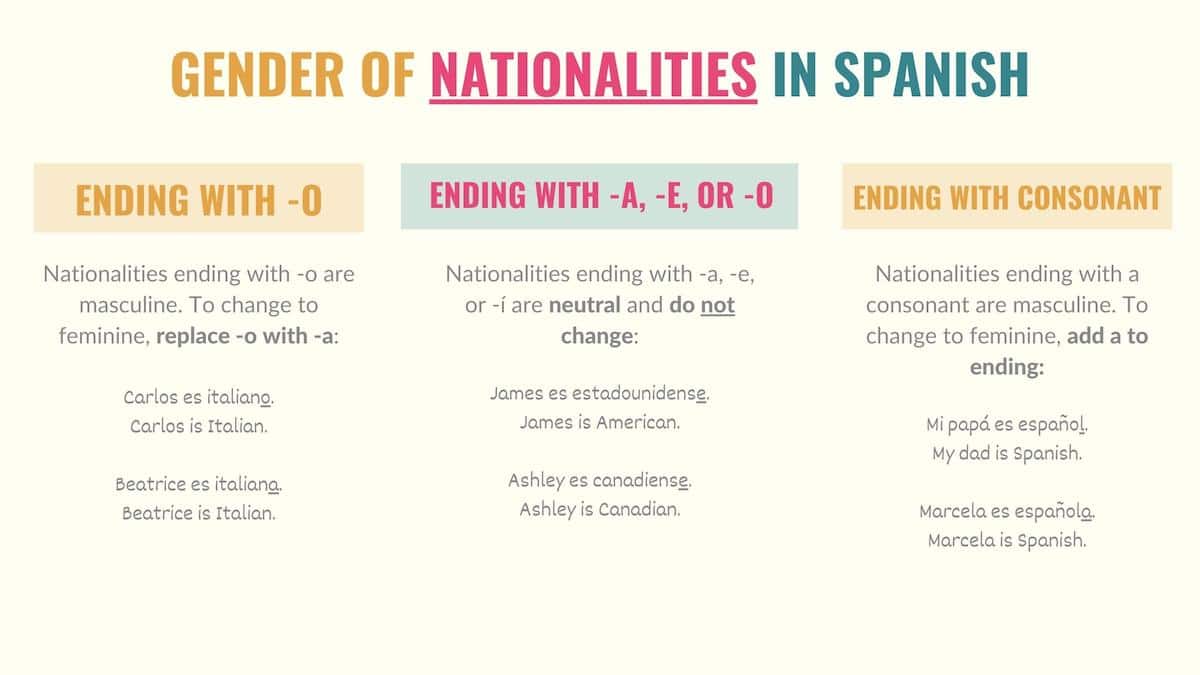
In Spanish, nationalities are adjectives. As such, they must agree with the number and sometimes the gender of the noun they’re describing. Often, the noun that a nationality is describing is a person or object. Here are some rules about male and female nationalities in Spanish:
Nationalities ending with -o
In Spanish, adjectives of nationality that end with o are masculine. To transform these words into feminine nationalities, you must replace the o with the vowel a.
Carlos es italiano.
Carlos is Italian.
Beatrice es italiana.
Beatrice is Italian.
Nationalities ending with -e, -a or -í
These types of adjectives are neutral and cannot mark gender. To put it another way, when it comes to nationalities in Spanish that end with e, a or í, you must use the same word for feminine and masculine nouns.
James es estadounidense.
James is American.
Ashley es canadiense.
Ashley is Canadian.
Nationalities ending with a consonant
Nationalities in Spanish that end with a consonant are masculine by default. To make them feminine adjectives, you must add the vowel a to the end.
Mi papá es español.
My dad is Spanish.
Marcela es española.
Marcela is Spanish.
Take Note: The most common endings for nationalities in Spanish are -ano, -ense, -ino, -iano, -és, -í, and -o. However, as a tip, it’s easier to focus on the last letter of these adjectives when changing their gender or making them plural.
Plural forms of nationalities in Spanish
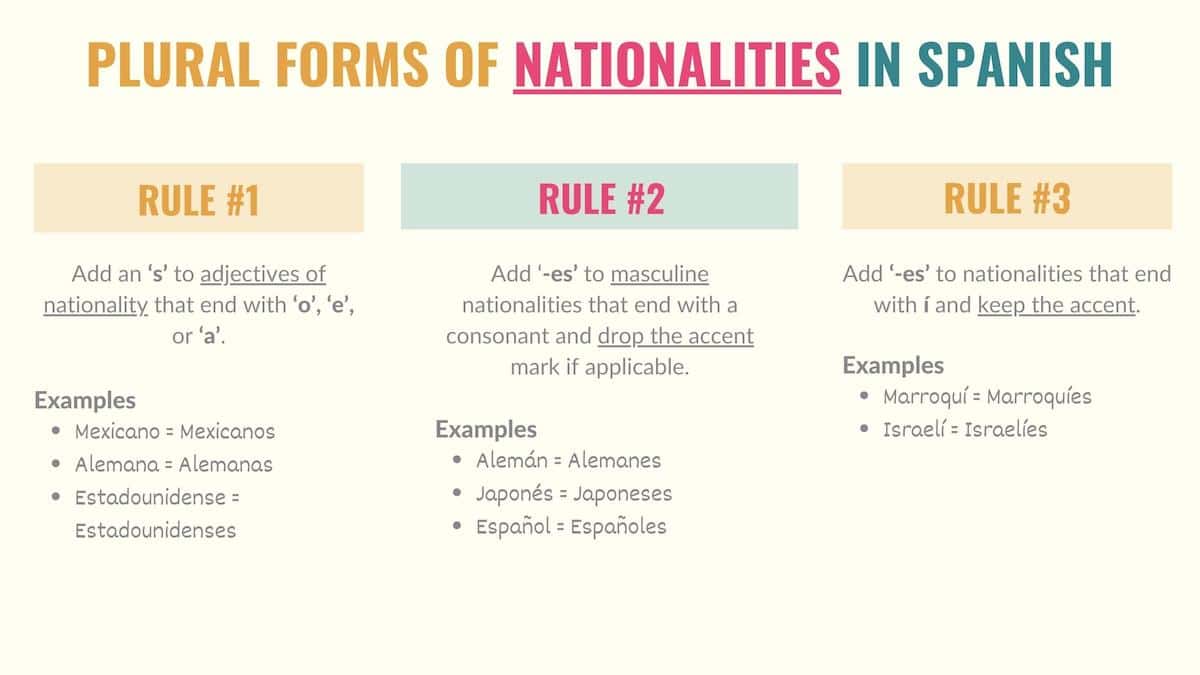
Although some adjectives of nationality may not mark the gender, in Spanish, you must always pluralize nationalities when describing a group of people or things.
Here are the rules you need to follow to make plural nationalities in Spanish:
1. Add an ‘s’ to adjectives of nationality that end with ‘o’, ‘e’, or ‘a’.
For example:
- Mexicano = Mexicanos
- Alemana = Alemanas
- Estadounidense = Estadounidenses
2. Add ‘-es’ to masculine nationalities that end with a consonant and drop the accent mark if applicable.
For example:
- Alemán = Alemanes
- Japonés = Japoneses
- Español = Españoles
3. Add ‘-es’ to nationalities that end with í and keep the accent.
For example:
- Marroquí = Marroquíes
- Israelí = Israelíes
What verb is used to talk about nationalities in Spanish?
Adjectives of nationality work with the verb ser if you’re using them to describe where something or someone is from:
Erica es puertorriqueña y yo soy mexicana.
Erica is Puerto Rican, and I am Mexican.
¿Los chicos nuevos son portugueses?
Are the new guys Portuguese?
However, in some cases, the adjective of nationality will immediately follow the noun if you’re using it to distinguish one thing from another. For example:
La comida china es muy preferida.
Chinese food is my favorite.
Este es un grupo de pop japonés.
This is a Japanese pop group.
Take Note: In Spanish, adjectives of nationality are used to describe people and things. If you want to be more precise with your portraits, check my guide on the most common adjectives to describe a person.


Bonus: Asking Someone About their Nationality
Now that you’ve learned adjectives of nationality, you should also know some questions you can use to ask people where they’re from.
These are the most common questions you can use to ask someone about their nationality:
- ¿De dónde eres? – Where are you from?
- ¿De qué país eres? – What country are you from?
- ¿Cuál es tu nacionalidad? – What is your nationality? (formal)
| Spanish | English |
|---|---|
| Tú: Hola, ¿de dónde eres? | You: I saw Sandra yesterday. |
| Tu compañero: Soy argenino. | Your classmate: I’m Argentinian. |
Download the Spanish Nationalities & Countries PDF
Now that you’ve learned this vocabulary, you should feel more comfortable talking about nationalities in Spanish. Buena suerte. Feel free to download a PDF I’ve created including the list of countries and nationalities and rules we’ve covered to refer back to later.