
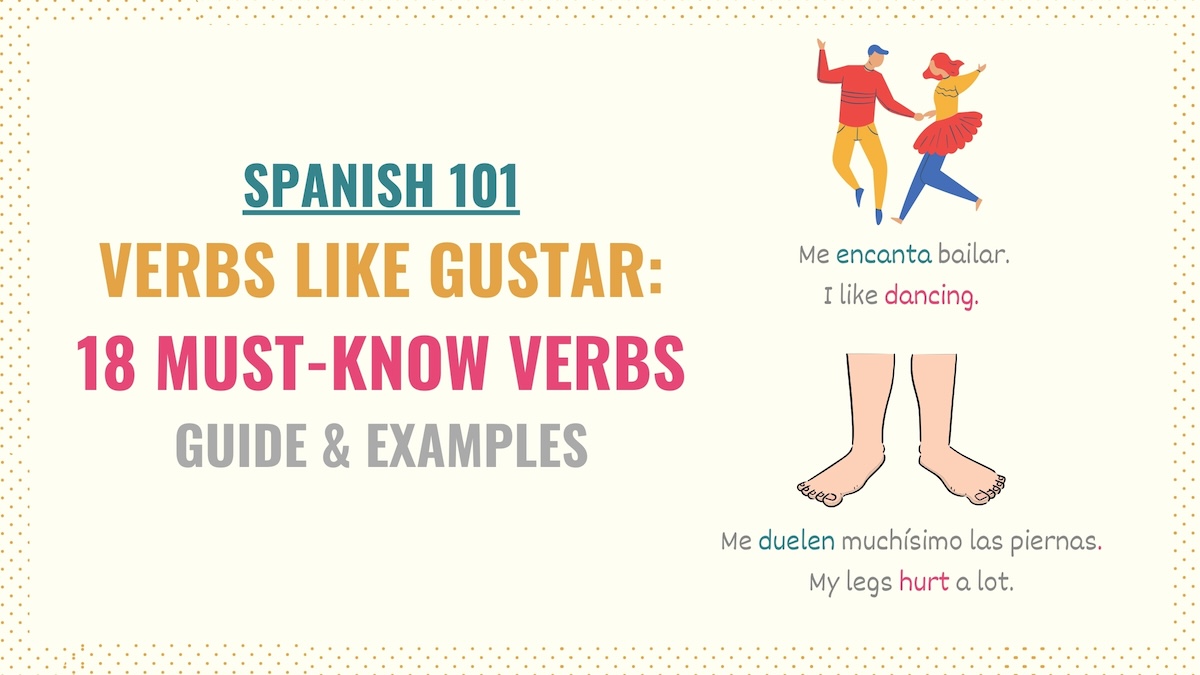
Gustar and verbs like gustar convey the feelings and emotions that the subject provokes on someone or something. Their key differentiator is that they inverse the sentence order. Unlike most sentences, verbs like gustar in Spanish start with the object and end with the subject.
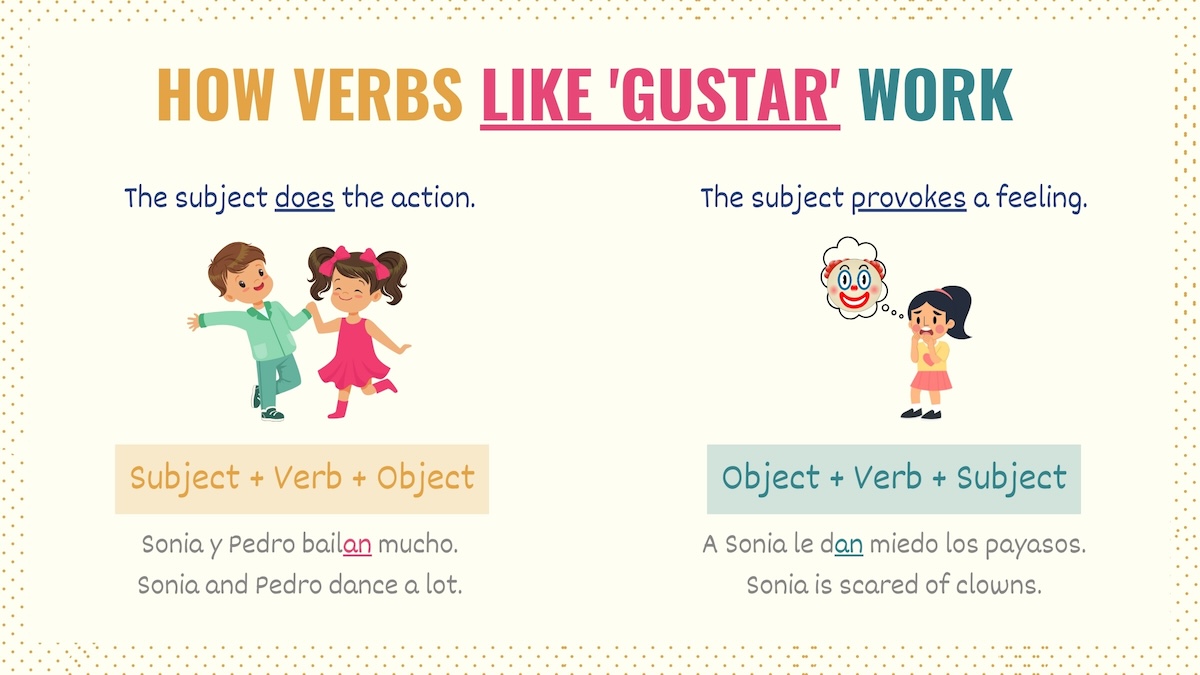
Because the subjects of verbs like gustar affect someone, they must use Spanish indirect object pronouns to express who the person experiencing the feeling is.
List of Verbs Like Gustar
- Aburrir: To bore
- Agradar: To like
- Apetecer: To feel like
- Apretar: To be too tight
- Caer bien: To like
- Costar trabajo: To struggle
- Dar asco: To disgust
- Dar gusto: To glad
- Dar miedo: To scare
- Dar pena: To be embarrassed
- Dar risa: To make laugh
- Divertir: To amuse
- Doler: To hurt
- Encantar: To love / To like
- Faltar: To miss
- Fascinar: To fascinate / To love
- Hartar: To annoy
- Importar: To care about
- Impresionar: To impress
- Interesar: To interest
- Molestar: To bother
- Ofender: To offend
- Preocupar: To worry
- Quedar: To fit / To have something left
- Quedar bien/mal: To look good/bad on someone
These are some of the most common verbs that behave like gustar, and here are some examples so you can start getting familiar with their conjugation.
Me fascina conocer gente nueva.
I love meeting new people.
A ti te duelen las rodillas.
Your knees hurt.
¿Crees que a Iván le interese esta película?
Do you think Ivan may be interested in this movie?
Para ser honesta, no nos apetece hacer nada.
To be honest, we don’t feel like doing anything.
Hablar contigo me da muchísimo gusto.
Talking to you makes me really happy.
Take Note: Depending on the Spanish dialect, some of these verbs may work with either indirect or direct object pronouns. This only affects the elements used rather than the meaning of the sentence. For example, “la aburre la política” or “le aburre la política”.
How to Use & Conjugate Verbs Like Gustar in Spanish
Verbs like gustar are conjugated like any other Spanish verb – based on the subject who performs the action. With these verbs, the subject is the activity or things provoking a feeling on someone else.
Check these examples:
Me molesta el ruido.
The noise bothers me.
A Laura le aprietan los zapatos.
The shoes are too tight on Laura.
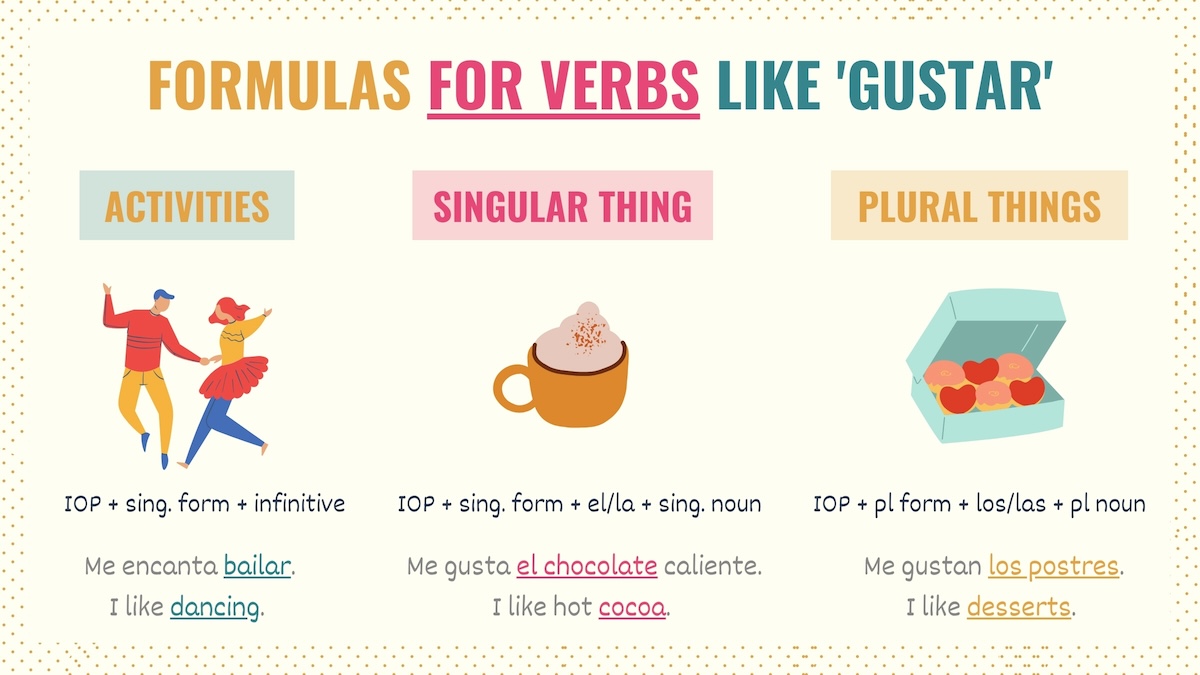
In example #1, the verb molestar is conjugated for the third-person singular (él/ella/usted) because el ruido (the subject) is singular. But, in example #2, the conjugation is plural because los zapatos is a plural subject.
These singular and plural conjugations are the most common conjugations for verbs like gustar. Conjugate in singular form when talking about a singular subject (a noun, or a verb in infinitive form):
El chico nuevo me cae bien.
I like the guy.
A Kelly le preocupa llegar tarde.
Kelly is worried about being late.
Conjugate in plural form when using plural nouns:
Al niño le costaban trabajo las matemáticas.
The kid used to struggle with math.
Tengo dos gatitos, ¿no te interesan?
I have two kitties, are you interested in them?
Verbs like gustar can be conjugated across different tenses, but they will still maintain the same conjugation rules.
Take Note: Notice that the English sentences look very different from the sentences we form with gustar and verbs like gustar. So, don’t be surprised if the translations don’t seem to match.
What pronouns to use
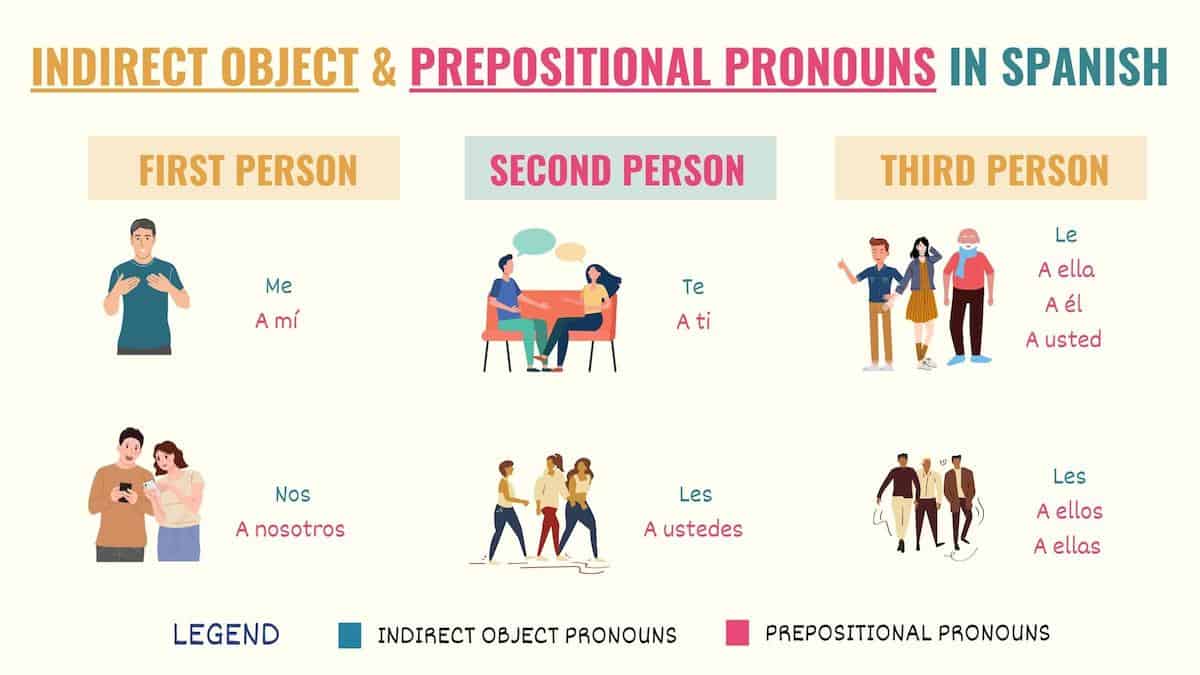
On top of using a reverse order (object, verb, subject), one of the main differentiators of verbs like gustar are the pronouns they work with. With these verbs, indirect object pronouns are used to indicate who is the person experiencing a feeling.
Check the following example and notice that the only element that changes are the pronouns, allowing you to describe the feelings of different people:
No me interesa la política, pero a mis hermanos sí les interesa mucho. ¿A ti te interesa?
I am not interested in politics, but my siblings are. Are you interested in politics?
In addition to indirect object pronouns, the structure a + noun/prepositional pronoun is used to clarify, emphasize, or introduce the object.
A + [noun/prepositional pronoun]
A Miriam no le cae bien Jonathan.
Miriam doesn’t like Jonathan.
¿A ustedes les apetece tomarse unos días?
Do you guys feel like taking a few days off?
A mis hermanos les da asco la sangre.
My brothers are disgusted by blood.
Take Note: Caer bien and gustar can be used to say “I like you” in Spanish. Although the translation doesn’t show the difference, there is a significant nuance in meaning.
Gustar and Verbs Like Gustar Key Points
Verbs like gustar are pivotal for Spanish communication since they allow you to express the feeling something causes on you or another person. Here are some key points to remember:
- Verbs like gustar use an OVS order. In other words, the sentence starts with the object and ends with the subject.
- These verbs are conjugated based on the subject –the thing provoking the feeling.
- Verbs like gustar use indirect object pronouns to indicate who experiences the feeling.
- Often, these verbs have a singular or plural conjugation.
- Structures with the preposition a are used to clarify, introduce, or emphasize the object.