

Si without an accent means ‘if’ and is used to create conditional sentences, such as voy a ir si puedo. Sí with an accent means ‘yes’. On top of affirming or confirming a statement, sí can also be used to emphasize positive sentences: sí, sí voy a ir, and to express a reflexive action.

Sí and Si in Spanish are crucial for daily communication. So, in this guide, I’ll show you the key uses and differences between these words.
Si vs Sí: What’s the Difference?
The absence and presence of the accent in si and sí changes the meaning of these words:
Si la veo, yo le digo.
If I see her, I’ll let her know.
Sí, yo le digo si la veo.
Yes, I’ll let her know if I see her.
Si sabes algo, me dices ¿sí?
If you know something, let me know, okay?
The accent mark also affects the pronunciation of si and sí.
Sí with an accent adds emphasis to the vowel ‘í’, whereas this sound is not intensified with si. As a Spanish conjugation, si is always followed by a conjugated verb or object pronouns, while sí can work on its own.
Take Note: Just like the accent mark changes the meaning of si and sí, the same happens with the pair of words el vs él.
When to use si
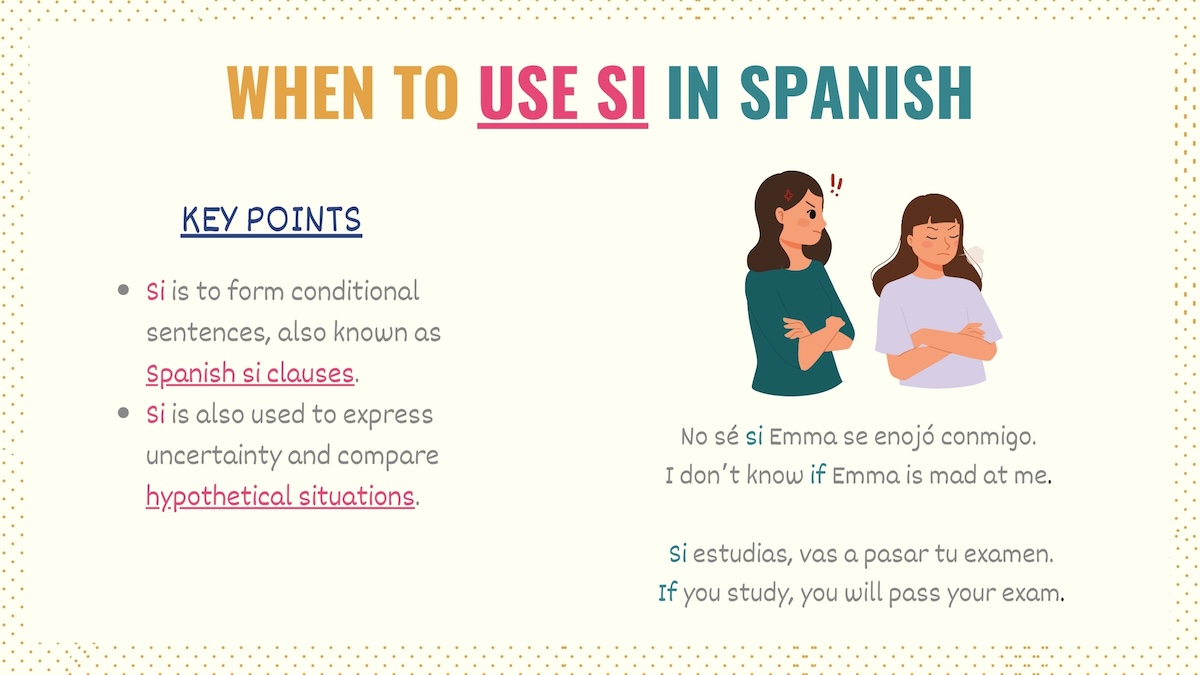
The most important use of si is to form conditional sentences, also known as Spanish si clauses. Si introduces the condition that must be fulfilled to reach a certain outcome
[Si] + [conjugated verb]
Si estudias, vas a pasar tu examen.
If you study, you will pass your exam.
¿Qué harías si ganaras la lotería?
What would you do if you won the lottery?
Si hubiera podido, te habría ayudado.
If I could’ve, I would have helped you.
Háblame si cambias de opinión.
Call me if you change your mind.
On top of conditional statements, si is also used to express uncertainty and compare hypothetical situations:
No sé si Emma se enojó conmigo.
I don’t know if Emma is mad at me.
¿Supiste si Brenda renunció?
Did you hear if Brenda quit?
Lo recuerdo como si hubiera sido ayer.
I remember it as if it was yesterday.
Sí with an accent
As the equivalent of ‘yes’, sí with an accent affirms or seeks to confirm information:
[Sí] + [verb conjugated] + [complement]
Sí, soy mexicano.
Yes, I’m Mexican.
Sí, si quieres, vamos mañana.
Yes, if you want, let’s go tomorrow
Avísame cuando llegues, ¿sí?
Let me know when you get there, yes?
In real life conversations, sí can also be used to emphasize the information given in a sentence. In this context, sí is the equivalent of ‘do’ or ‘be’:
[Sí] + [verb conjugated] + [complement]
Creo que sí estoy enfermo.
I think I am sick.
Laura no quiere ir, pero Tania sí.
Laura doesn’t want to go, but Tania does.
¿Sí encontraste las galletas que te gustan?
Did you find the cookies that you like?
When combined with prepositions, si forms part of reflexive expressions, working similarly to Spanish reflexive pronouns:
[Noun] + [verb conjugated] + [preposition] + [sí]
Los niños se ayudan entre sí.
Children help each other.
A Ashley le gusta tomarse fotos de sí misma.
Ashley likes to take photos of herself.
Los nuevos jugadores tienen mucha confianza en sí mismos.
The new players have a lot of confidence in themselves.

Take Note: There are many slang terms you can use to say ‘yes’ in Spanish. Using these informal expressions can help you sound more natural.
Si or Sí: Key Points
Si vs sí is a topic that you need to master since both words have crucial applications in Spanish. Here are a few key points to remember:
Si (no accent)
- It has a less emphatic pronunciation.
- It’s used to create conditional sentences. Si (if) introduces the condition that must be fulfilled to reach an outcome.
- It can also express uncertainty and compare hypothetical situations.
Sí (with accent)
- Its pronunciation emphasizes the vowel ‘i’.
- It means ‘yes’.
- It emphasizes the affirmative information given in a sentence.
- When combined with prepositions, sí is used in reflexive expressions, indicating actions directed towards oneself.