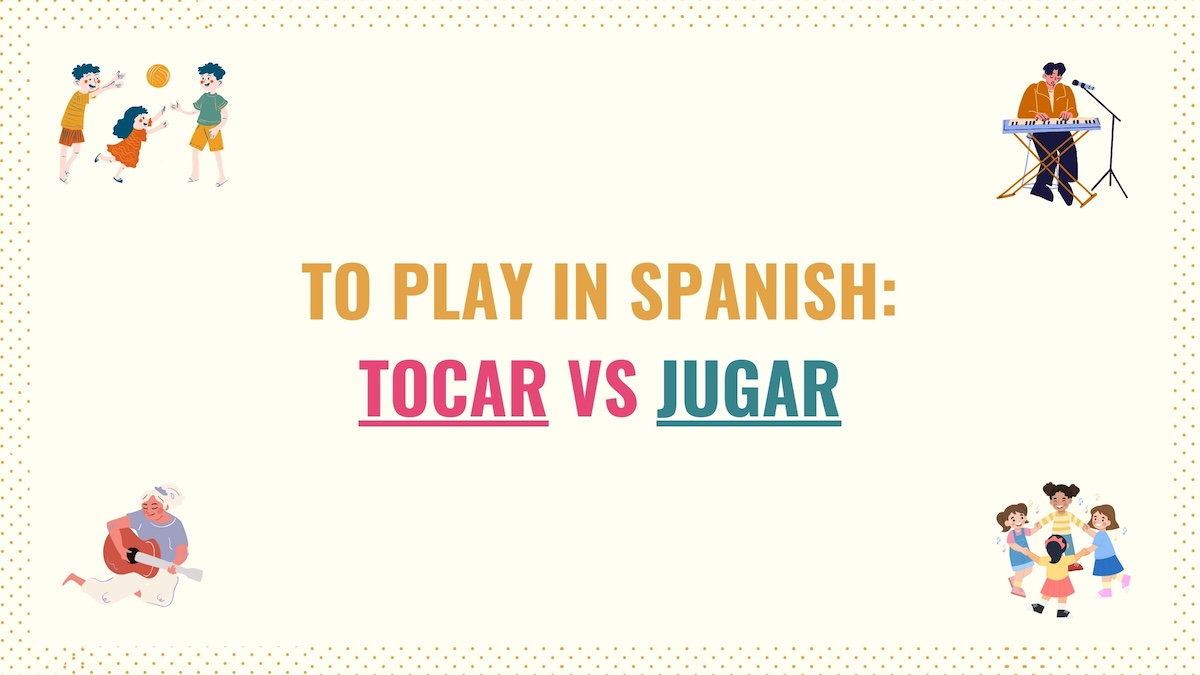
Both tocar and jugar mean ‘to play’. However, in Spanish, tocar holds this meaning when referring to playing music or instruments. On the other hand, jugar relates to playing games and sports.
María y Juan tocan la batería.
María and Juan play the drums.
Jugamos Monopoly toda la noche.
We played Monopoly the whole night.
Tocar vs Jugar: Key Points
- ‘Tocar’ means ‘to play’, but it’s only used with music or instruments.
- In other contexts, it’s used to talk about obligations or as the direct translation of ‘to touch’.
- ‘Jugar’ refers to playing games, sports, cards, or performing any other activities to entertain yourself.
- It’s the direct translation of ‘to play’.
- In the present tense, ‘jugar’ has an O to U stem-change. ‘Tocar’ has changes in the preterite, subjunctive and imperative.
Tocar vs jugar is a pair of tricky verbs that Spanish beginners often confuse. In the guide below, you’ll learn when and how to use these verbs correctly.
When to Use Tocar in Spanish?
One of the main uses of the verb tocar is to talk about the instruments and music people play.
¿Cuándo aprendiste a tocar el piano?
When did you learn to play the piano?
La banda de mi hermano toca jazz.
My brother’s band plays jazz.
Los domingos, Matt y su banda tocan en este restaurante.
Matt and his band play in this restaurant on Sundays.
In daily life Spanish, tocar also means ‘to be someone’s turn’. As a result, it can be used to talk about duties and obligations, or express that someone is next.
[Indirect pronoun] + [tocar conjugated] + (infinitive verb)
No te toca a ti, me toca a mí.
It’s not your turn, it’s mine.
¿A quién le toca lavar los trastes?
Whose turn is it to wash the dishes?
Hoy nos tocó comer pollo y ensalada.
Today, we had chicken and salad.
Finally, tocar is also used as the direct translation of ‘to touch’ or ‘to knock’.
Cuando llegues, toca fuerte.
When you arrive, knock loudly.
No toques la estufa porque está caliente.
Don’t touch the stove because it’s hot.
Take Note: When conjugating tocar, there are some stem-changes you should keep in mind.
When to Use Jugar?
Jugar is the direct translation of ‘to play’. In Spanish, jugar expresses that someone performs an activity with the purpose of amusing or entertaining themselves. Therefore, it’s combined with games, objects, or certain sports.
Mi gato juega con mis calcetines.
My cat plays with my socks.
A Diana le gusta jugar con su cabello.
Diana likes playing with her hair.
El bebé juega con el piano de su papá.
The baby plays with his father’s piano.
Tus hermanas juegan voleibol y las mías juegan baloncesto.
Your sisters play volleyball and mine play basketball.
Note that in the previous example, we use jugar with an instrument. This doesn’t imply that the baby is producing music, but rather just using the piano as a toy to entertain himself.
Some of the sports are often combined with jugar are:
- Futbol/Soccer
- Voleibol
- Baseball
- Basketball
- Golf
- Water polo
- Ping pong
- Hockey
- Tenis
- Rugby
Take Note: Jugar is the only verb that has an O to U stem change when conjugated in the present tense.
When it comes to sports, In Spanish, you must use practicar instead of jugar to express that you’re training or practicing a sport more seriously.
Antes practicaba tenis, pero ahora sólo juego de vez en cuando.
Before, I used to practice tennis, but now I only play once in a while.