
Indefinite words in Spanish play a crucial role since they allow you to refer to nouns in an unspecified way. So, in this guide, you’ll find all the information you need to use Spanish indefinites correctly. Here’s an overview of what we’ll go over:
I’ve included examples and additional resources to help you understand this topic.
What Are Indefinite Words?
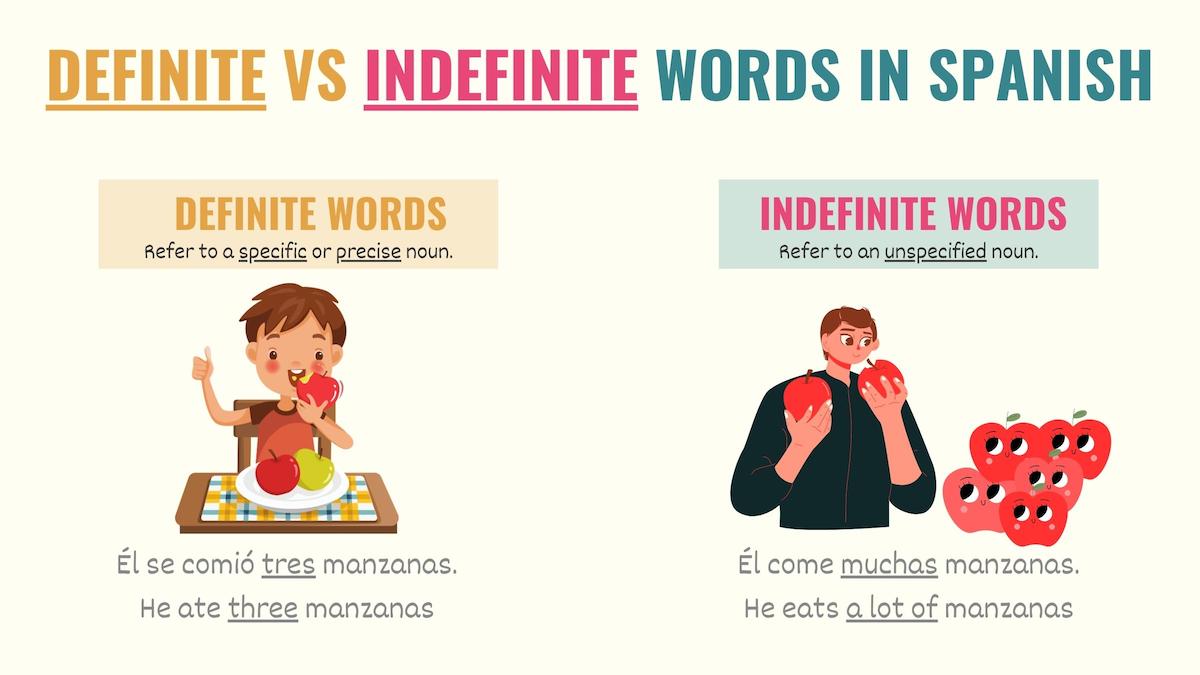
In Spanish, indefinite words are terms that modify, describe, or replace nouns without specifying their exact amount or identity. Simply put, indefinites provide approximate information about a noun rather than identifying it with accuracy.
Check these sentences:
No tenemos mucho tiempo.
We don’t have a lot of time.
Todos tienen que leer este libro.
Everybody has to read this book.
Let’s take a look at these examples. Mucho doesn’t convey the precise amount of time you have, and todos doesn’t refer to someone in particular. As shown in these sentences, Spanish indefinites can be adjectives or pronouns depending on whether they describe or replace the noun.
Take Note: Spanish indefinite articles (un, una) are also a type of indefinite word. However, articles have different applications than adjectives and pronouns. So, you should take the time to learn what definite and indefinite articles in Spanish are and how they work.
Indefinite adjectives in Spanish
Indefinite adjectives in Spanish (also called indefinite determiners or adjectives of quantity) always come before the noun. This type of adjective usually refers to amounts in a non-precise way. Be aware that an indefinite adjective must mark the noun’s gender and number.
Here is a list of Spanish indefinite adjectives:
- Ambos: Both
- Algún: Some
- Bastante: Enough / A lot of
- Cada: Each
- Cierto: Certain
- Cualquier: Any
- Demasiado: A lot of / Many / Much
- Mucho: A lot of / Many / Much
- Ningún: Not a single / No / Any
- Poco: Few / Little
- Tal: Such
- Tanto: Much
- Todo: Every / All / Everybody
- Varios: Several
Here are some sentences:
[Indefinite adjective] + [noun]
Hay poca leche.
There’s a little milk.
Cada año vamos a la playa.
Each year we go to the beach.
Todas las camisas están sucias.
All the shirts are dirty.
Alicia tiene muchas bolsas.
Alicia has many bags.
No tenemos ningún problema.
We don’t have any issues.
Take Note: Numbers in Spanish are the opposite of indefinite adjectives since they refer to an exact amount. For example, mis dos camisas están sucias.
Indefinite pronouns Spanish list
An indefinite pronoun in Spanish replaces nouns without referring to their exact identity.
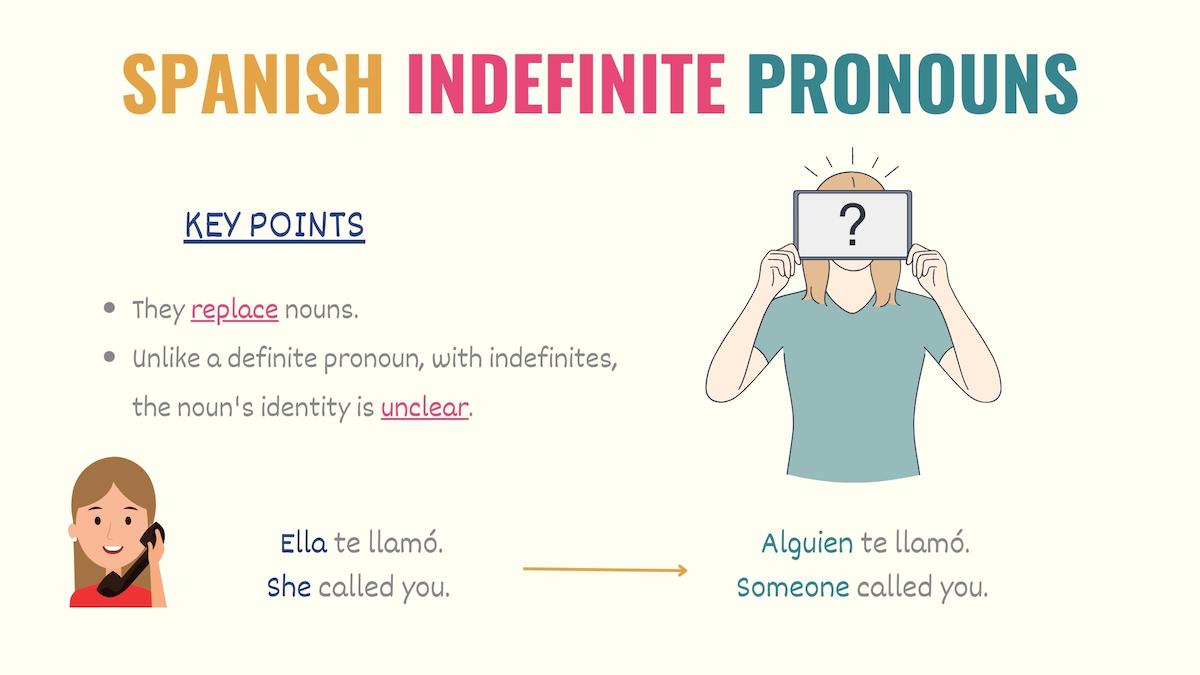
For the most part, these pronouns have gender and plural forms. Below is a list of the most common Spanish indefinite pronouns:
- Algo*: Something
- Alguien*: Someone / Anyone
- Bastante: Enough / A lot of
- Cualquiera*: Anyone / Any
- Demasiado: A lot of / Many / Much
- Mucho: A lot of / Many / Much
- Nada*: Nothing / Anything
- Nadie*: No one / Nobody
- Ninguno: No one / Nobody / None
- Otro: Other / Another
- Poco: Few / Little
- Tanto: Much
- Todo: Every / All / Everybody
- Varios: Several
* These are invariable words, meaning that they only have a single form and do not change to mark gender or number.
Check these sentences:
Alguien vino a buscarte.
Someone came looking for you.
Hay algo debajo de la mesa.
There’s something below the table.
Cualquiera puede hacer eso.
Anyone can do that.
Ya no quedan muchos, ¡apúrate!
There aren’t many left, hurry!
¿Y las chicas? ¿Ninguna quiso venir?
And the girls? Did no one want to come?


Spanish Indefinite Words Related Resources
Spanish indefinite words are essential for your communication. As you learned, some of those terms have gender and number. As a result, you should check the rules for plural words and how the Spanish gender works.
In Spanish grammar, indefinite adjectives and pronouns are considered determiners. These types of words provide different information about nouns. So, you should also get familiar with other determiners.
Finally, check other Spanish pronouns and adjectives to help you sound more natural and express your ideas more clearly.
Download the Indefinite Words PDF
Indefinite adjectives and pronouns are crucial for effective conversations. To simplify this vocabulary, I’ve created a free PDF with the highlights and words from this guide you can download.