The plural forms are crucial to use nouns correctly. So, in this guide, you’ll learn how to change a noun from singular to plural in Spanish. Here is a quick summary of what we’ll cover:
- Endings for Plural Forms
- Plural Adjectives, Verbs & Pronouns (Agreement)
- Words that Are Always Plural
- Key Points
- Downloadable PDF
Take Note: The pluralization rules you’re about to learn are applied to all Spanish nouns.
Forming Plurals: Rules for Plural Nouns in Spanish
Spanish plural nouns are used to communicate that we’re talking about two or more people, things, places, or ideas.
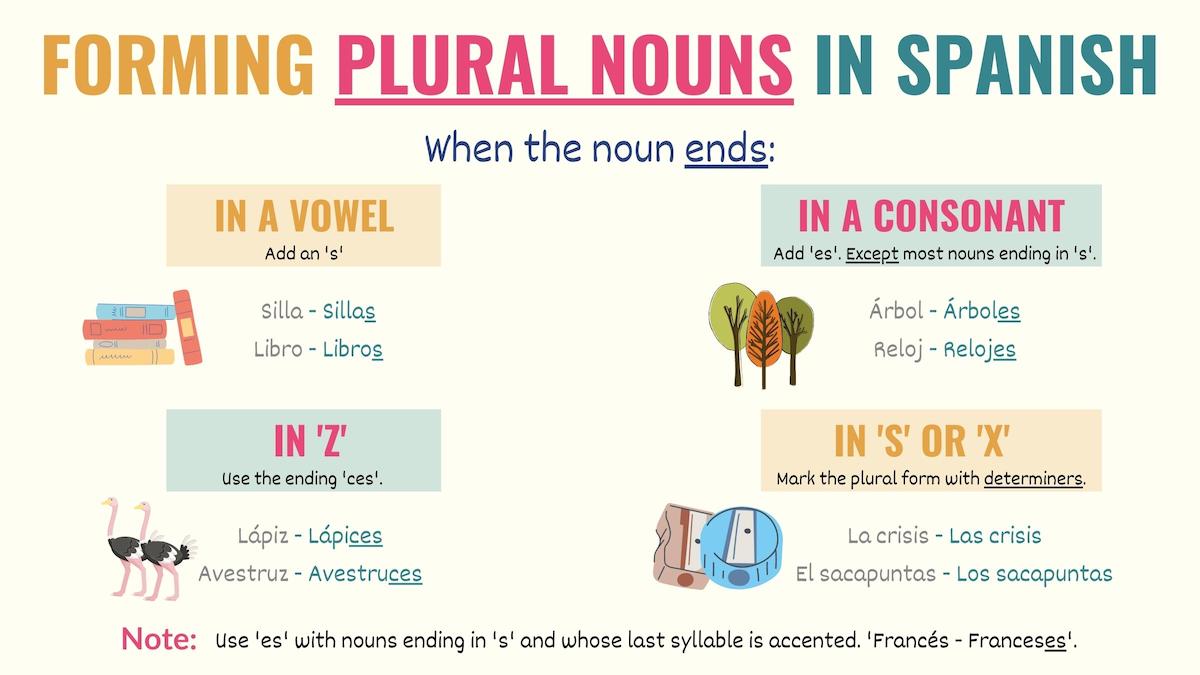
The rules to form Spanish plurals are:
Spanish nouns ending in a vowel
With nouns that end in a vowel, add an ‘s’ to change it to a plural noun. For example:
| Singular word | Plural word |
|---|---|
| Buró (bedside table) | Burós (bedside tables) |
| Café (coffee/brown) | Cafés (coffees/brown) |
| Computadora (computer) | Computadoras (computers) |
| Cuaderno (notebook) | Cuadernos (notebooks) |
| Gato (cat) | Gatos (cats) |
| Hombre (man) | Hombres (men) |
| Papá (dad) | Papás (parents) |
| Silla (chair) | Sillas (chairs) |
Take Note: Nouns ending in ‘í’ or ‘ú’ can use endings ‘s’ or ‘es’. For example, bisturí can have two plural forms – bisturís or bisturíes.


Nouns ending in a consonant
The plural form for nouns that end with a consonant is formed with the ending ‘-es’. This rule doesn’t apply to most singular nouns ending in ‘s’. Check these examples:
| Singular word | Plural word |
|---|---|
| Animal (animal) | Animales (animals) |
| Árbol (tree) | Árboles (trees) |
| Autobús (bus) | Autobuses (buses) |
| Canción (song) | Canciones (songs) |
| Color (color) | Colores (colors) |
| Joven (young man) | Jóvenes (young men) |
| Mes (month) | Meses (months) |
| Metal (metal) | Metales (metals) |
| País (country) | Países (countries) |
| Papel (paper) | Papeles (papers) |
| Profesor (professor) | Profesores (professors) |
| Reloj (clock/watch) | Relojes (clocks/watches) |
Take Note: When forming Spanish plural words, we change the stressed syllable. According to accent rules, this change sometimes prevents you from using an accent mark. For example, nouns ending with –ión always drop the accent mark in their plural form.
Nouns ending in ‘z’
Nouns that end with a ‘z’ must use the plural ending ‘-ces’. You can see some examples in the table below:
| Singular word | Plural word |
|---|---|
| Actriz (actress) | Actrices (actresses) |
| Avestruz (ostrich) | Avestruces (ostriches) |
| Cruz (cross) | Cruces (crosses) |
| Juez (judge) | Jueces (judges) |
| Lápiz (pencils) | Lápices (pencils) |
| Luz (light) | Luces (lights) |
| Nariz (nose) | Narices (noses) |
| Pez (fish) | Peces (fish) |
Take Note: When it comes to plural nouns, we replace a ‘z’ with a ‘c’ for spelling purposes. You will also see this spelling change in verb conjugations to keep the pronunciation consistent.
Nouns that end with ‘s’ or ‘x’
For the most part, Spanish nouns that end with an ‘s’ or ‘x’ are invariable (constant), meaning you cannot add a plural ending to them. With these words, the plural form is marked through the definite article or other Spanish determiners you use:
| Singular word | Plural word |
|---|---|
| Crisis (crisis) | Las crisis (crisis) |
| Sacapuntas (pencil sharpener) | Los sacapuntas (pencil sharpeners) |
| Tórax (thorax) | Los tórax (thoraxes) |
| Viernes (Friday) | Los viernes (Fridays) |
Take Note: The Spanish days of the week is a set of nouns that follow this rule.
However, you must use the plural ending ‘-es’ if a noun ends in ‘-s’ and their last syllable is accented:
| Singular word | Plural word |
|---|---|
| Compás (compass) | Compases (compasses) |
| Francés (french) | Franceses (french) |
| Interés (interest) | Intereses (interests) |
| Revés (setback) | Reveses (setbacks) |
Spanish Grammar: Noun, Verb, Pronoun & Adjective Plural Agreement
A basic rule in Spanish grammar is agreement. Simply put, ‘agreement’ means that all of the elements in your sentence match in number (singular or plural) and, in some cases, gender.
Check these singular and plural sentences:
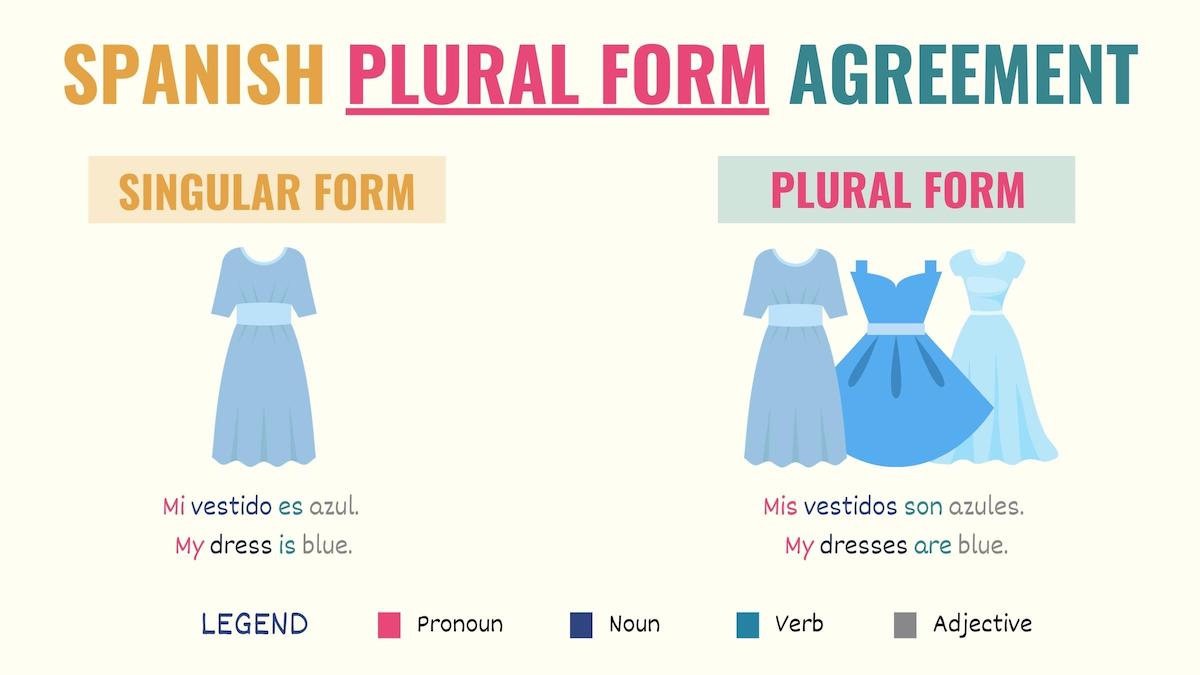
As you can see in the graphic above, plural adjectives in Spanish are formed by following the same pluralization rules as nouns. For example: azul becomes azules.
Pronouns must take the characteristics of the noun they replace. So, when working with plural nouns, you must ensure that you use the appropriate plural pronoun. Finally, you must use a third-person plural verb conjugation if the verb describes the noun or refers to the action performed by it.
For example:
| Singular conjugation | Plural conjugation |
|---|---|
| Mi vestido es azul. My dress is blue. | Mis vestidos son azules. My dresses are blue. |
Take Note: Unlike English, many Spanish parts of speech must use a plural form. Nouns, pronouns, adjectives, and verbs are words that are pluralized if needed.
Bonus: Words that Are Always Plural in Spanish
In Spanish, there are some words that are always used in plural form. Here are some examples of these nouns:
- Añicos (formal) – Pieces
- Cosquillas – Tickle
- Gafas – Glasses
- Lentes – Glasses
- Tijeras – Scissors
- Trabalenguas – Tongue twister
- Vacaciones – Vacation / Holiday
- Víveres – Provisions / Supplies
Take Note: Remember that there are some nouns in Spanish that end with an ‘s’ and have a singular and plural form, which you will mark with a determiner word (el análisis vs los análisis).


Key Points
Knowing the rules for plural words is an essential part of basic grammar. Here are some points you should keep in mind:
- A plural noun is used when talking about more than one person, thing, place, or idea.
- The plural endings in Spanish are:
- ‘s’ for nouns ending in vowels. Casa vs Casas.
- ‘es’ for nouns ending in consonants except ‘s’. Reloj vs relojes.
- Only use this ending with words that end with ‘s’ if their last syllable has an accent mark.
- ‘ces’ for nouns ending in ‘z’. Lápiz vs lápices.
- If a noun ends with ‘s’, you must mark the singular and plural form with a determiner word.
- When changing a noun from singular to plural, some accent marks may be dropped.
- The plural form is applied to nouns, adjectives, pronouns, and verb conjugation as needed.
Download PDF
Enjoyed the guide? I’ve made a PDF you can download with the highlights for you to review the main concepts of how to make words plural in Spanish along with the rules, key points, graphics and examples.