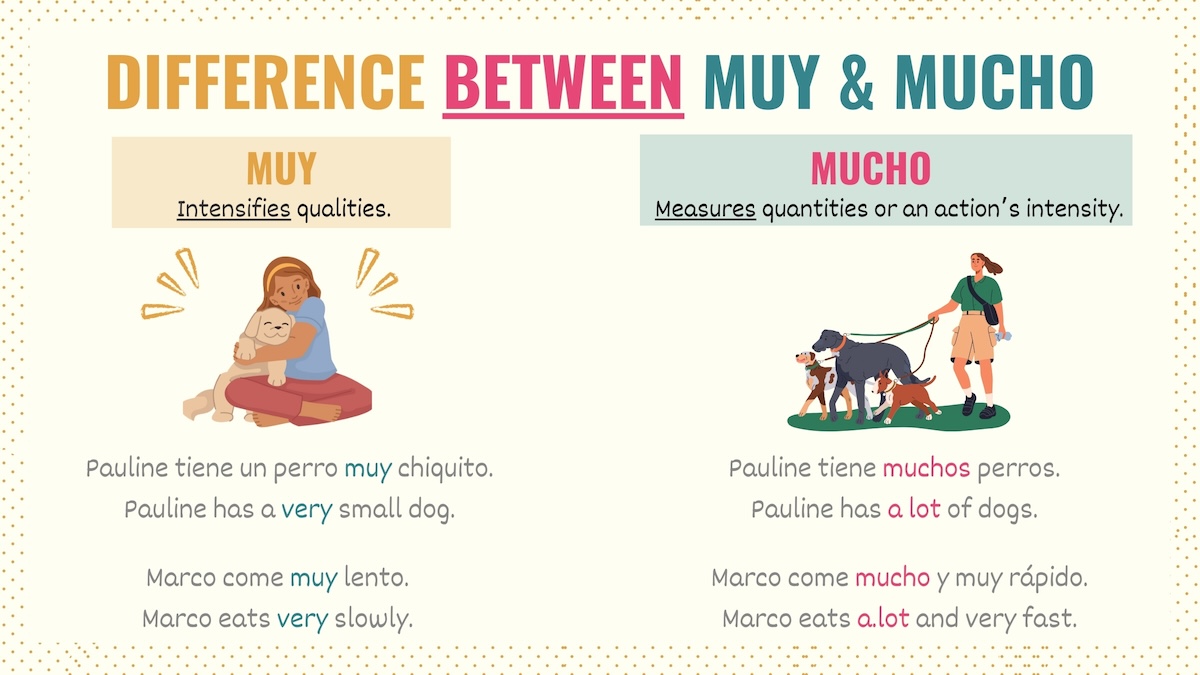
Muy means ‘very’. It intensifies the qualities described by an adjective or another adverb. Mucho is the equivalent of ‘a lot’ or ‘very much’, and it conveys the intensity or degree of an action. Unlike muy, mucho can also express the amount of something.
Key Points: Muy vs Mucho
Because they may share the same translation, muy vs mucho is a topic that confuses many students. Here are some key points to remember:
Muy:
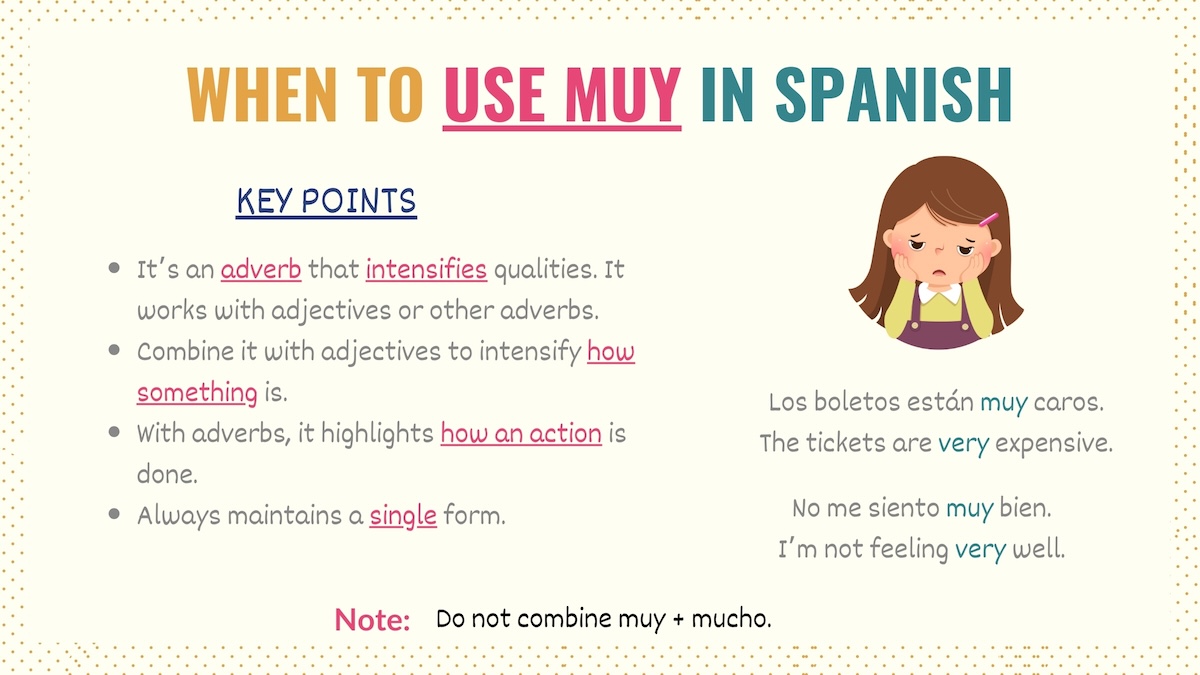
- It’s a Spanish adverb that intensifies the qualities described by an adjective or another adverb.
- How something is: Es un perro muy bonito.
- How an action is done: Sandy habla muy rápido.
- It’s placed before an adjective or adverb and doesn’t have plural or feminine forms.
- Muy means ‘very’ and cannot be combined with ‘mucho’.
Mucho:
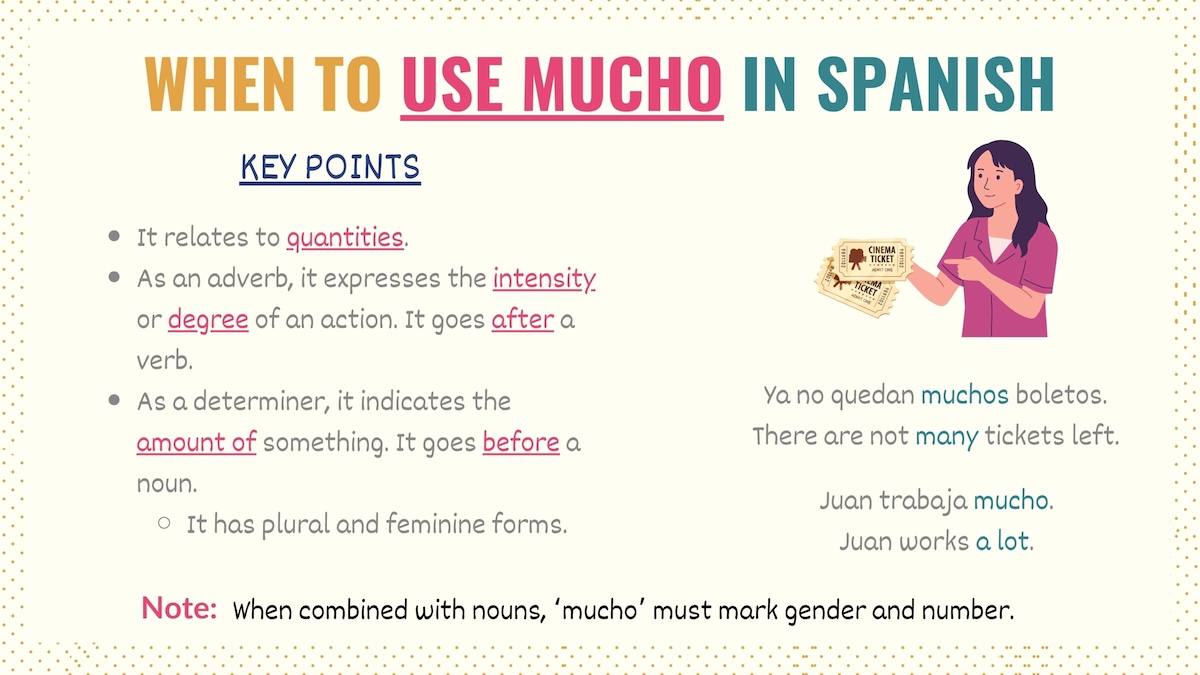
- It relates to quantities.
- As an adverb, mucho indicates the degree or intensity of an action (como mucho).
- In this context, it means ‘a lot’ or ‘much’ and maintains a single form.
- When combined with nouns, mucho acts as a determiner to express the quantity of something.
- As a determiner, it must agree with the noun’s gender and number (mucho, muchos, mucha, muchas). It means ‘much’, ‘many’, ‘a lot’ or ‘a lot of’.
In this article, you’ll learn when to use muy or mucho, and I’ll provide you with real-life examples to show you their applications.
Muy vs Mucho: What’s the Difference?
The key difference between mucho vs muy lies in their usage.
Watch the Spanish Immersion Lesson!
At Tell Me In Spanish, I record all my lessons in English and Spanish immersion. Watch the immersion lesson on the differences between muy and mucho in Spanish.
When to use muy
In Spanish, muy is an adverb that intensifies the qualities expressed by an adjective or another adverb. In other words, it highlights how something or someone is, or how an action is done.
Check these examples and see the characteristics that muy is emphasizing:
[Subject] + [verb conjugated] + muy + [adjective/adverb]
El internet está muy lento.
The internet is very slow.
Vanessa e Ivonne son muy altas.
Vanessa and Ivonne are very tall.
Mis hermanos comen muy rápido.
My brothers eat very fast.
Pierre habla español muy bien.
Pierre speaks Spanish very well.
Ten cuidado, la sopa está muy caliente.
Be careful, the soap is very hot.
Take Note: Muy is a Spanish adverb, and as such, it doesn’t work with nouns—only with adjectives or other adverbs. As a result, it maintains a single form and does not change based on gender or number.


When to use mucho in Spanish
Mucho is a word that relates to quantities. As an adverb, it expresses the degree or intensity of an action:
[Verb conjugated] + mucho
La quiero mucho.
I love her very much.
¿Esa cámara te costó mucho?
Did that camera cost you much?
¡Tu hermano come mucho y muy rápido!
Your brother eats a lot and very fast!
When working with nouns, mucho acts as a Spanish determiner, indicating the quantity of something. Because it’s providing information about nouns, in this context, mucho has feminine and plural forms.
[Verb conjugated] + [mucho*] + [noun]
No tengo mucho tiempo.
I don’t have much time.
Compré muchos paquetes de galletas.
I bought many packages of cookies.
Susana tiene muchas camisas rosas.
Susana has many pink shirts.
Hablar en público me da mucha vergüenza.
Speaking in public makes me very embarrassed.
Check the last example. Notice that in Spanish we use the word mucha because we’re measuring a feminine noun (vergüenza). However, in English, we use ‘very’ to emphasize an adjective (embarrassed).
This distinction is particularly common when using the verb dar to express emotions.
Take Note: In Spanish, using ‘muy mucho’ is incorrect because muy is used to intensify qualities, not quantities.To express very much, you can simply say ‘mucho’ or use the superlative form muchísimo.
Te amo muchísimo.
I love you very much.
To put these words into practice, you can take this muy vs mucho quiz. You can also download a copy of this lesson’s notes for further review. ¡Muy buena suerte 😏!
If you’re ready to test your knowledge, you should take this muy vs mucho quiz.