Dar is one of the most common verbs you’ll use in Spanish. Since this verb has many irregularities, in this guide, you’ll learn how to conjugate ‘dar’. On top of the conjugation charts (which you’ll find below), I’ve also included examples and some common uses of this verb.
- Dar Overview
- Indicative Tenses of Dar Conjugations
- Subjunctive Tenses of Dar Conjugations
- Imperative (Commands) of Dar Conjugations
- Uses & Examples
- Download Dar Conjugation Tables & Uses Cheat sheets
- Dar Conjugation Practice Quiz
Overview of Dar
| Verb Characteristic | Property |
|---|---|
| Verb Type | -AR |
| Irregular | Yes |
| Infinitive | Dar |
| Gerund (Present Participle) Form | Dando |
| Past Participle Form | Dado |
| Synonyms | Entregar, proporcionar, provocar, regalar |
Irregularities:
- Present: doy (only ‘yo’), dais (vosotros)
- Preterite: change of endings for all subjects (see preterite conjugations)
- Present Subjunctive: dé (yo, él, ella, usted), deis (vosotros)
- Imperfect Subjunctive: die- (all subject pronouns)
- Affirmative Imperative: dé (usted)
- Negative Imperative: dé (usted), deis (vosotros)
Take Note: Dar is one of Spanish’s most common transitive verbs. Since a direct or indirect object must always follow it, dar usually works with direct and indirect object pronouns.
Indicative Conjugations of Dar
Present tense
In the present tense, the yo and vosotros forms of ‘dar’ are irregular. In this tense, dar is used to talk about things you give to people or emotions that something provokes in you. Las arañas me dan miedo.
| Person | Conjugation | Translation |
|---|---|---|
| Yo | Doy | I give |
| Tú | Das | You give |
| Él / Ella Usted | Da | He/She gives You (formal) give |
| Nosotros | Damos | We give |
| Vosotros | Dais | You give |
| Ellos / Ellas Ustedes | Dan | They give You (plural) give |
Take Note: Notice that -oy is the same ending you use to conjugate the verb ser in the first person singular (yo).
Preterite tense
All the preterite forms of dar are irregular. The Spanish preterite refers to the objects you gave someone or the feelings that something provoked in you at a specific moment in the past. For example: mi mamá me dio este anillo.
| Person | Conjugation | Translation |
|---|---|---|
| Yo | Di | I gave |
| Tú | Diste | You gave |
| Él / Ella Usted | Dio | He/She gave You (formal) gave |
| Nosotros | Dimos | We gave |
| Vosotros | Disteis | You gave |
| Ellos / Ellas Ustedes | Dieron | They gave You (plural) gave |
Imperfect tense
The imperfect tense is used to talk about objects people used to give you or to describe the feelings something caused you repeatedly in the past. For example, mi abuela nos daba muchos dulces. The imperfect conjugation of ‘dar’ is regular and can be translated as ‘used to give’ or ‘gave’.
| Person | Conjugation | Translation |
|---|---|---|
| Yo | Daba | I gave I used to give |
| Tú | Dabas | You gave You used to give |
| Él / Ella Usted | Daba | He/She gave He/She used to give You (formal) gave You used to give |
| Nosotros | Dábamos | We gave We used to give |
| Vosotros | Dabais | You gave You used to give |
| Ellos / Ellas Ustedes | Daban | They gave They used to give You (formal) gave You (plural) used to give |
Near future
The near future in Spanish is used to talk about things you’ll give someone in the immediate future. This tense is formed with ir (present) + a + dar and can be translated as “going to give”.
| Person | Conjugation | Translation |
|---|---|---|
| Yo | Voy a dar | I’m going to give |
| Tú | Vas a dar | You’re going to give |
| Él / Ella Usted | Va a dar | He/She is going to give You (formal) are going to give |
| Nosotros | Vamos a dar | We’re going to give |
| Vosotros | Vais a dar | You’re going to give |
| Ellos / Ellas Ustedes | Van a dar | They’re going to give You (plural) are going to give |
Future simple tense
The simple future allows you to express that you will give something to someone at some point in the future. For example, te daré más dinero en unos días.
| Person | Conjugation | Translation |
|---|---|---|
| Yo | Daré | I will give |
| Tú | Darás | You will give |
| Él / Ella Usted | Dará | He / She will give You (formal) will give |
| Nosotros | Daremos | We will give |
| Vosotros | Daréis | You will give |
| Ellos / Ellas Ustedes | Darán | They will give You (plural) will give |
Conditional tense
The conditional form of ‘dar’ conveys that someone would give something to another or that a situation would provoke a feeling in a person if certain circumstances are met. For example: ver esta película me daría mucho miedo. This tense is conjugated by adding the conditional endings to ‘dar’.
| Person | Conjugation | Translation |
|---|---|---|
| Yo | Daría | I would give |
| Tú | Darías | You would give |
| Él / Ella Usted | Daría | He/She would give You would give |
| Nosotros | Daríamos | We would give |
| Vosotros | Daríais | You would give |
| Ellos / Ellas Ustedes | Darían | They would give You (plural) would give |
Present perfect tense
‘Dar’ in the present perfect tense expresses you would give something to someone in a moment close to the present. The formula to conjugate the present perfect tense in Spanish is haber (present tense) + dado.
| Person | Conjugation | Translation |
|---|---|---|
| Yo | He dado | I have given |
| Tú | Has dado | You have given |
| Él / Ella Usted | Ha dado | He/She has given You have given |
| Nosotros | Hemos dado | We have given |
| Vosotros | Habéis dado | You have given |
| Ellos / Ellas Ustedes | Han dado | They have given You (plural) have given |
Past perfect
To conjugate to the past perfect tense, you need to use the imperfect form of haber + dado, which is the past participle form of ‘dar’. The past perfect of ‘dar’ expresses that you gave something to someone before some other reference point in the past. Pensé que ya te había dado tu celular.
| Person | Conjugation | Translation |
|---|---|---|
| Yo | Había dado | I had given |
| Tú | Habías dado | You had given |
| Él / Ella Usted | Había dado | He/She had given You have given |
| Nosotros | Habíamos dado | We had given |
| Vosotros | Habíais dado | You had given |
| Ellos / Ellas Ustedes | Habían dado | They had given You (plural) had given |
Future perfect
The future perfect of ‘dar’ is built by conjugating haber to the future tense and adding dado (the past participle of ‘dar’). In this tense, ‘dar’ communicates you will give something to someone by or before a certain time in the future.
| Person | Conjugation | Translation |
|---|---|---|
| Yo | Habré dado | I will have given |
| Tú | Habrás dado | You will have given |
| Él / Ella Usted | Habrá dado | He/She will have given You will have given |
| Nosotros | Habremos dado | We will have given |
| Vosotros | Habréis dado | You will have given |
| Ellos / Ellas Ustedes | Habrán dado | They will have given You (plural) will have given |
Conditional perfect
‘Dar’ conjugated to the conditional perfect is used to talk about things you would have given or feelings you would have felt if a past condition was met. For example: si hubiera visto esa película, me habría dado mucho miedo.
| Person | Conjugation | Translation |
|---|---|---|
| Yo | Habría dado | I would have given |
| Tú | Habrías dado | You would have given |
| Él / Ella Usted | Habría dado | He/She would have given You would have given |
| Nosotros | Habríamos dado | We would have given |
| Vosotros | Habríais dado | You would have given |
| Ellos / Ellas Ustedes | Habrían dado | They would have given You (plural) would have given |
Progressive tenses
The progressive tenses in Spanish refer to actions that are in progress at the moment of speaking. So, dar expresses that someone is giving something to another person at the moment of speaking. The structure to form these tenses is estar (conjugated) + gerund form of dar (dando).
| Progressive Tense | Formula | Translation Example |
|---|---|---|
| Present | Estar (present) + dando | I am giving |
| Preterite | Estar (preterite) + dando | You were giving |
| Imperfect | Estar (imperfect) + dando | He was giving |
| Future | Estar (future) + dando | We will be giving |
| Conditional | Estar (conditional) + dando | They would be giving You (plural) would be giving |
Dar Subjunctive Conjugations
Present subjunctive conjugation
In the present subjunctive, vosotros, yo, and él/ella have their own irregular conjugations, respectively. The present subjunctive of ‘dar’ is used to talk about the expectation or possibility of someone giving you something. For example: espero que tus amigos te den muchos regalos.
| Person | Conjugation | Translation |
|---|---|---|
| Yo | Dé | I give |
| Tú | Des | You give |
| Él / Ella Usted | Dé | He/She gives You give |
| Nosotros | Demos | We give |
| Vosotros | Deis | You give |
| Ellos / Ellas Ustedes | Den | They give You (plural) give |
Take Note: Notice that the first and third-person singular forms (‘yo’, ‘él’, ‘ella’, and ‘usted’) have an acute accent. This accent is used to distinguish between the preposition de and the present subjunctive form of dar.
Present perfect subjunctive
Haber in the present subjunctive + dado is the structure you should use to build the present perfect subjunctive form of ‘dar’. The present perfect subjunctive of ‘dar’ is used to talk about wishes and probabilities. For example, no creo que le hayan dado su reloj.
| Person | Conjugation | Translation |
|---|---|---|
| Yo | Haya dado | I have given |
| Tú | Hayas dado | You have given |
| Él / Ella Usted | Haya dado | He/She has given |
| Nosotros | Hayamos dado | We have given |
| Vosotros | Hayáis dado | You have given |
| Ellos / Ellas Ustedes | Hayan dado | They have given You (plural) have given |
Imperfect subjunctive
We use the imperfect subjunctive of ‘dar’ to talk about what would happen if we gave something to someone. ¿Qué harías si te dieran dos millones de pesos?
The imperfect subjunctive has two conjugation models depending on which type of Spanish you’re using:
Latin American Spanish version
| Person | Conjugation | Translation |
|---|---|---|
| Yo | Diera | I gave |
| Tú | Dieras | You gave |
| Él / Ella Usted | Diera | He/She gave |
| Nosotros | Diéramos | We gave |
| Ellos / Ellas Ustedes | Dieran | They gave You (plural) gave |
Note: The table above doesn’t include the conjugation for vosotros because this pronoun is not used in Latin American Spanish.
Castilian Spanish version
| Person | Conjugation | Translation |
|---|---|---|
| Yo | Diese | I gave |
| Tú | Dieses | You gave |
| Él / Ella Usted | Diese | He/She gave You gave |
| Nosotros | Diésemos | We gave |
| Vosotros | Dieseis | You gave |
| Ellos / Ellas Ustedes | Diesen | They gave You (plural) gave |
Past perfect subjunctive
The past perfect subjunctive of ‘dar’ can be used to talk about what would have happened if you had given something to someone. These hypothetical situations can no longer happen because their time has passed. For example si le hubiera dado las llaves…(If I had given him the keys).
| Person | Conjugation | Translation |
|---|---|---|
| Yo | Hubiera dado | I had given |
| Tú | Hubieras dado | You had given |
| Él / Ella Usted | Hubiera dado | He/She had given |
| Nosotros | Hubiéramos dado | We had given You had given |
| Vosotros | Hubierais dado | You had given |
| Ellos / Ellas Ustedes | Hubieran dado | They had given You (plural) had given |


Dar Imperative Conjugations
The Spanish imperative mood is used to tell people what to do (affirmative commands) or what not to do (negative commands).
Affirmative commands
The affirmative imperative conjugation of dar is only irregular for the ‘usted’ form. The affirmative commands of dar command people to give something to someone. For instance: dame eso.
| Person | Conjugation | Translation |
|---|---|---|
| Tú | Da | Give |
| Usted | Dé | Give |
| Vosotros | Dad | Give |
| Ustedes | Den | Give |
Negative commands
Since the Spanish negative imperative is based on the present subjunctive, dar is irregular when conjugating ‘usted’, ‘ustedes’, and ‘vosotros’. Negative commands allow you to order someone to not give something to another. For example: no le des dulces al bebé.
| Person | Conjugation | Translation |
|---|---|---|
| Tú | No des | Don’t give |
| Usted | No dé | Don’t give |
| Vosotros | No deis | Don’t give |
| Ustedes | No den | Don’t give |
How to Use ‘Dar’ in Spanish
Now that you know all the conjugations of dar, you should check the sections below to check the uses of ‘dar’ in Spanish.
As a synonym of ‘to give’, ‘hand’, or ‘donate’:
[Indirect object pronoun] + [dar conjugated]
¿Me das una papa, por favor?
Can you give me a chip, please?
La señora nos dio esta bolsa.
The lady gave us this bag.
To describe the emotions or feelings something causes you:
[Indirect object pronoun] + [dar conjugated] + [feeling]
De niña, me daban miedo las arañas.
When I was a kid, I used to be afraid of spiders.
Nos da gusto que te haya ido bien.
We are glad that everything went well.
Take Note: When referring to the feeling something causes you, dar follows the same conjugation pattern as ‘gustar’. Click here to learn more about verbs like ‘gustar’.
To talk about the subject a person teaches
Oigan, ¿quién les da español?
Hey, guys, who teaches you Spanish?
Ojalá Mr. Lee nos diera física.
I wish Mr. Lee taught us Physics.
Download Dar Conjugation Tables & Uses Cheat sheets
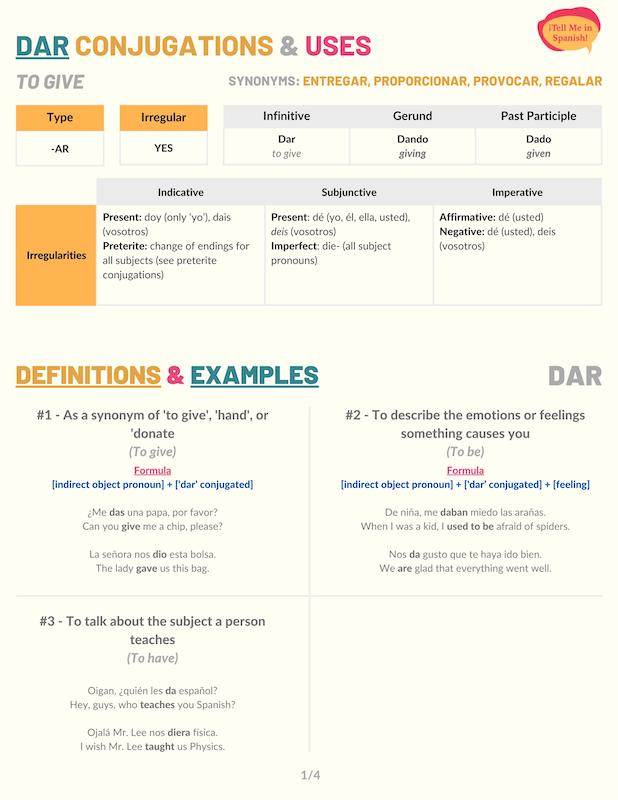
Download the PDF containing all of dar’s conjugation tables, verb characteristics, and uses so you can study it at your own pace!
Practice Quiz: Dar Conjugation
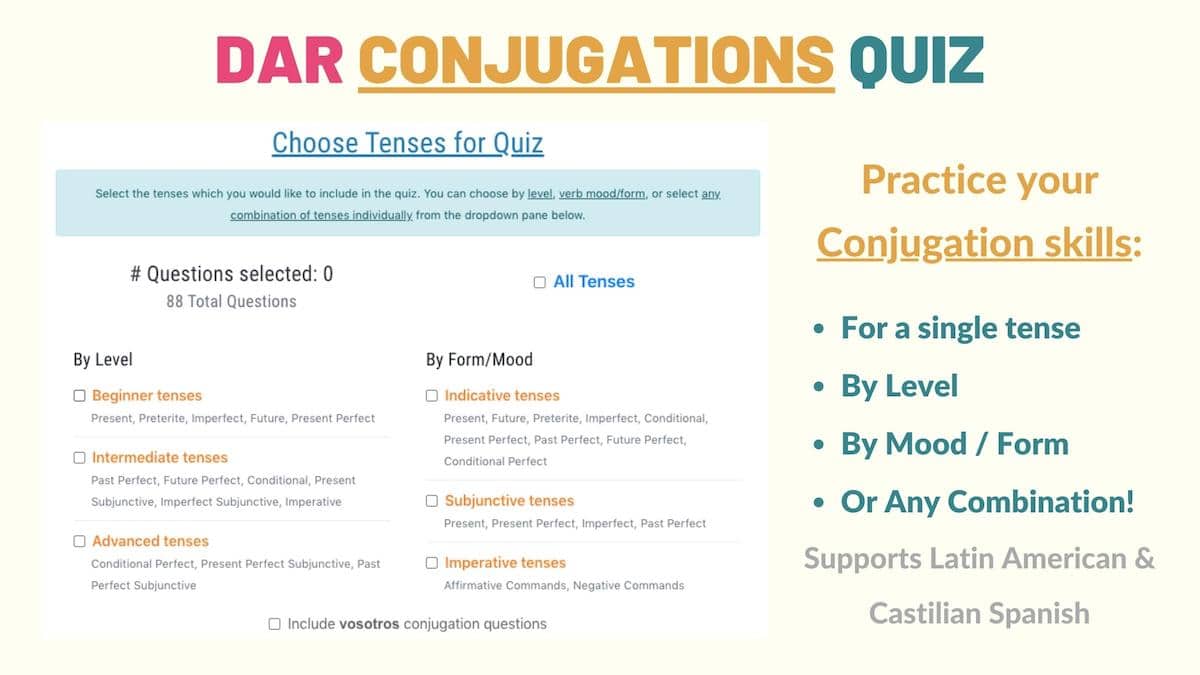
Take the dar conjugation quiz to practice your conjugation skills and see results for which tenses you’ve mastered and those that need work.