The letter y in Spanish has two different sounds depending on whether vowels follow it and its position within the word. Because of this, many learners wonder how to pronounce y in Spanish.
Since this letter is used to spell many essential words and to connect elements, in this guide, you’ll find all the key information to pronounce the Spanish y correctly.
I’ve included examples, recordings for you to check the pronunciation, and a vocabulary list to practice these sounds.
How to Pronounce Y in Spanish
The Spanish y, called ‘ye’ or ‘y griega’, has a vocalic and a consonant sound depending on its function or position within the word. When standing alone as a connecting word, ‘y’ sounds the same as the Spanish vowel i. In English, this sounds exactly like the letter ‘e’.
Ruby y Tabatha trabajan aquí.
Ruby and Tabatha work here.
Quiero peras y manzanas.
I want pears and apples.
This vocalic change is also applied when a word ends with the letter y in Spanish. For example:
- Ay: Ai
- Hoy: Hoi
- Muy: Mui
- Pony: Poni
- Soy: Soi
This pronunciation of ‘y’ is exactly like the sound of English words ending with the letter ‘y’ (like in very, tiny, etc).
The letter y in Spanish behaves like a consonant when followed by a vowel. In this case, you must pronounce y similar to the English sounds ‘ja’, ‘je’, ‘ji’, ‘jo’, or ‘ju’. Click on the recording to check the pronunciation of the syllables ya, ye, yi, yo and yu.
Here are some examples of words with ‘y’ and how they’re pronounced in Spanish:
| Spanish word | Sounds like |
|---|---|
| Yate (yacht) | Jaw |
| Yerno (son-in-law) | Jerk |
| Rayita (small strip) | Jig |
| Yo (I) | Jog |
| Yucatán | Jook |
Most dialects use this sound to pronounce y in Spanish. However, as you’re about to learn, there are a few places where the y is pronounced differently.
Take Note: In Spanish, when working as a connecting word, ‘y’ is replaced with ‘e’ when the following word starts with an ‘i’ sound. You can learn more about this spelling rule in my guide on y vs e.
Y sound variations
The Spanish letter y has a different and distinctive consonant sound in Argentina and Uruguay. In these countries, y sounds like ‘sh’ when followed by a vowel. Here are some examples:
- Ayudar: Ashudar
- Papaya: Papasha
- Yema: Shema
- Yo: Sho
Keep in mind that these countries use the same vocalic sound as other Spanish-speaking countries. Simply put, in Rioplatense Spanish, y is pronounced like ‘i’ when standing alone or used at the end of a word:
Compré unas flores y unos chocolates.
I bought some flowers and some chocolates.
Yo soy una persona muy paciente.
I’m a very patient person.
Take Note: The double l in Spanish (ll) is pronounced the same as we pronounce the consonant y.
Spanish Words that Start with Y
Here are some of the most common Spanish words that start with y that you may want to know. You can use these terms as a way to practice your pronunciation.
- Yerno: Son-in-law
- Yeso: Plaster cast
- Yo: I
- Yoga: Yoga
- Yogur: Yogurt
- Yoyo: Yo-yo
As you can see, there are not many basic words that start with this letter. However, other words contain ‘y’ and this also can be helpful for your vocabulary:
- Apoyo: Support
- Ayuda: Help
- Ayudar: To help
- Ensayo: Essay
- Hoy: Today
- Joya: Jewel
- Mayo: May
- Mayoría: Majority
- Muy: Very
- Payaso: Clown
- Playa: Beach
- Playera: Shirt
- Rey: King
- Subrayar: Highlight
- Suyo: Hers / His / Yours
- Tuyo: Yours


Key Points
As one of the twenty-seven letters of the Spanish alphabet and as a conjunction, the letter ‘y’ is key for essential vocabulary and effective communication. Here are the main points you should remember.
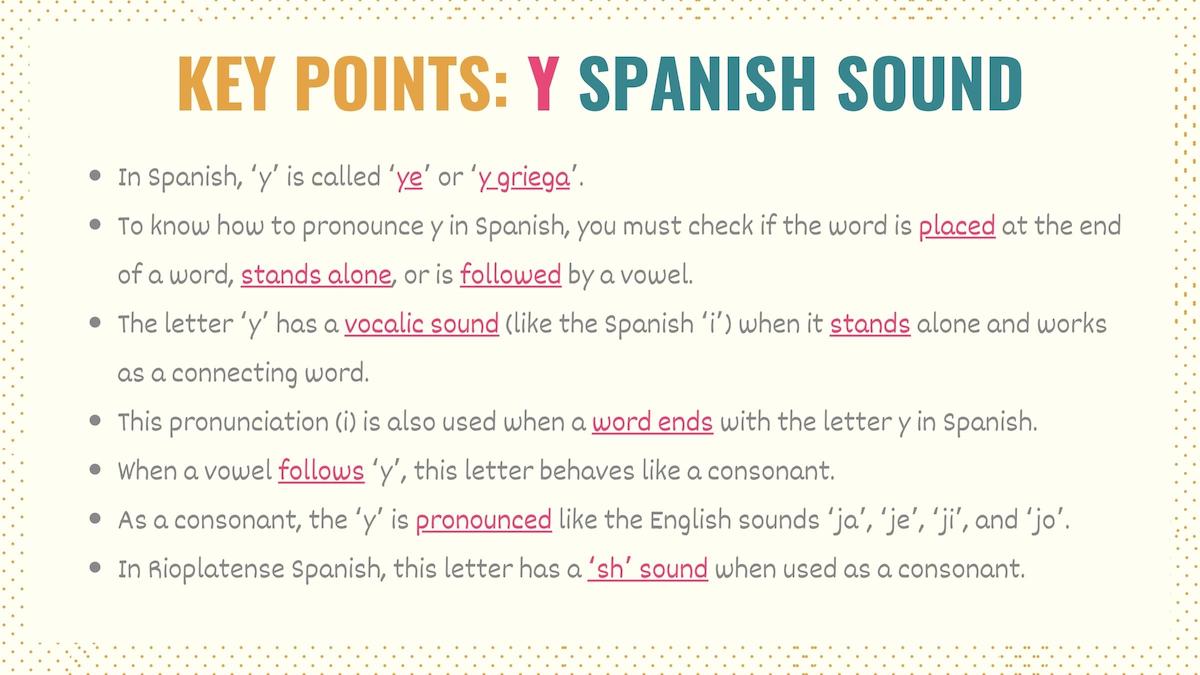
- In Spanish, ‘y’ is called ‘ye’ or ‘y griega’.
- To know how to pronounce y in Spanish, you must check if the word is placed at the end of a word, stands alone, or is followed by a vowel.
- The letter ‘y’ has a vocalic sound (like the Spanish ‘i’) when it stands alone and works as a connecting word.
- This pronunciation (i) is also used when a word ends with the letter y in Spanish.
- When a vowel follows ‘y’, this letter behaves like a consonant.
- As a consonant, the ‘y’ is pronounced like the English sounds ‘ja’, ‘je’, ‘ji’, and ‘jo’.
- In Rioplatense Spanish, this letter has a ‘sh’ sound when used as a consonant.
Spanish Pronunciation Additional Resources
Now that you’ve learned how to pronounce y in Spanish, here are some next steps you can take to improve your Spanish pronunciation. First, study the alphabet and its pronunciation. Second, check how to pronounce the ll in Spanish since this digraph behaves very similarly to ‘y’.
Because in many cases, y in Spanish sounds like the letter ‘j’ in English, you might be wondering how to pronounce j in Spanish.
Finally, take the time to practice the sounds you learn with common vocabulary. That way, you get to practice your pronunciation while acquiring new words.
Download the Y in Spanish Pronunciation PDF
Y in Spanish is one of the letters that can really trip up Spanish for beginners. You can download a free copy of the PDF for this guide with all the graphics and key points. Revisit them anytime you need a refresher on how to pronounce y.