
Ay is an interjection and expresses different emotions, such as surprise, frustration, or pain. On the other hand, ahí (there) is an adverb that conveys location as in ‘está ahí’. Finally, hay expresses existence or impersonal obligation, and it means ‘there is’ or ‘there are’.

Ay, Ahí, Hay: Key Points
- Ay, ahí, and hay are different words with distinct uses and pronunciation.
- Ahí in Spanish is an adverb that indicates that someone or something’s located relatively close to the speaker. It means ‘there’ or ‘over there’.
- Allí also means ‘there’ or ‘over there’, but expresses a bigger distance from the speaker and listener.
- Hay is an impersonal form of the verb haber. It expresses existence and it means ‘there is’ or ‘there are’.
- Hay que + infinitive expresses obligation.
- As in interjection, ay can stand on its own since it only expresses emotions or reactions towards something.
When to Use Ahí in Spanish
Ahí is an adverb of place in Spanish. As such, it indicates that a person or object is located in a place close to the person we’re speaking to. In this context, ahí means ‘there’ or ‘over there’.
Tus llaves están ahí en la mesa.
Your keys are there on the table.
Si quieres, nos vemos ahí.
If you want, we can meet there.
¿Ese pastel de ahí es tuyo?
Is that cake over there yours?
¿Viven por el parque? Yo también vivo por ahí.
Do you guys live near the park? I also live around there.
On top of expressing location, in Spanish, ahí can also be used as a time expression for the past, being close in meaning to ‘then’, ‘in that moment’, or ‘at that point’.
Fue ahí cuando Arturo se mudó con Claudia.
It was then when Arturo moved in with Claudia.
¿Ahí ya te habías casado o todavía no?
Had you already gotten married by then or not yet?
Take Note: When pronouncing ahí, the stress of the pronunciation falls into the letter i. In other words, this is the vowel that must be pronounced more emphatically.
Ahí or Allí
Ahí and allí are both adverbs of place but they have some nuances in meaning. Allí also indicates where things or people are located, but it conveys that their location is far from the speaker and listener.
La chava que está allí es Lorena.
The girl that is over there is Lorena.
¿Le das las flores? Sí, esas de allí.
Can you give her the flowers? Yes, those ones over there.
El concierto es en el teatro. ¿Sabes cómo llegar allí?
The concert is in the theater. Do you know how to get there?
Even though the translation doesn’t reflect it, in Spanish, ahí conveys less distance than allí and it also focuses on the speaker’s perspective.

Take Note: Because they convey spatial distance, adverbs such as ahí and allí are often paired with Spanish demonstratives to provide additional information.
When & How to Use Hay
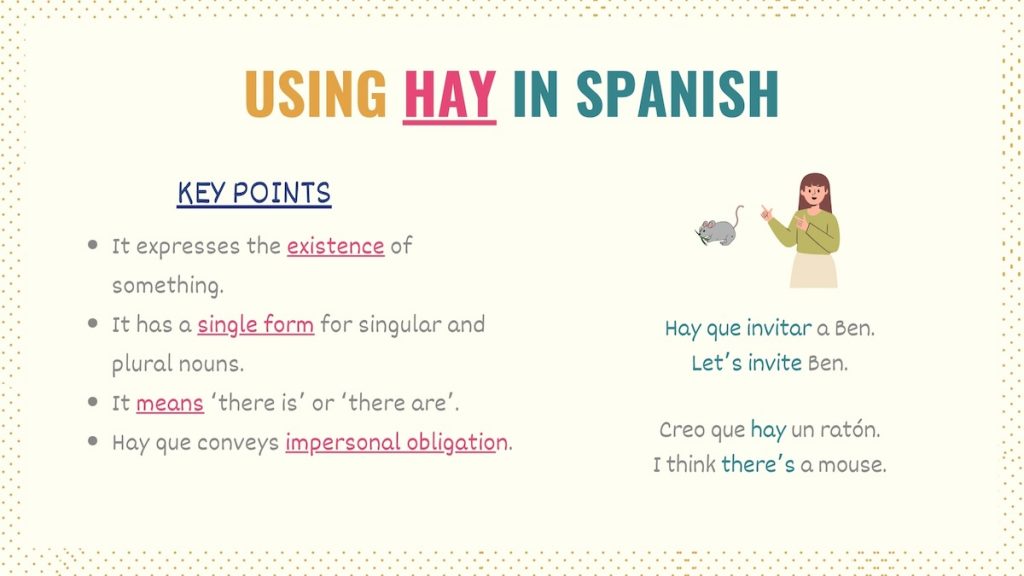
Hay in Spanish is the impersonal form of haber, meaning that it only has this conjugation for plural and singular nouns. Hay expresses the existence or presence of something in a certain place.
Hay + [indefinite determiner] + [noun]
Creo que ahí hay un ratón.
I think there is a mouse there.
No sé cuántas galletas hay.
I don’t know how many cookies there are.
¿Por qué hay tanta gente en la calle?
Why are there so many people on the street?
Unlike ay and ahí that don’t change, hay can be conjugated in all Spanish tenses to convey existence over time.
In Spanish, hay is also used to express impersonal obligation. To do so, you must use the structure hay que + infinitive.
Hay que + [infinitive verb]
Hay que invitar a Ben.
Let’s invite Ben.
¿Ya no hay leche? Hay que comprar más.
There is no more milk? We need to buy more.
Si no hay galletas, hay que preparar más.
If there are no more cookies, we need to make more.
Take Note: Impersonal obligation means that you’re not directing the duty to someone in particular, but you’re rather speaking in general. To express obligation for someone specific, you must use the verb tener. This is one of the main differences between haber and tener.


Using Ay in Spanish
As a Spanish exclamatory word, ay is used to react or respond to a statement by conveying emotions such as surprise, frustration, happiness, etc. Depending on the context, ay is close in meaning to ‘ouch’, ‘oh’, ‘oh my’, ‘damn’, etc.
¡Ay! Se me olvidó la cartera.
Damn! I forgot my wallet.
¡Ay, ándale! Acompáñame al dentista.
Oh, c’mon! Take me to the dentist.
¡Ay! Creo que hay un ratón ahí, abajo de la mesa.
Oh! I think there’s a mouse there, under the table.
Take Note: Ay is pronounced exactly the same as hay. A key differentiator between these words is that ay can stand on its own and make sense, whereas hay needs to be followed by nouns in order to make sense.