Asistir is a regular -IR verb that can help you practice this type of conjugation. So, in this guide, we’ll go over how to conjugate asistir and the most common applications of this verb. Here is a quick overview of what you’ll learn:
- Asistir Overview
- Indicative Tenses of Asistir Conjugations
- Subjunctive Tenses of Asistir Conjugations
- Imperative (Commands) of Asistir Conjugations
- Uses & Examples
- Download Asistir Conjugation Tables & Uses Cheat sheets
- Asistir Conjugation Practice Quiz
Since ‘asistir’ has multiple meanings in Spanish, the conjugation tables below will only show translations for one of its meanings for brevity.
Overview of Asistir
| Verb Characteristic | Property |
|---|---|
| Verb Type | -IR |
| Irregular | No |
| Infinitive | Asistir |
| Gerund (Present Participle) Form | Asistiendo |
| Past Participle Form | Asistido |
| Synonyms | Ayudar, Ir, Acudir |
Indicative Conjugations of Asistir
Present tense
The present tense conjugations of ‘asistir’ are regular. In this tense, ‘asistir’ communicates that someone helps people or attends a certain event or place. For example, Tania asiste a esta escuela.
| Person | Conjugation | Translation |
|---|---|---|
| Yo | Asisto | I attend |
| Tú | Asistes | You attend |
| Él / Ella Usted | Asiste | He/She attends You (formal) attend |
| Nosotros | Asistimos | We attend |
| Vosotros | Asistís | You attend |
| Ellos / Ellas Ustedes | Asisten | They attend You (plural) attend |
Preterite tense
The past preterite tense of asistir communicates that someone attended an event or helped another person at a specific moment in the past. ¿Cuántas personas asistieron a esa función?
| Person | Conjugation | Translation |
|---|---|---|
| Yo | Asistí | I attended |
| Tú | Asististe | You attended |
| Él / Ella Usted | Asistió | He/She attended You (formal) attended |
| Nosotros | Asistimos | We attended |
| Vosotros | Asististeis | You attended |
| Ellos / Ellas Ustedes | Asistieron | They attended You (plural) attended |
Imperfect tense
Use the imperfect tense’s conjugations of ‘asistir’ to talk about the places someone used to attend or help someone provided repeatedly in the past. El profesor nunca asistía a esas conferencias.
| Person | Conjugation | Translation |
|---|---|---|
| Yo | Asistía | I attended I used to attend |
| Tú | Asistías | You attended You used to attend |
| Él / Ella Usted | Asistía | He/She attended He/She used to attend You (formal) attended You (formal) used to attend |
| Nosotros | Asistíamos | We attended We used to attend |
| Vosotros | Asistíais | You attended You used to attend |
| Ellos / Ellas Ustedes | Asistían | They attended They used to attend You (plural) attended You (plural) used to attend |
Near future
The Spanish near future allows you to talk about places you’ll attend or people you’re going to help at some point in the immediate future. For instance: Julian va a asistir a ese evento. This tense is formed with ir (present tense) + a + asistir and can be translated as “going to attend”.
| Person | Conjugation | Translation |
|---|---|---|
| Yo | Voy a asistir | I’m going to attend |
| Tú | Vas a asistir | You’re going to attend |
| Él / Ella Usted | Va a asistir | He/She is going to attend You (formal) are going to attend |
| Nosotros | Vamos a asistir | We’re going to attend |
| Vosotros | Vais a asistir | You’re going to attend |
| Ellos / Ellas Ustedes | Van a asistir | They’re going to attend You (plural) are going to attend |
Future simple tense
We use asistir in the future tense to communicate that someone will attend a place or will help a person at some point in the future. Luke asistará al doctor Smith.
| Person | Conjugation | Translation |
|---|---|---|
| Yo | Asistiré | I will attend |
| Tú | Asistirás | You will attend |
| Él / Ella Usted | Asistirá | He/She will attend You (formal) will attend |
| Nosotros | Asistiremos | We will attend |
| Vosotros | Asistiréis | You (formal) will attend |
| Ellos / Ellas Ustedes | Asistirán | They will attend You (plural) will attend |
Conditional tense
The conditional conjugations of asistir express that someone would attend a place or assist a person under specific circumstances or conditions. Yo jamás asistiría a ese lugar sin ti.
| Person | Conjugation | Translation |
|---|---|---|
| Yo | Asistiría | I would attend |
| Tú | Asistirías | You would attend |
| Él / Ella Usted | Asistiría | He/She would attend You (formal) would attend |
| Nosotros | Asistiríamos | We would attend |
| Vosotros | Asistiríais | You would attend |
| Ellos / Ellas Ustedes | Asistirían | They would attend You (plural) would attend |
Present perfect tense
The present perfect tense of ‘asistir’ is used to talk about places you have or haven’t attended. For example, ¿quién ha asistido a las reuniones? The present perfect is conjugated with the formula haber (present tense) + asistido.
| Person | Conjugation | Translation |
|---|---|---|
| Yo | He asistido | I have attended |
| Tú | Has asistido | You have attended |
| Él / Ella Usted | Ha asistido | He/She has attended You (formal) have attended |
| Nosotros | Hemos asistido | We have attended |
| Vosotros | Habéis asistido | You have attended |
| Ellos / Ellas Ustedes | Han asistido | They have attended You (plural) have attended |
Past perfect
The past perfect conjugations of ‘asistir’ allows you to communicate that someone attended a place or assisted another person before some other reference point in the past. Nunca había asistido a estas reuniones.
| Person | Conjugation | Translation |
|---|---|---|
| Yo | Había asistido | I had attended |
| Tú | Habías asistido | You had attended |
| Él / Ella Usted | Había asistido | He/She had attended You (formal) had attended |
| Nosotros | Habíamos asistido | We had attended |
| Vosotros | Habíais asistido | You had attended |
| Ellos / Ellas Ustedes | Habían asistido | They had attended You (plural) had attended |
Future perfect
In the future perfect, asistir expresses that someone will have attended a place or helped someone by or before a certain time in the future. For example, al final de este mes, Judith habrá asistido al doctor tres veces.
| Person | Conjugation | Translation |
|---|---|---|
| Yo | Habré asistido | I will have attended |
| Tú | Habrás asistido | You will have attended |
| Él / Ella Usted | Habrá asistido | He/She will have attended You (formal) will have attended |
| Nosotros | Habremos asistido | We will have attended |
| Vosotros | Habréis asistido | You will have attended |
| Ellos / Ellas Ustedes | Habrán asistido | They will have attended You (plural) will have attended |
Conditional perfect
‘Asistir’ conjugated to the conditional perfect tense communicates that someone would have attended somewhere or helped a person if a past condition had been met. For instance: ¿habrían asistido si hubieran sabido que era obligatorio?
| Person | Conjugation | Translation |
|---|---|---|
| Yo | Habría asistido | I would have attended |
| Tú | Habrías asistido | You would have attended |
| Él / Ella Usted | Habría asistido | He/She would have attended You (formal) would have attended |
| Nosotros | Habríamos asistido | We would have attended |
| Vosotros | Habríais asistido | You would have attended |
| Ellos / Ellas Ustedes | Habrían asistido | They would have attended You (plural) would have attended |
Progressive tenses
We use the progressive forms of asistir to communicate that someone is in the process of attending a place or helping another person. For instance: María no está asistiendo a clases. The progressive tenses are formed with ‘estar’ + and the present participle of ‘asistir’.
| Progressive Tense | Formula | Translation Example |
|---|---|---|
| Present | Estar (present) + asistiendo | I am attending |
| Preterite | Estar (preterite) + asistiendo | You were attending |
| Imperfect | Estar (imperfect) + asistiendo | He was attending |
| Future | Estar (future) + asistiendo | We will be attending |
| Conditional | Estar (conditional) + asistiendo | They would be attending |
Asistir Subjunctive Conjugations
In Spanish, the subjunctive is used to talk about wishes, hypothetical situations or express uncertainty. The conjugation charts below show the subjunctive forms of ‘asistir’.
Present subjunctive
The present subjunctive forms of ‘asistir’ are regular. With this tense, ‘asistir’ is used to express recommendations or expectations about helping or attending a place or event. For instance: Esperamos que tú y tu familia asistan al evento.
| Person | Conjugation | Translation |
|---|---|---|
| Yo | Asista | I attend |
| Tú | Asistas | You attend |
| Él / Ella Usted | Asista | He/She attends You (formal) attend |
| Nosotros | Asistamos | We attend |
| Vosotros | Asistáis | You attend |
| Ellos / Ellas Ustedes | Asistan | They attend You (plural) attend |
Present perfect subjunctive
Haber in the present subjunctive + asistido is the formula to build the present perfect subjunctive of ‘asistir’. Conjugate ‘asistir’ to this tense to express doubt about someone attending a place. Dudo que David haya asistido a la reunión.
| Person | Conjugation | Translation |
|---|---|---|
| Yo | Haya asistido | I have attended |
| Tú | Hayas asistido | You have attended |
| Él / Ella Usted | Haya asistido | He/She has attended You (formal) have attended |
| Nosotros | Hayamos asistido | We have attended |
| Vosotros | Hayáis asistido | You have attended |
| Ellos / Ellas Ustedes | Hayan asistido | They have attended You (plural) have attended |
Imperfect subjunctive
You can use the imperfect subjunctive of ‘asistir’ to talk about past suggestions, wishes, and recommendations you made to someone about attending a place. La maestro nos pidió que asistiéramos a esta conferencia.
The imperfect subjunctive has two conjugation models depending on which type of Spanish you’re using:
Latin American Spanish version
| Person | Conjugation | Translation |
|---|---|---|
| Yo | Asistiera | I attended |
| Tú | Asistieras | You attended |
| Él / Ella Usted | Asistiera | He/She attended You (formal) attended |
| Nosotros | Asistiéramos | We attended |
| Ellos / Ellas Ustedes | Asistieran | They attended You (plural) attended |
Note: The table above doesn’t include the conjugation for vosotros because this pronoun is not used in Latin American Spanish.
Castilian Spanish version
| Person | Conjugation | Translation |
|---|---|---|
| Yo | Asistiese | I attended |
| Tú | Asistieses | You attended |
| Él / Ella Usted | Asistiese | He/She attended You (formal) attended |
| Nosotros | Asistiésemos | We attended |
| Vosotros | Asistieseis | You attended |
| Ellos / Ellas Ustedes | Asistiesen | They attended You (plural) attended |
Past perfect subjunctive
In the past perfect subjunctive, asistir expresses that someone would have attended something or would have helped a person if a past circumstance was met. You can also use these conjugations to express regret for not going somewhere. Hubiera asistido si me hubiera avisado a tiempo.
| Person | Conjugation | Translation |
|---|---|---|
| Yo | Hubiera asistido | I had attended |
| Tú | Hubieras asistido | You had attended |
| Él / Ella Usted | Hubiera asistido | He/She had attended You (formal) had attended |
| Nosotros | Hubiéramos asistido | We had attended |
| Vosotros | Hubierais asistido | You had attended |
| Ellos / Ellas Ustedes | Hubieran asistido | They had attended You (plural) had attended |


Asistir Imperative Conjugations
The imperative is for giving commands in Spanish. It allows you to tell people what to do (affirmative imperative) and what not to do (negative imperative).
Affirmative commands
Use affirmative commands of ‘asistir’ to order people to attend a meeting or place, or to help someone. Por favor, asistan al doctor López.
| Person | Conjugation | Translation |
|---|---|---|
| Tú | Asiste | Attend |
| Usted | Asista | Attend |
| Vosotros | Asistid | Attend |
| Ustedes | Asistan | Attend |
Negative commands
On the other hand, the negative imperative allows you to order someone to not attend a place or help a person. For example: no asistan a esa conferencia, es muy aburrida.
| Person | Conjugation | Translation |
|---|---|---|
| Tú | No asistas | Don’t attend |
| Usted | No asista | Don’t attend |
| Vosotros | No asistáis | Don’t attend |
| Ustedes | No asistan | Don’t attend |
Meanings of Asistir & Examples
In Spanish, asistir is a formal verb. Here are the two situations where we use it:
1. Talking about attending a place or event
[Asistir conjugated] + a + [noun]
¿Por qué nadie asistió a la boda de Joan?
Why did nobody go to Joan’s wedding?
El gerente anterior nunca asistía a estos eventos.
The previous manager never attended these events.
Tip: With this meaning, you can use the verbs ir or venir to sound more casual.
2. Talking about assisting or helping people
[Direct object pronoun] + [asistir conjugated]
Ese enfermero me asistió en la cirugía.
That nurse helped me with the surgery.
Señorita, ¿necesita que la asista con su aplicación?
Miss, do you need me to assist you with your application?
Tip: In this situation, ayudar is a more casual synonym you can use instead of ‘asistir’.
Download Asistir Conjugation Tables & Uses Cheat sheets
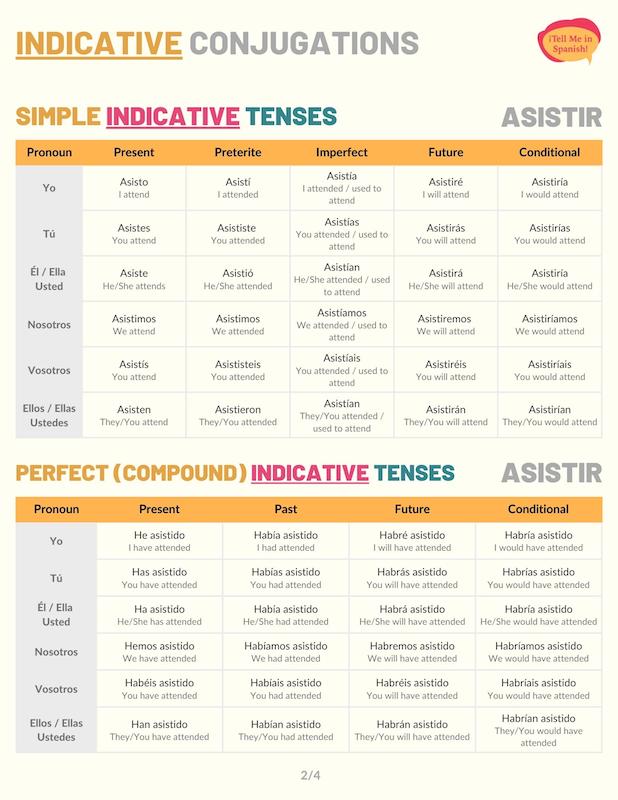
Download a copy of the cheat sheets PDF with all the charts, meanings, and uses you need to learn how to conjugate asistir in Spanish.
Practice Quiz: Asistir Conjugation
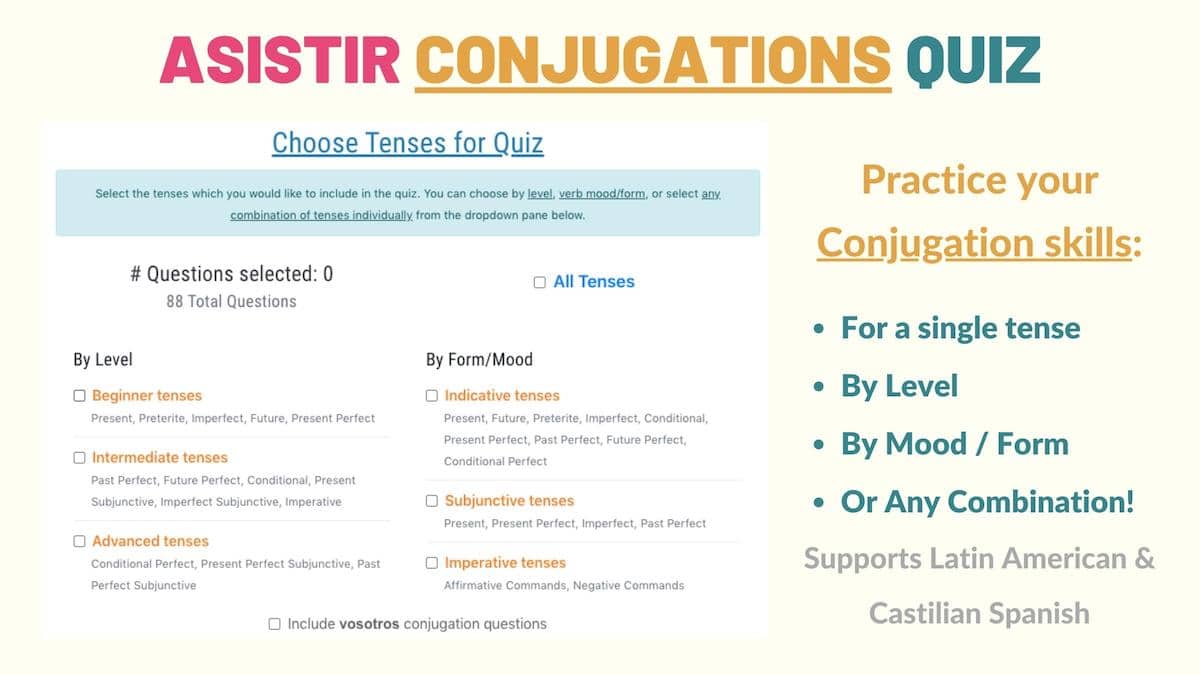
While asistir is a regular verb with no stem changes, it can be tricky to memorize all of the tense endings for -IR verbs. Put your knowledge to the test by taking this asistir conjugation practice quiz!