Ayudar is a regular -AR used in daily-life situations. Since this verb is useful for your vocabulary and to practice Spanish -AR conjugations, in the following sections, we’ll go through all of the ayudar conjugation charts. Here is what you’ll learn:
- Ayudar Overview
- Indicative Tenses of Ayudar Conjugations
- Subjunctive Tenses of Ayudar Conjugations
- Imperative (Commands) of Ayudar Conjugations
- Uses & Examples
- Download Ayudar Conjugation Tables & Uses Cheat sheets
- Ayudar Conjugation Practice Quiz
Overview of Ayudar
Indicative Conjugations of Ayudar
Present tense
The present tense conjugations of ayudar communicate that something or someone helps another person. For instance: Mis vecinos ayudan a muchas personas.
| Person | Conjugation | Translation |
|---|---|---|
| Yo | Ayudo | I help |
| Tú | Ayudas | You help |
| Él / Ella Usted | Ayuda | He/She helps You (formal) help |
| Nosotros | Ayudamos | We help |
| Vosotros | Ayudáis | You help |
| Ellos / Ellas Ustedes | Ayudan | They help You (plural) help |
Preterite tense
We use ayudar’s preterite conjugations to express that someone or something helped us do something at a specific point in the past. Here is an example: Esta semana, Tom me ayudó a pintar.
| Person | Conjugation | Translation |
|---|---|---|
| Yo | Ayudé | I helped |
| Tú | Ayudaste | You helped |
| Él / Ella Usted | Ayudó | He/She helped You (formal) helped |
| Nosotros | Ayudamos | We helped |
| Vosotros | Ayudasteis | You helped |
| Ellos / Ellas Ustedes | Ayudaron | They helped You (plural) helped |
Imperfect tense
The imperfect tense conjugations of ‘ayudar’ allow you to express that something or someone used to help you repeatedly or at an unspecified time in the past. Mi abuela ayudaba mucho a mi mamá.
| Person | Conjugation | Translation |
|---|---|---|
| Yo | Ayudaba | I helped I used to help |
| Tú | Ayudabas | You helped You used to help |
| Él / Ella Usted | Ayudaba | He/She helped He/She used to help You (formal) helped You (formal) used to help |
| Nosotros | Ayudábamos | We helped We used to help |
| Vosotros | Ayudabais | You helped You used to help |
| Ellos / Ellas Ustedes | Ayudaban | They helped They used to help You (plural) helped You (plural) used to help |
Near future
The Spanish near future (also known as the immediate future) communicates that someone is going to help another person soon in the future. For example: Voy a ayudar a Daniela al rato. The formula for the near future is ir (present tense) + a + ayudar.
| Person | Conjugation | Translation |
|---|---|---|
| Yo | Voy a ayudar | I’m going to help |
| Tú | Vas a ayudar | You’re going to help |
| Él / Ella Usted | Va a ayudar | He/She is going to help You (formal) are going to help |
| Nosotros | Vamos a ayudar | We’re going to help |
| Vosotros | Vais a ayudar | You’re going to help |
| Ellos / Ellas Ustedes | Van a ayudar | They’re going to help You (plural) are going to help |
Future simple tense
Ayudar in the future tense is used to express that someone plans to help another person at some moment in the future. Pablo me ayudará la próxima semana.
| Person | Conjugation | Translation |
|---|---|---|
| Yo | Ayudaré | I will help |
| Tú | Ayudarás | You will help |
| Él / Ella Usted | Ayudará | He/She will help You (formal) will help |
| Nosotros | Ayudaremos | We will help |
| Vosotros | Ayudaréis | You (formal) will help |
| Ellos / Ellas Ustedes | Ayudarán | They will help You (plural) will help |
Conditional tense
Use the conditional forms of ‘ayudar’ to convey that someone or something would help you do something. For example, mis vecinos me dijeron que me ayudarían con la mudanza. You can check how to conjugate ayudar to this tense in the conjugation chart below:
| Person | Conjugation | Translation |
|---|---|---|
| Yo | Ayudaría | I would help |
| Tú | Ayudarías | You would help |
| Él / Ella Usted | Ayudaría | He/She would help You (formal) would help |
| Nosotros | Ayudaríamos | We would help |
| Vosotros | Ayudaríais | You would help |
| Ellos / Ellas Ustedes | Ayudarían | They would help You (plural) would help |
Present perfect tense
In Spanish, the present perfect tense of ‘ayudar’ is used to talk about things or people that have or haven’t helped you. For instance: Esta aplicación me ha ayudado mucho.
| Person | Conjugation | Translation |
|---|---|---|
| Yo | He ayudado | I have helped |
| Tú | Has ayudado | You have helped |
| Él / Ella Usted | Ha ayudado | He/She has helped You (formal) have helped |
| Nosotros | Hemos ayudado | We have helped |
| Vosotros | Habéis ayudado | You have helped |
| Ellos / Ellas Ustedes | Han ayudado | They have helped You (plural) have helped |
Past perfect
The past perfect tense of ‘ayudar’ expresses that someone or something had helped a person. For example: Juan me dijo que te había ayudado.
| Person | Conjugation | Translation |
|---|---|---|
| Yo | Había ayudado | I had helped |
| Tú | Habías ayudado | You had helped |
| Él / Ella Usted | Había ayudado | He/She had helped You (formal) had helped |
| Nosotros | Habíamos ayudado | We had helped |
| Vosotros | Habíais ayudado | You had helped |
| Ellos / Ellas Ustedes | Habían ayudado | They had helped You (plural) had helped |
Future perfect
Use the future perfect forms of ‘ayudar’ to communicate that someone or something will have helped with something by or before a certain time in the future. For example, ¿a cuántas personas habrás ayudado para el fin de mes?
| Person | Conjugation | Translation |
|---|---|---|
| Yo | Habré ayudado | I will have helped |
| Tú | Habrás ayudado | You will have helped |
| Él / Ella Usted | Habrá ayudado | He/She will have helped You (formal) will have helped |
| Nosotros | Habremos ayudado | We will have helped |
| Vosotros | Habréis ayudado | You will have helped |
| Ellos / Ellas Ustedes | Habrán ayudado | They will have helped You (plural) will have helped |
Conditional perfect
‘Ayudar’ conjugated to the conditional perfect tense communicates that something or someone would have helped you if a past condition had been met. For instance: Si me hubieras dicho, yo te habría ayudado.
| Person | Conjugation | Translation |
|---|---|---|
| Yo | Habría ayudado | I would have helped |
| Tú | Habrías ayudado | You would have helped |
| Él / Ella Usted | Habría ayudado | He/She would have helped You (formal) would have helped |
| Nosotros | Habríamos ayudado | We would have helped |
| Vosotros | Habríais ayudado | You would have helped |
| Ellos / Ellas Ustedes | Habrían ayudado | They would have helped You (plural) would have helped |
Progressive tenses
Estar (conjugated) + present participle (in this case, ayudando) is the formula to build the progressive tenses of ‘ayudar’. We use these tenses to emphasize that someone or something is helping another person at the moment of speaking. For example: ¿Quién te está ayudando con tu proyecto?
| Progressive Tense | Formula | Translation Example |
|---|---|---|
| Present | Estar (present) + ayudando | I am helping |
| Preterite | Estar (preterite) + ayudando | You were helping |
| Imperfect | Estar (imperfect) + ayudando | He was helping |
| Future | Estar (future) + ayudando | We will be helping |
| Conditional | Estar (conditional) + ayudando | They would be helping |
Ayudar Subjunctive Conjugations
In Spanish, the subjunctive is used to talk about wishes, hypothetical situations or express uncertainty. The conjugation charts below show the subjunctive forms of ayudar.
Present subjunctive
The subjunctive conjugations of ayudar allow you to request help for you or others. As shown, in the conjugation chart below, ‘ayudar’ is a regular verb in the subjunctive tense. For instance: ¡Que alguien me ayude, por favor!
| Person | Conjugation | Translation |
|---|---|---|
| Yo | Ayude | I help |
| Tú | Ayudes | You help |
| Él / Ella Usted | Ayude | He/She helps You (formal) help |
| Nosotros | Ayudemos | We help |
| Vosotros | Ayudéis | You help |
| Ellos / Ellas Ustedes | Ayuden | They help You (plural) help |
Present perfect subjunctive
Haber in the present subjunctive + ayudado is the structure you should use to build the present perfect subjunctive form of ‘ayudar’. With this tense, ayudar can be used to express expectations or uncertainty about the things or people being helped. ¿Crees que Tim haya ayudado a Susan?
| Person | Conjugation | Translation |
|---|---|---|
| Yo | Haya ayudado | I have helped |
| Tú | Hayas ayudado | You have helped |
| Él / Ella Usted | Haya ayudado | He/She has helped You (formal) have helped |
| Nosotros | Hayamos ayudado | We have helped |
| Vosotros | Hayáis ayudado | You have helped |
| Ellos / Ellas Ustedes | Hayan ayudado | They have helped You (plural) have helped |
Imperfect subjunctive
We use the imperfect subjunctive of ‘ayudar’ to build the reported speech and communicate that someone asked us to help another person. For example: Mi mamá me dijo que te ayudara.
The imperfect subjunctive has two conjugation models (Latin American and Castilian) depending on which type of Spanish you’re using.
Latin American Spanish version
| Person | Conjugation | Translation |
|---|---|---|
| Yo | Ayudara | I helped |
| Tú | Ayudaras | You helped |
| Él / Ella Usted | Ayudara | He/She helped You (formal) helped |
| Nosotros | Ayudáramos | We helped |
| Ellos / Ellas Ustedes | Ayudaran | They helped You (plural) helped |
Note: The table above doesn’t include ayudar’s conjugation for vosotros since this pronoun is not used in Latin American Spanish.
Castilian Spanish version
| Person | Conjugation | Translation |
|---|---|---|
| Yo | Ayudase | I helped |
| Tú | Ayudases | You helped |
| Él / Ella Usted | Ayudase | He/She helped You (formal) helped |
| Nosotros | Ayudásemos | We helped |
| Vosotros | Ayudaseis | You helped |
| Ellos / Ellas Ustedes | Ayudasen | They helped You (plural) helped |
Past perfect subjunctive
In the past perfect subjunctive, ayudar communicates that someone or something would have helped a person if a past circumstance was met. In this tense, ‘ayudar’ can also be used to make hypotheses about what would happen if someone had helped you. For example: Si ustedes me hubieran ayudado, habría terminado más rápido.
| Person | Conjugation | Translation |
|---|---|---|
| Yo | Hubiera ayudado | I had helped |
| Tú | Hubieras ayudado | You had helped |
| Él / Ella Usted | Hubiera ayudado | He/She had helped You (formal) had helped |
| Nosotros | Hubiéramos ayudado | We had helped |
| Vosotros | Hubierais ayudado | You had helped |
| Ellos / Ellas Ustedes | Hubieran ayudado | They had helped You (plural) had helped |

Ayudar Imperative Conjugations
The imperative mood in Spanish is used to order someone to do something (affirmative commands) or not do something (negative commands).
Affirmative commands
The affirmative imperative forms of ‘ayudar’ are used to order someone to help another person. For example: Oigan, ayúdenme con estas cajas.
| Person | Conjugation | Translation |
|---|---|---|
| Tú | Ayuda | Help |
| Usted | Ayude | Help |
| Vosotros | Ayudad | Help |
| Ustedes | Ayuden | Help |
Negative commands
‘Ayudar’ conjugated to the negative imperative allows you to command someone to not help another person. For instance: ¡No ayuden a su hermana con su tarea!
| Person | Conjugation | Translation |
|---|---|---|
| Tú | No ayudes | Don’t help |
| Usted | No ayude | Don’t help |
| Vosotros | No ayudéis | Don’t help |
| Ustedes | No ayuden | Don’t help |
Meanings of Ayudar & Examples
Now that you’ve learned how to conjugate ayudar, you should check these examples and structures so you can also learn how to use this verb correctly.
Ayudar is the direct translation of ‘to help’. Therefore, this verb is used to talk about helping others do something.
Combine ‘ayudar’ with a verb in infinitive form to express that something or someone helps you accomplish an activity.
[DOP] + [Ayudar conjugated] + a + [infinitive verb]
Mi novio me ayudó a aprender español.
My boyfriend helped me learn Spanish.
Sus amigos la van a ayudar a mudarse.
Her friends are going to help her move.
You must use the preposition con if ‘ayudar’ is followed by a noun:
Disculpen, ¿nos ayudarían con esta encuesta?
Sorry, would you guys help us with this survey?
Take Note: Ayudar is a transitive verb. As a result, it works with a direct object pronoun (DOP) when a person is helping someone else or with a reciprocal pronoun if people are helping each other.
Download Ayudar Conjugation Tables & Uses Cheat sheets
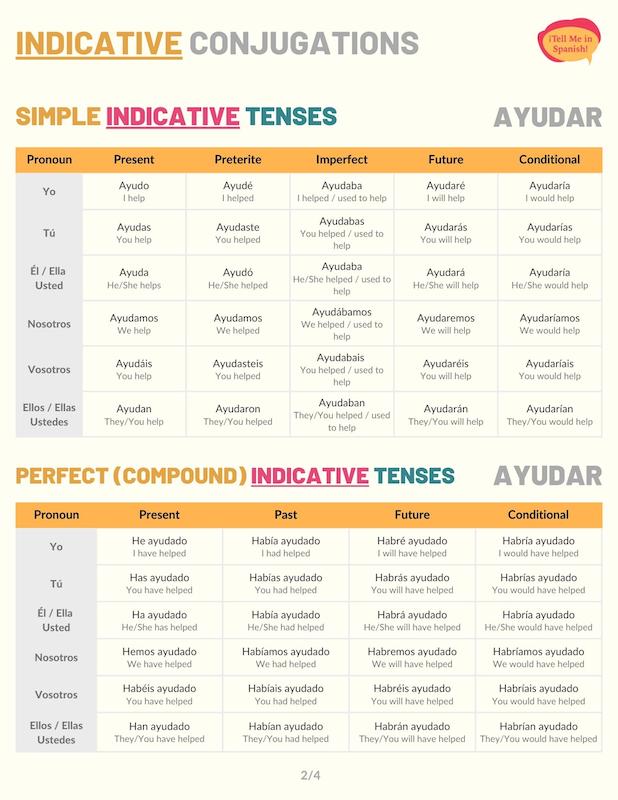
You can download a copy of the ‘ayudar’ conjugation PDF which contains all the charts needed to conjugate this verb to all the tenses, meanings, and uses.
Practice Quiz: Ayudar Conjugation
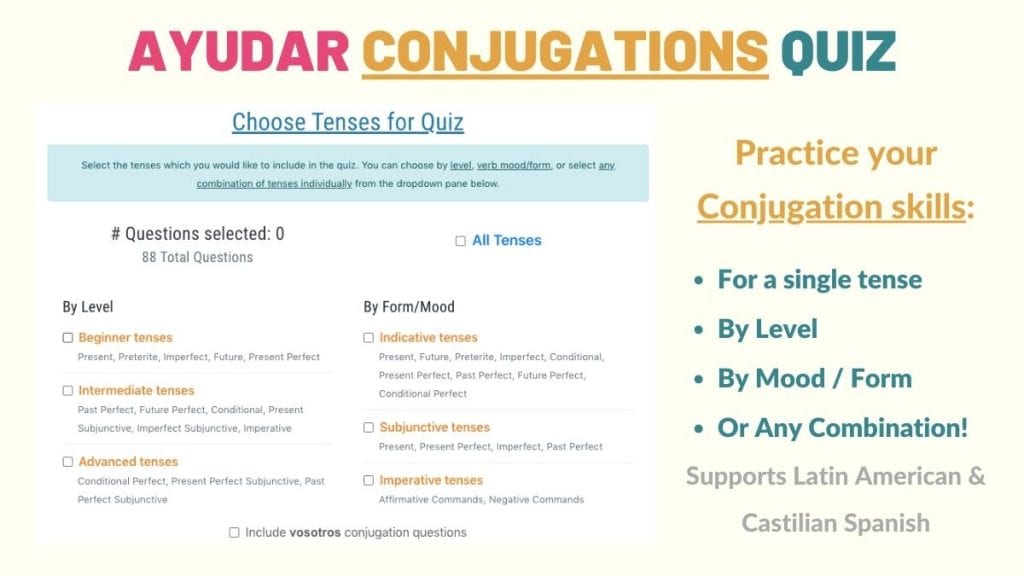
If you’re ready to test your skills or practice conjugating this verb, then take the ayudar conjugation quiz!