
Querer is one of most common -ER verbs you’ll ever use in Spanish. Since it has some irregularities, in this guide, you’ll find charts for the most frequently used querer conjugations. Below is a summary of what you’ll learn:
- Querer Overview
- Indicative Tenses of Querer Conjugations
- Subjunctive Tenses of Querer Conjugations
- Imperative (Commands) of Querer Conjugations
- Uses & Examples
- Download Querer Conjugation Tables & Uses Cheat sheets
- Querer Conjugation Practice Quiz
Take Note: There are many tenses in Spanish. However, we don’t use them all. Many are simply old and outdated. As a result, in this guide, you’ll only learn the tenses you need to know to become fluent in Spanish.
Overview of Querer
| Verb Characteristic | Property |
|---|---|
| Verb Type | -ER |
| Irregular | Yes |
| Infinitive | Querer |
| Gerund (Present Participle) Form | Queriendo |
| Past Participle Form | Querido |
| Synonyms | Amar, desear, estimar. |
Irregularities:
- Preterite: quis for all subject pronouns.
- Future & Conditional: querr for all subject pronouns.
- Imperfect subjunctive: quis for all subject pronouns.
Stem Changes: E to IE
- Present tense: quier except for ‘nosotros’ and ‘vosotros’.
- Present subjuctive: quier except for ‘nosotros’ and ‘vosotros’.
- Affirmative imperative: quier except for ‘vosotros’.
- Negative imperative: quier for all subject pronouns.
Indicative Conjugations of Querer
Present tense
The present tense conjugations of ‘querer’ have an -E to -IE stem change for all subjects except ‘nosotros’ and ‘vosotros’. You can check these changes in the conjugation chart below. In the present tense, ‘querer’ is used to talk about current wishes or to express affection towards someone. Yo quiero mucho a mi mamá –for example.
| Person | Conjugation | Translation |
|---|---|---|
| Yo | Quiero | I want |
| Tú | Quieres | You want |
| Él / Ella Usted | Quiere | He/She wants You (formal) want |
| Nosotros | Queremos | We want |
| Vosotros | Queréis | You want |
| Ellos / Ellas Ustedes | Quieren | They want You (plural) want |
Preterite tense
All the preterite conjugations of querer are irregular. Quis- is the stem you must use to conjugate ‘querer’ to the preterite tense. These conjugations refer to the wishes or feelings someone had at a specific moment in the past. Sammy te quiso mucho.
| Person | Conjugation | Translation |
|---|---|---|
| Yo | Quise | I wanted |
| Tú | Quisiste | You wanted |
| Él / Ella Usted | Quiso | He/She wanted You (formal) wanted |
| Nosotros | Quisimos | We wanted |
| Vosotros | Quisisteis | You wanted |
| Ellos / Ellas Ustedes | Quisieron | They wanted You (plural) wanted |
Take Note: With regular verbs, the preterite endings for ‘yo’ and ‘él/ella/usted’ have an accent mark. However, the accent is omitted in verbs that are irregular in the preterite tense.
Imperfect tense
Querer is a regular verb when conjugated to the imperfect tense. We use the past imperfect of ‘querer’ to talk about things you used to want or feelings you had for someone at some point in the past. In this tense, querer is commonly used to request things politely. Quería ver si me puedes ayudar.
| Person | Conjugation | Translation |
|---|---|---|
| Yo | Quería | I wanted I used to want |
| Tú | Querías | You wanted You used to want |
| Él / Ella Usted | Quería | He/She wanted He/She used to want You (formal) wanted You (formal) used to want |
| Nosotros | Queríamos | We wanted We used to want |
| Vosotros | Queríais | You wanted You used to want |
| Ellos / Ellas Ustedes | Querían | They wanted They used to want You (plural) wanted You (plural) used to want |
Near future
In Spanish, the near future is used to refer to things you want at some point in the immediate future. Creo que voy a querer otro pedazo de pizza. The near future of this verb is formed with ir (present) + a + querer and can be translated as “going to want”.
| Person | Conjugation | Translation |
|---|---|---|
| Yo | Voy a querer | I’m going to want |
| Tú | Vas a querer | You’re going to want |
| Él / Ella Usted | Va a querer | He/She is going to want You (formal) are going to want |
| Nosotros | Vamos a querer | We’re going to want |
| Vosotros | Vais a querer | You’re going to want |
| Ellos / Ellas Ustedes | Van a querer | They’re going to want You (plural) are going to want |
Future simple tense
All the conjugations for the future tense of ‘querer’ are irregular. To form this tense, you must use the stem querr for all subject pronouns. Use ‘querer’ in the future simple to talk about future wishes or affections. For instance: ¿algún día querrás casarte?
| Person | Conjugation | Translation |
|---|---|---|
| Yo | Querré | I will want |
| Tú | Querrás | You will want |
| Él / Ella Usted | Querrá | He/She will want You (formal) will want |
| Nosotros | Querremos | We will want |
| Vosotros | Querréis | You (formal) will want |
| Ellos / Ellas Ustedes | Querrán | They will want You (plural) will want |
Conditional tense
To conjugate querer to the conditional tense, you must use the irregular stem querr for all subjects. The conditional forms of ‘querer’ are used to talk about the things you would want under certain circumstances.
| Person | Conjugation | Translation |
|---|---|---|
| Yo | Querría | I would want |
| Tú | Querrías | You would want |
| Él / Ella Usted | Querría | He/She would want You (formal) would want |
| Nosotros | Querríamos | We would want |
| Vosotros | Querríais | You would want |
| Ellos / Ellas Ustedes | Querrían | They would want You (plural) would want |
Present perfect tense
The present perfect of ‘querer’ is formed with the formula ‘haber’ + querer’s past participle (querido). This tense is used to talk about the love you have had or things you have wanted. For example: siempre he querido visitar Europa.
| Person | Conjugation | Translation |
|---|---|---|
| Yo | He querido | I have wanted |
| Tú | Has querido | You have wanted |
| Él / Ella Usted | Ha querido | He/She has wanted You (formal) have wanted |
| Nosotros | Hemos querido | We have wanted |
| Vosotros | Habéis querido | You have wanted |
| Ellos / Ellas Ustedes | Han querido | They have wanted You (plural) have wanted |
Past perfect
Querer conjugated to the past perfect tense refers to the love someone had or the things that person wanted before some other reference point in the past. Hasta ese momento, yo la había querido mucho. The formula for the past perfect is haber (imperfect form) + querido.
| Person | Conjugation | Translation |
|---|---|---|
| Yo | Había querido | I had wanted |
| Tú | Habías querido | You had wanted |
| Él / Ella Usted | Había querido | He/She had wanted You (formal) had wanted |
| Nosotros | Habíamos querido | We had wanted |
| Vosotros | Habíais querido | You had wanted |
| Ellos / Ellas Ustedes | Habían querido | They had wanted You (plural) had wanted |
Future perfect
To form the future perfect of ‘querer’, conjugate haber to the future tense and add querido (the past participle of ‘querer’). With this tense, ‘querer’ is used to talk about the things someone wants by or before a certain time in the future. For instance: ¿qué habrá querido decir Juan ayer?
| Person | Conjugation | Translation |
|---|---|---|
| Yo | Habré querido | I will have wanted |
| Tú | Habrás querido | You will have wanted |
| Él / Ella Usted | Habrá querido | He/She will have wanted You (formal) will have wanted |
| Nosotros | Habremos querido | We will have wanted |
| Vosotros | Habréis querido | You will have wanted |
| Ellos / Ellas Ustedes | Habrán querido | They will have wanted You (plural) will have wanted |
Conditional perfect
‘Querer’ conjugated to the conditional perfect tense refers to things you would have wanted. For example: Cecy habría querido conocer a tus amigos.
| Person | Conjugation | Translation |
|---|---|---|
| Yo | Habría querido | I would have wanted |
| Tú | Habrías querido | You would have wanted |
| Él / Ella Usted | Habría querido | He/She would have wanted You (formal) would have wanted |
| Nosotros | Habríamos querido | We would have wanted |
| Vosotros | Habríais querido | You would have wanted |
| Ellos / Ellas Ustedes | Habrían querido | They would have wanted You (plural) would have wanted |
Progressive tenses
The progressive tenses of ‘querer’ are used to express that a person wants something at the moment of speaking. These tenses may not be as frequently used in daily-life conversations.
| Progressive Tense | Formula | Translation Example |
|---|---|---|
| Present | Estar (present) + queriendo | I am wanting |
| Preterite | Estar (preterite) + queriendo | You were wanting |
| Imperfect | Estar (imperfect) + queriendo | He was wanting |
| Future | Estar (future) + queriendo | We will be wanting |
| Conditional | Estar (conditional) + queriendo | They would be wanting |
Querer Subjunctive Conjugations
In Spanish, the subjunctive mood is used to talk about wishes, hypothetical situations or express uncertainty. The conjugation charts below show the subjunctive forms of querer.
Present subjunctive
The present subjunctive conjugations of ‘querer’ are formed by using the irregular stem ‘quier’. This rule is not applicable to ‘nosotros’ and ‘vosotros’. In the present subjunctive, ‘querer’ allows you to express uncertainty about someone’s feelings or the things they want to do. For instance: no creo que la quiera.
| Person | Conjugation | Translation |
|---|---|---|
| Yo | Quiera | I want |
| Tú | Quieras | You want |
| Él / Ella Usted | Quiera | He/She want You (formal) want |
| Nosotros | Queramos | We want |
| Vosotros | Queráis | You want |
| Ellos / Ellas Ustedes | Quieran | They want You (plural) want |
Present perfect subjunctive
The present perfect subjunctive of ‘querer’ can be used to communicate hypotheses or uncertainty about what people wanted. Haber in the present subjunctive + querido is the structure you should use to build this tense. Dudo que Peter haya querido lastimarte.
| Person | Conjugation | Translation |
|---|---|---|
| Yo | Haya querido | I have wanted |
| Tú | Hayas querido | You have wanted |
| Él / Ella Usted | Haya querido | He/She has wanted You (formal) have wanted |
| Nosotros | Hayamos querido | We have wanted |
| Vosotros | Hayáis querido | You have wanted |
| Ellos / Ellas Ustedes | Hayan querido | They have wanted You (plural) have wanted |
Imperfect subjunctive
The imperfect subjunctive forms of ‘querer’ are frequently used to request things politely. For example, quisiera un café con leche, por favor.
The imperfect subjunctive has two conjugation models depending on which type of Spanish you’re using:
Latin American Spanish version
| Person | Conjugation | Translation |
|---|---|---|
| Yo | Quisiera | I wanted |
| Tú | Quisieras | You wanted |
| Él / Ella Usted | Quisiera | He/She wanted You (formal) wanted |
| Nosotros | Quisiéramos | We wanted |
| Ellos / Ellas Ustedes | Quisieran | They wanted You (plural) wanted |
Note: The table above doesn’t include the conjugation for vosotros because this pronoun is not used in Latin American Spanish.
Castilian Spanish version
| Person | Conjugation | Translation |
|---|---|---|
| Yo | Quisiese | I wanted |
| Tú | Quisieses | You wanted |
| Él / Ella Usted | Quisiese | He/She wanted You (formal) wanted |
| Nosotros | Quisiésemos | We wanted |
| Vosotros | Quisieseis | You (formal) wanted |
| Ellos / Ellas Ustedes | Quisiesen | They wanted You (plural) wanted |
Past perfect subjunctive
In the past perfect subjunctive, querer is used to talk about past wishes you had, but that you can no longer have. For example: hubiera querido aprender otro idioma.
| Person | Conjugation | Translation |
|---|---|---|
| Yo | Hubiera querido | I had wanted |
| Tú | Hubieras querido | You had wanted |
| Él / Ella Usted | Hubiera querido | He/She had wanted You (formal) had wanted |
| Nosotros | Hubiéramos querido | We had wanted |
| Vosotros | Hubierais querido | You had wanted |
| Ellos / Ellas Ustedes | Hubieran querido | They had wanted You (plural) had wanted |


Querer Imperative Conjugations
Commands in Spanish (Imperative Mood) allow you to tell people what to do (affirmative commands) or what not to do (negative commands). However, the imperative forms of ‘querer’ may not be very common because you cannot order people to love someone, to want or wish for something.
Affirmative commands
The affirmative commands of ‘querer’ can be used to command people to love someone or want something. For instance: quiérete más, hija. With the exception of ‘vosotros’, all subject pronouns use the irregular stem ‘quier’.
| Person | Conjugation | Translation |
|---|---|---|
| Tú | Quiere | Want |
| Usted | Quiera | Want |
| Vosotros | Quered | Want |
| Ustedes | Quieran | Want |
Negative commands
Since the negative imperative conjugations are based on the present subjunctive, all forms of ‘querer’ are irregular. Negative commands are used to command people to not love or want something. For example: no la quieras a ella, quiéreme a mí.
| Person | Conjugation | Translation |
|---|---|---|
| Tú | No quieras | Don’t want |
| Usted | No quiera | Don’t want |
| Vosotros | No quieráis | Don’t want |
| Ustedes | No quieran | Don’t want |
Meanings of Querer & Examples
Now that you’ve learned the most important conjugations for ‘querer’, here are some common applications for this verb:
- Express wishes and things you want
¿Quién quiere más pastel?
Who wants more cake?
Creo que Luke quería decirte algo.
I think Luke wanted to tell you something.
¿Qué crees que quiera Laura?
What do you think Laura wants?
- Express affection
Mi abuelita nos quería mucho.
My granny loved us very much.
Yo quise muchísimo a mi perrito.
I loved my dog very much.
Take Note: Although in this context ‘querer’ means ‘to love’, in Spanish, this verb is not as intense as amar. Check this article if you want to learn more about the difference between ‘te amo’ and ‘te quiero’.
Download Querer Conjugation Tables & Uses Cheat sheets
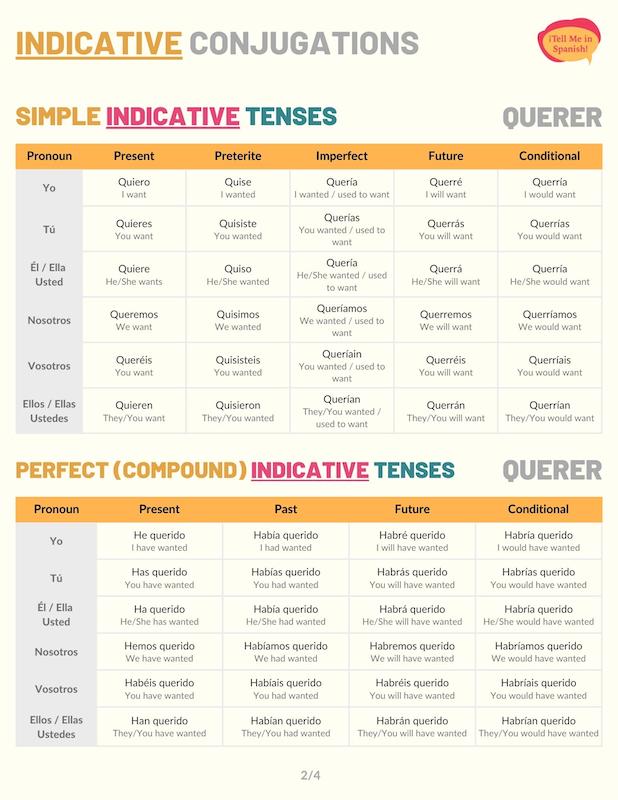
I’ve created a PDF for you to download containing all of the conjugation tables, verb characteristics, and uses so you can study it at your own pace!
Practice Quiz: Querer Conjugation
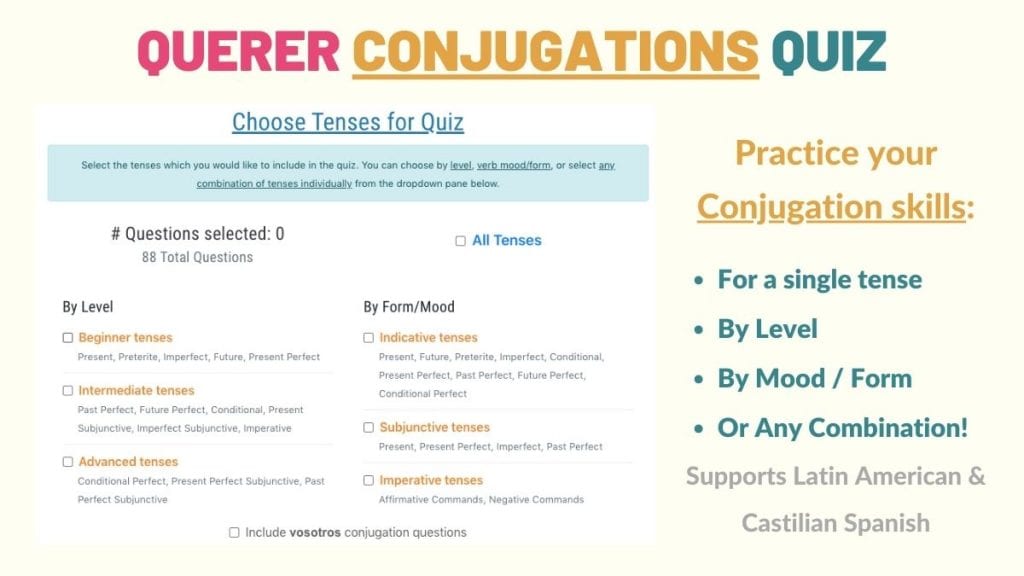
To conjugate querer, you need to be aware of all its particular stem changes and irregularities. You can practice your conjugation skills with this verb by taking the conjugation quiz for ‘querer’.