Contar is one of the most common stem-changing verbs in Spanish. For that reason, in this guide, you’ll learn the most important conjugations for contar and some of its basic uses.
Here’s a quick overview of what you’ll learn:
- Contar Overview
- Indicative Tenses of Contar Conjugations
- Subjunctive Tenses of Contar Conjugations
- Imperative Tense (Commands) of Contar Conjugations
- Uses & Examples
- Download Contar Conjugation Tables & Uses Cheat sheets
- Contar Conjugation Practice Quiz
Take Note: There are many tenses in Spanish. However, we don’t use them all. Many are simply old and outdated. As a result, in this guide, you’ll only learn the tenses you need to know to become fluent in Spanish.
Overview of Contar
| Verb Characteristic | Property |
|---|---|
| Verb Type | -AR |
| Irregular | No |
| Infinitive | Contar |
| Gerund (Present Participle) Form | Contando |
| Past Participle Form | Contado |
| Synonyms | Decir, relatar, numerar |
Stem Changes: O to UE
- Present: cuent (except ‘nosotros’ and ‘vosotros’)
- Present Subjunctive: cuent
- Affirmative Imperative: cuent (except ‘vosotros’)
- Negative Imperative: cuent
Take Note: Notice that when referring to numbers or amounts, contar means ‘to count’. For simplicity and so that this isn’t overly repetitive, each of the tenses will only show translations with the meaning of ‘to tell’.
Indicative Conjugations of Contar
Present tense
The present tense of contar has stem changes. In other words, ‘contar’ is a stem-changing verb for all pronouns, except ‘nosotros’ and ‘ustedes’. As a result, most subject pronouns follow a O to UE change.
| Person | Conjugation | Translation |
|---|---|---|
| Yo | Cuento | I tell |
| Tú | Cuentas | You tell |
| Él / Ella Usted | Cuenta | He/She tells You (formal) tell |
| Nosotros | Contamos | We tell |
| Vosotros | Contáis | You tell |
| Ellos / Ellas Ustedes | Cuentan | They/You tell You (plural) tell |
Preterite tense
All the preterite forms of ‘contar’ are regular. The Spanish preterite expresses that you told or counted something at a specific moment in the past. For example: le conté a Daniela.
| Person | Conjugation | Translation |
|---|---|---|
| Yo | Conté | I told |
| Tú | Contaste | You told |
| Él / Ella Usted | Contó | He/She told You (formal) told |
| Nosotros | Contamos | We told |
| Vosotros | Contasteis | You told |
| Ellos / Ellas Ustedes | Contaron | They told You (plural) told |
Imperfect tense
The Spanish imperfect tense is used to talk about things you used to tell or count repeatedly in the past. For example, yo contaba muchos chistes. The imperfect conjugation of ‘contar’ is regular and can be translated as ‘used to tell’ or ‘told’.
| Person | Conjugation | Translation |
|---|---|---|
| Yo | Contaba | I told / I used to tell |
| Tú | Contabas | You told / You used to tell |
| Él / Ella Usted | Contaba | He/She told / He/She used to tell You told / You used to tell |
| Nosotros | Contábamos | We told / We used to tell |
| Vosotros | Contabais | You told / You used to tell |
| Ellos / Ellas Ustedes | Contaban | They told / You told They used to tell / You used to tell |
Near future
The near future in Spanish is used to talk about things you’ll tell or count in the immediate future. This tense is formed with ir (present) + a + contar and can be translated as “going to tell”.
| Person | Conjugation | Translation |
|---|---|---|
| Yo | Voy a contar | I’m going to tell |
| Tú | Vas a contar | You’re going to tell |
| Él / Ella Usted | Va a contar | He/She is going to tell You (formal) are going to tell |
| Nosotros | Vamos a contar | We’re going to tell |
| Vosotros | Vais a contar | You’re going to tell |
| Ellos / Ellas Ustedes | Van a contar | They’re going to tell You (plural) are going to tell |
Future simple tense
The simple future allows you to express that you will tell or count something at some point in the future. For example, algún día te contaré cómo conocí a tu papá.
| Person | Conjugation | Translation |
|---|---|---|
| Yo | Contaré | I will tell |
| Tú | Contarás | You will tell |
| Él / Ella Usted | Contará | He/She will tell You (formal) will tell |
| Nosotros | Contaremos | We will tell |
| Vosotros | Contaréis | You will tell |
| Ellos / Ellas Ustedes | Contarán | They will tell You (plural) will tell |
Conditional tense
The conditional form of ‘contar’ conveys that someone would tell or count something if certain circumstances are met. For example: te contaría, pero no tengo tiempo. This tense is conjugated by adding the conditional endings to ‘contar’.
| Person | Conjugation | Translation |
|---|---|---|
| Yo | Contaría | I would tell |
| Tú | Contarías | You would tell |
| Él / Ella Usted | Contaría | He/She would tell You (formal) would tell |
| Nosotros | Contaríamos | We would tell |
| Vosotros | Contaríais | You would tell |
| Ellos / Ellas Ustedes | Contarían | They would tell You (plural) would tell |
Present perfect tense
‘Contar’ in the present perfect tense expresses that you told or counted something in a moment close to the present. The formula to conjugate the present perfect tense in Spanish is haber (present tense) + contado.
| Person | Conjugation | Translation |
|---|---|---|
| Yo | He contado | I have told |
| Tú | Has contado | You have told |
| Él / Ella Usted | Ha contado | He/She has told You (formal) have told |
| Nosotros | Hemos contado | We have told |
| Vosotros | Habéis contado | You have told |
| Ellos / Ellas Ustedes | Han contado | They have told You (plural) have told |
Past perfect
To conjugate to the past perfect tense, you need to use the imperfect form of haber + contado, which is the past participle form of ‘contar’. The past perfect of ‘contar’ expresses that you told or counted something before some other reference point in the past. Cuando llegué, Sandra ya te había contado.
| Person | Conjugation | Translation |
|---|---|---|
| Yo | Había contado | I had told |
| Tú | Habías contado | You had told |
| Él / Ella Usted | Había contado | He/She had told You (formal) had told |
| Nosotros | Habíamos contado | We had told |
| Vosotros | Habíais contado | You had told |
| Ellos / Ellas Ustedes | Habían contado | They had told You (plural) had told |
Future perfect
The future perfect of ‘contar’ is built by conjugating haber to the future tense and adding contar’s past participle (contado). This verb in the future perfect tense communicates you will count or tell something by or before a certain time in the future.
| Person | Conjugation | Translation |
|---|---|---|
| Yo | Habré contado | I will have told |
| Tú | Habrás contado | You will have told |
| Él / Ella Usted | Habrá contado | He/She will have told You (formal) will have told |
| Nosotros | Habremos contado | We will have told |
| Vosotros | Habréis contado | You will have told |
| Ellos / Ellas Ustedes | Habrán contado | They will have told You (plural) will have told |
Conditional perfect
‘Contar’ conjugated to the conditional perfect is used to talk about things you would have told someone if a past condition was met. For example: si hubiera sabido, te habría contado.
| Person | Conjugation | Translation |
|---|---|---|
| Yo | Habría contado | I would have told |
| Tú | Habrías contado | You would have told |
| Él / Ella Usted | Habría contado | He/She would have told You (formal) would have told |
| Nosotros | Habríamos contado | We would have told |
| Vosotros | Habríais contado | You would have told |
| Ellos / Ellas Ustedes | Habrían contado | They would have told You (plural) would have told |
Progressive tenses
The progressive tenses in Spanish refer to actions that are in progress at the moment of speaking. Using ‘contar’, it expresses that someone is telling something right now. The structure to form these tenses is estar (conjugated) + gerund form of contar (contando).
| Progressive Tense | Formula | Translation Example |
|---|---|---|
| Present | Estar (present) + contando | I am telling |
| Preterite | Estar (preterite) + contando | You were telling |
| Imperfect | Estar (imperfect) + contando | He was telling |
| Future | Estar (future) + contando | We will be telling |
| Conditional | Estar (conditional) + contando | They would be telling |
Contar Subjunctive Conjugations
The Spanish subjunctive mood is used to talk about wishes, hypothetical actions or express uncertainty.
Present subjunctive
In the present subjunctive, contar is also a stem-changing verb. With the exception of ‘nosotros’ and ‘vosotros’, all the present subjunctive forms have an O to UE change. The present subjunctive of ‘contar’ is used to talk about the expectation or possibility of someone telling you something. For example: ojalá Juan nos cuente qué pasó.
| Person | Conjugation | Translation |
|---|---|---|
| Yo | Cuente | I tell |
| Tú | Cuentes | You tell |
| Él / Ella Usted | Cuente | He/She tells You (formal) tell |
| Nosotros | Contemos | We tell |
| Vosotros | Contéis | You tell |
| Ellos / Ellas Ustedes | Cuenten | They tell You (plural) tell |
Present perfect subjunctive
Haber in the present subjunctive + contado is the structure you should use to build the present perfect subjunctive form of ‘contar’. The present perfect subjunctive of ‘contar’ is used to talk about wishes and probabilities. For example, ¿crees que le hayan contado?
| Person | Conjugation | Translation |
|---|---|---|
| Yo | Haya contado | I have told |
| Tú | Hayas contado | You have told |
| Él / Ella Usted | Haya contado | He/She has told You (formal) have told |
| Nosotros | Hayamos contado | We have told |
| Vosotros | Hayáis contado | You have told |
| Ellos / Ellas Ustedes | Hayan contado | They have told You (plural) have told |
Imperfect subjunctive
We use the imperfect subjunctive of ‘contar’ to talk about what would happen if we told something to someone. This tense expresses wishes or hypothetical situations that are difficult to accomplish. Juan se enojaría conmigo si le contara lo que hice.
The imperfect subjunctive has two conjugation models depending on which type of Spanish you’re using:
Latin American Spanish version
| Person | Conjugation | Translation |
|---|---|---|
| Yo | Contara | I told |
| Tú | Contaras | You told |
| Él / Ella Usted | Contara | He/She told You (formal) told |
| Nosotros | Contáramos | We told |
| Ellos / Ellas Ustedes | Contaran | They told You (plural) told |
Note: The table above doesn’t include the conjugation for vosotros because this pronoun is not used in Latin American Spanish.
Castilian Spanish version
| Person | Conjugation | Translation |
|---|---|---|
| Yo | Contase | I told |
| Tú | Contases | You told |
| Él / Ella Usted | Contase | He/She told You (formal) told |
| Nosotros | Contásemos | We told |
| Vosotros | Contaseis | You told |
| Ellos / Ellas Ustedes | Contasen | They told You (plural) told |
Past perfect subjunctive
The past perfect subjunctive of ‘contar’ can be used to talk about what would have happened if you had told something to someone. These are hypothetical situations that can no longer happen because their time has passed. For example si le hubiera contado…(If I had told him).
| Person | Conjugation | Translation |
|---|---|---|
| Yo | Hubiera contado | I had told |
| Tú | Hubieras contado | You had told |
| Él / Ella Usted | Hubiera contado | He/She had told You (formal) had told |
| Nosotros | Hubiéramos contado | We had told |
| Vosotros | Hubierais contado | You had told |
| Ellos / Ellas Ustedes | Hubieran contado | They had told You (plural) had told |


Contar Imperative Conjugations
The Spanish imperative is used to tell people what to do (affirmative commands) or what not to do (negative commands).
Affirmative commands
‘Contar’ affirmative commands have a stem-changing form for ‘tú’, ‘usted’ and ‘ustedes’. Like the present indicative and subjunctive, these pronouns have a change from O to UE. The affirmative imperative of contar allows you to order or ask someone to tell you something. Cuéntame qué pasó.
| Person | Conjugation | Translation |
|---|---|---|
| Tú | Cuenta | Tell |
| Usted | Cuente | Tell |
| Vosotros | Contad | Tell |
| Ustedes | Cuenten | Tell |
Negative commands
Since the Spanish negative imperative is based on the present subjunctive, contar is a stem-changing verb for all subjects except ‘vosotros’. The negative imperative of contar is used to command people to not tell something to someone. For instance: no le cuentes a Jorge.
| Person | Conjugation | Translation |
|---|---|---|
| Tú | No cuentes | Don’t tell |
| Usted | No cuente | Don’t tell |
| Vosotros | No contéis | Don’t tell |
| Ustedes | No cuenten | Don’t tell |
Meanings of Contar & Examples
Now that you’ve seen all the conjugation charts of contar, you should learn its meanings as well as how and when to use this verb.
- Expressing that someone is telling something
[Indirect object pronoun] + [‘contar’ conjugated]
¿Por qué le has contado?
Why have you told him?
Roció contaba muy buenos chistes.
Rocío used to tell very good jokes.
- Talking about counting things or numbers
Muchachos, cuenten bien su dinero.
Guys, count your money well.
El niño cuenta hasta diez.
The kid counts to ten.
- Expressing that something is valid or invalid
Ojalá las tareas contaran menos.
I wish homework counted less.
El gol no contó porque estabas fuera de lugar.
The goal didn’t count because you were offside.
Download Contar Conjugation Tables & Uses Cheat sheets
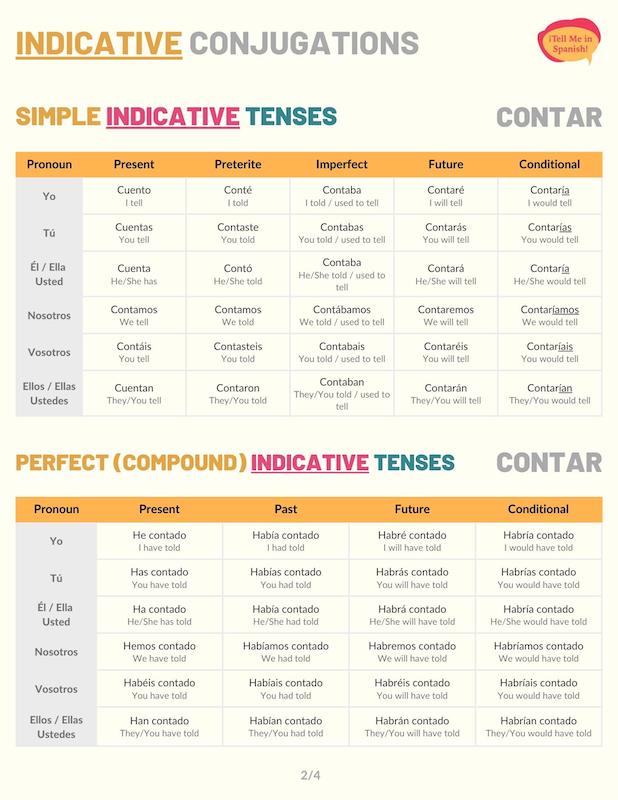
I’ve created a PDF for you to download containing all Contar’s conjugation tables, verb characteristics, and uses so you can study it at your own pace!
Practice Quiz: Contar Conjugation
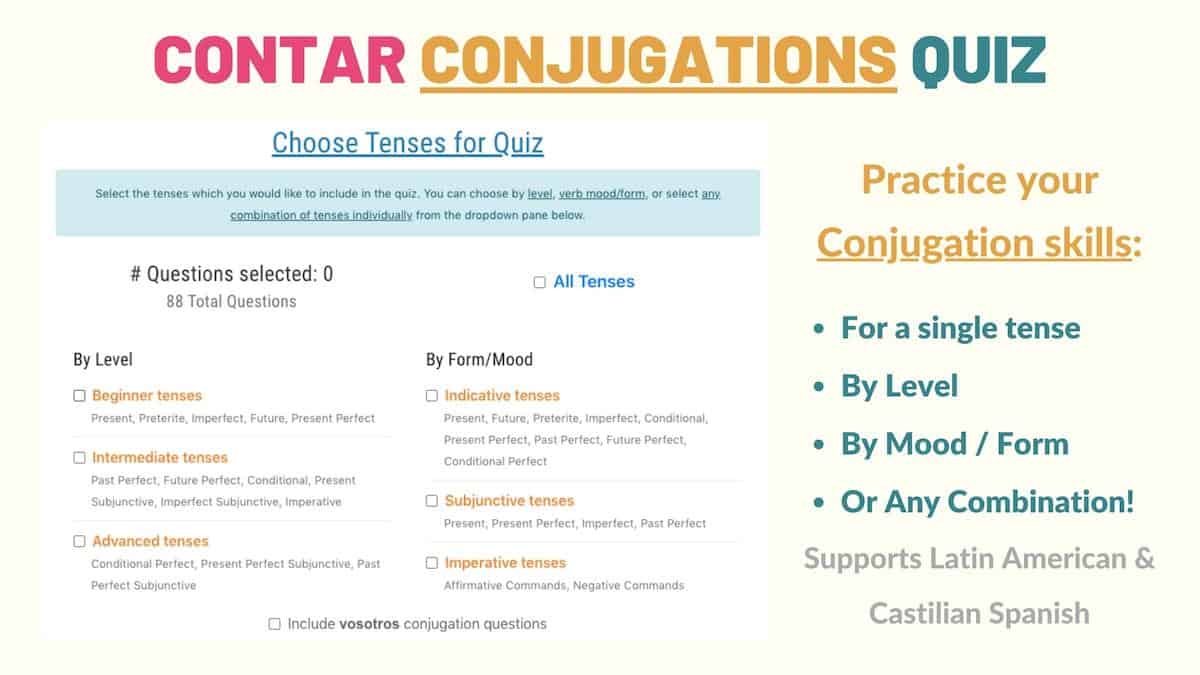
Take our ‘contar’ conjugation quiz to test your skills and practice this stem-changing verb in all its tenses. You can customize your quiz based on mood, your Spanish level, and more.