Comenzar conjugation patterns can help you practice E to IE and consonant changes. Additionally, this is a common -AR verb that you’ll use in many situations. So, since knowing how to conjugate comenzar is a must for Spanish learners, in this guide, you’ll learn:
- Comenzar Overview
- Indicative Tenses of Comenzar Conjugations
- Subjunctive Tenses of Comenzar Conjugations
- Imperative (Commands) of Comenzar Conjugations
- Uses & Examples
- Download Comenzar Conjugation Tables & Uses Cheat sheets
- Comenzar Conjugation Practice Quiz
Take Note: There are many tenses in Spanish. However, we don’t use them all. Many are simply old and outdated. As a result, in this guide, you’ll only learn the tenses you need to know to become fluent in Spanish.
Overview of Comenzar
| Verb Characteristic | Property |
|---|---|
| Verb Type | -AR |
| Irregular | No |
| Infinitive | Comenzar |
| Gerund (Present Participle) Form | Comenzando |
| Past Participle Form | Comenzado |
| Synonyms | Empezar, iniciar. |
Stem Changes: E to IE
- Present tense: comienz for all subject pronouns except ‘nosotros’ and ‘vosotros’.
- Preterite tense: comenc only for ‘yo’
- Present subjunctive: comienc for ‘yo’, ‘tú’, ‘él’, ‘ella’, ‘ustedes’ comenc for ‘nosotros’ and ‘vosotros’.
- Affirmative imperative: comienz for ‘tú’ and comienc for ‘usted’ and ‘ustedes’.
- Negative imperative: comienc for all subject pronouns except ‘vosotros’.
Indicative Conjugations of Comenzar
Present tense
The present tense conjugation of comenzar has a stem change from E to IE. However, this change isn’t applied to ‘nosotros’ and ‘vosotros’. In this tense, ‘comenzar’ communicates the moment an action starts in the present. For example: Las clases comienzan a las 8.
| Person | Conjugation | Translation |
|---|---|---|
| Yo | Comienzo | I begin |
| Tú | Comienzas | You begin |
| Él / Ella Usted | Comienza | He/She begins You (formal) begin |
| Nosotros | Comenzamos | We begin |
| Vosotros | Comenzáis | You begin |
| Ellos / Ellas Ustedes | Comienzan | They begin You (plural) begin |
Preterite tense
In the past preterite, comenzar is a verb with consonant changes for the pronoun yo. With this pronoun, we must replace the ‘z’ for a ‘c’. Use comenzar preterite conjugations to express that an action started at a specific moment in the past. For instance, comencé a trabajar hace dos años.
| Person | Conjugation | Translation |
|---|---|---|
| Yo | Comencé | I began |
| Tú | Comenzaste | You began |
| Él / Ella Usted | Comenzó | He/She began You (formal) began |
| Nosotros | Comenzamos | We began |
| Vosotros | Comenzasteis | You began |
| Ellos / Ellas Ustedes | Comenzaron | They began You (plural) began |
Imperfect tense
In the past indicative imperfect tense, comenzar is a regular verb. Use this tense to point out when a past ongoing event used to start. For example: mis clases comenzaban a las 3.
| Person | Conjugation | Translation |
|---|---|---|
| Yo | Comenzaba | I began I used to begin |
| Tú | Comenzabas | You began You used to begin |
| Él / Ella Usted | Comenzaba | He/She began He/She used to begin You (formal) began You (formal) used to begin |
| Nosotros | Comenzábamos | We began We used to begin |
| Vosotros | Comenzabais | You began You used to begin |
| Ellos / Ellas Ustedes | Comenzaban | They began They used to begin You (plural) began You (plural) used to begin |
Near future
Ir (present) + a + infinitive (in this case, ‘comenzar’) is the formula to conjugate the near future. In this tense, ‘comenzar’ communicates that an action is about to start at some point in the immediate future. La película ya va a comenzar.
| Person | Conjugation | Translation |
|---|---|---|
| Yo | Voy a comenzar | I’m going to begin |
| Tú | Vas a comenzar | You’re going to begin |
| Él / Ella Usted | Va a comenzar | He/She is going to begin You (formal) are going to begin |
| Nosotros | Vamos a comenzar | We’re going to begin |
| Vosotros | Vais a comenzar | You’re going to begin |
| Ellos / Ellas Ustedes | Van a comenzar | They’re going to begin You (plural) are going to begin |
Future simple tense
As shown on the conjugation chart below, comenzar is a regular verb in the future tense. In the future simple, you can use ‘comenzar’ to explain that an action or event will begin at some point in the future. Las clases comenzarán en unos días.
| Person | Conjugation | Translation |
|---|---|---|
| Yo | Comenzaré | I will begin |
| Tú | Comenzarás | You will begin |
| Él / Ella Usted | Comenzará | He/She will begin You (formal) will begin |
| Nosotros | Comenzaremos | We will begin |
| Vosotros | Comenzaréis | You (formal) will begin |
| Ellos / Ellas Ustedes | Comenzarán | They will begin You (plural) will begin |
Conditional tense
The conditional conjugations of comenzar express that an event or action would begin if certain circumstances are met. It’s also used to ask someone if they would start doing something. ¿Comenzarías a ver la película conmigo?
| Person | Conjugation | Translation |
|---|---|---|
| Yo | Comenzaría | I would begin |
| Tú | Comenzarías | You would begin |
| Él / Ella Usted | Comenzaría | He/She would begin You (formal) would begin |
| Nosotros | Comenzaríamos | We would begin |
| Vosotros | Comenzaríais | You would begin |
| Ellos / Ellas Ustedes | Comenzarían | They would begin You (plural) would begin |
Present perfect tense
Haber in the present tense + comenzado (past participle) is the formula of the Spanish present perfect tense. Use these conjugations to talk about the actions someone has or hasn’t started. For example: todavía no he comenzado a limpiar.
| Person | Conjugation | Translation |
|---|---|---|
| Yo | He comenzado | I have begun |
| Tú | Has comenzado | You have begun |
| Él / Ella Usted | Ha comenzado | He/She has begun You (formal) have begun |
| Nosotros | Hemos comenzado | We have begun |
| Vosotros | Habéis comenzado | You have begun |
| Ellos / Ellas Ustedes | Han comenzado | They have begun You (plural) have begun |
Past perfect
Comenzar in the past perfect tense communicates that an action or event started before some other reference point in the past. Cuando llegué, ya habían comenzado a abordar. To form the past perfect, use the imperfect form of ‘haber’ and the past participle form of ‘comenzar’.
| Person | Conjugation | Translation |
|---|---|---|
| Yo | Había comenzado | I had begun |
| Tú | Habías comenzado | You had begun |
| Él / Ella Usted | Había comenzado | He/She had begun You (formal) had begun |
| Nosotros | Habíamos comenzado | We had begun |
| Vosotros | Habíais comenzado | You had begun |
| Ellos / Ellas Ustedes | Habían comenzado | They had begun You (plural) had begun |
Future perfect
The future perfect of ‘comenzar’ expresses that something will begin by or before a certain time in the future. For instance: para entonces, ya habré comenzado otro libro.
| Person | Conjugation | Translation |
|---|---|---|
| Yo | Habré comenzado | I will have begun |
| Tú | Habrás comenzado | You will have begun |
| Él / Ella Usted | Habrá comenzado | He/She will have begun You (formal) will have begun |
| Nosotros | Habremos comenzado | We will have begun |
| Vosotros | Habréis comenzado | You will have begun |
| Ellos / Ellas Ustedes | Habrán comenzado | They will have begun You (plural) will have begun |
Conditional perfect
The conditional perfect conjugations of comenzar are used to convey that an event would have started as long as a past condition had been met. For example: si hubiera podido, habría comenzado a estudiar español antes.
| Person | Conjugation | Translation |
|---|---|---|
| Yo | Habría comenzado | I would have begun |
| Tú | Habrías comenzado | You would have begun |
| Él / Ella Usted | Habría comenzado | He/She would have begun You (formal) would have begun |
| Nosotros | Habríamos comenzado | We would have begun |
| Vosotros | Habríais comenzado | You would have begun |
| Ellos / Ellas Ustedes | Habrían comenzado | They would have begun You (plural) would have begun |
Progressive tenses
The progressive tenses of comenzar express that an action is starting at the moment of speaking. Or, in the case of past forms, to communicate that a past action was in progress when something else happened. Cuando llegué, estaban comenzado a abordar.
| Progressive Tense | Formula | Translation Example |
|---|---|---|
| Present | Estar (present) + comenzando | I am beginning |
| Preterite | Estar (preterite) + comenzando | You were beginning |
| Imperfect | Estar (imperfect) + comenzando | He was beginning |
| Future | Estar (future) + comenzando | We will be beginning |
| Conditional | Estar (conditional) + comenzando | They would be beginning |
Comenzar Subjunctive Conjugations
In Spanish, the subjunctive is used to talk about wishes, hypothetical situations or express uncertainty. The conjugation charts below show the subjunctive forms of comenzar.
Present subjunctive
The subjunctive conjugations of comenzar have an E to IE stem change for all subjects except ‘nosotros’ and ‘vosotros’. Additionally, all conjugations have a consonant change (z to c). In the subjunctive, ‘comenzar’ can be used to request someone to start something. For example: niños quiero que comiencen a guardar sus cosas.
| Person | Conjugation | Translation |
|---|---|---|
| Yo | Comience | I begin |
| Tú | Comiences | You begin |
| Él / Ella Usted | Comience | He/She begin You (formal) begin |
| Nosotros | Comencemos | We begin |
| Vosotros | Comencéis | You begin |
| Ellos / Ellas Ustedes | Comiencen | They begin You (plural) begin |
Present perfect subjunctive
Haber in the present subjunctive + comenzado is the formula to build the present perfect subjunctive of ‘comenzar’. When using this tense, ‘comenzar’ conveys doubt about the start of an action. No creo que hayas comenzado hace dos horas.
| Person | Conjugation | Translation |
|---|---|---|
| Yo | Haya comenzado | I have begun |
| Tú | Hayas comenzado | You have begun |
| Él / Ella Usted | Haya comenzado | He/She has begun You (formal) have begun |
| Nosotros | Hayamos comenzado | We have begun |
| Vosotros | Hayáis comenzado | You have begun |
| Ellos / Ellas Ustedes | Hayan comenzado | They have begun You (plural) have begun |
Imperfect subjunctive
You can use the imperfect subjunctive of ‘comenzar’ to talk about past suggestions you made about starting an action. Si comenzaras a trabajar temprano, terminarías más pronto.
The imperfect subjunctive has two conjugation models depending on which type of Spanish you’re using:
Latin American Spanish version
| Person | Conjugation | Translation |
|---|---|---|
| Yo | Comenzara | I began |
| Tú | Comenzaras | You began |
| Él / Ella Usted | Comenzara | He/She began You (formal) began |
| Nosotros | Comenzáramos | We began |
| Ellos / Ellas Ustedes | Comenzaran | They began You (plural) began |
Note: This table doesn’t include the conjugation for vosotros because this pronoun is not used in Latin American Spanish.
Castilian Spanish version
| Person | Conjugation | Translation |
|---|---|---|
| Yo | Comenzase | I began |
| Tú | Comenzases | You began |
| Él / Ella Usted | Comenzase | He/She began You (formal) began |
| Nosotros | Comenzásemos | We began |
| Vosotros | Comenzaseis | You began |
| Ellos / Ellas Ustedes | Comenzasen | They began You (plural) began |
Past perfect subjunctive
In the past perfect subjunctive, comenzar communicates that someone would have started doing something if a past circumstance was met. You can also use these conjugations to express regrets or hypothetical results if someone had begun something.
For example: ojalá la película hubiera comenzado más temprano.
| Person | Conjugation | Translation |
|---|---|---|
| Yo | Hubiera comenzado | I had begun |
| Tú | Hubieras comenzado | You had begun |
| Él / Ella Usted | Hubiera comenzado | He/She had begun You (formal) had begun |
| Nosotros | Hubiéramos comenzado | We had begun |
| Vosotros | Hubierais comenzado | You had begun |
| Ellos / Ellas Ustedes | Hubieran comenzado | They had begun You (plural) had begun |


Comenzar Imperative Conjugations
The imperative is used to give commands in Spanish. In other words, it’s used to tell people what to do (affirmative imperative) and what not to do (negative imperative).
Affirmative commands
The affirmative commands of ‘comenzar’ are used to order someone to start doing something. Comienza con este proyecto, por favor. In the imperative, ‘comenzar’ also has E to IE changes, which do not affect ‘vosotros’.
| Person | Conjugation | Translation |
|---|---|---|
| Tú | Comienza | Begin |
| Usted | Comience | Begin |
| Vosotros | Comenzad | Begin |
| Ustedes | Comiencen | Begin |
Negative commands
The negative imperative is used to order someone to not start an action. For example: no comiences la película sin mí.
| Person | Conjugation | Translation |
|---|---|---|
| Tú | No comiences | Don’t begin |
| Usted | No comience | Don’t begin |
| Vosotros | No comencéis | Don’t begin |
| Ustedes | No comiencen | Don’t begin |
Meanings of Comenzar & Examples
Now that you’ve learned how to conjugate comenzar, you should check these examples to see how to apply this verb correctly.
Comenzar is the direct translation of ‘to begin’ or ‘to start’. As a result, it’s used to talk about the start or beginning of something.
[Comenzar conjugated] + [complement]
La película comenzó hace 10 minutos.
The movie started 10 minutes ago.
Todavía no hemos comenzado a comer.
We haven’t begun to eat.
Espero que el concierto comience pronto.
I hope the concert begins soon.
Take Note: Comenzar + a + infinitive verb expresses that someone starts doing something.
Download Comenzar Conjugation Tables & Uses Cheat sheets
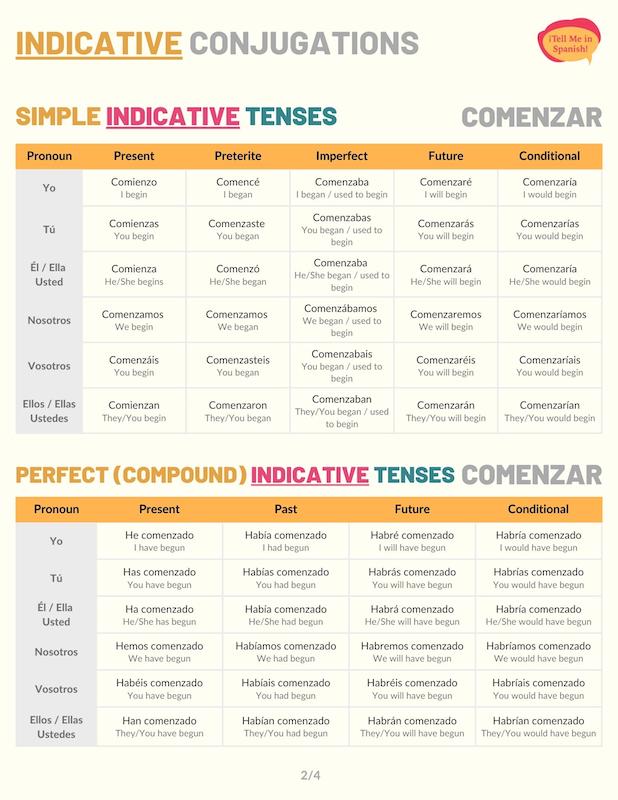
I’ve created a PDF for you to download containing all of the conjugation tables, verb characteristics, and uses so you can study it at your own pace!
Practice Quiz: Comenzar Conjugation
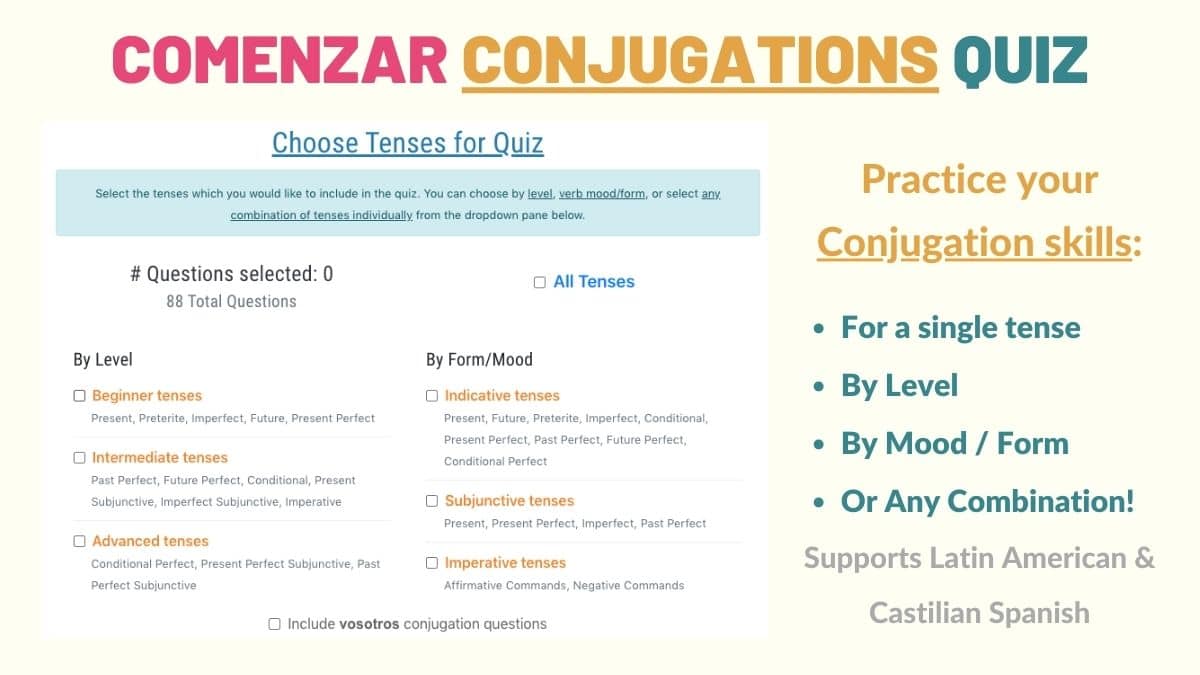
Now that you’ve learned how to conjugate comenzar, take the comenzar conjugation practice quiz to test your knowledge on the various tenses with stem-changes.