Since it’s such a common verb, in this guide, you’ll find all the conjugation charts for ‘jugar’.
- Jugar Overview
- Indicative Tenses of Jugar Conjugations
- Subjunctive Tenses of Jugar Conjugations
- Imperative (Commands) of Jugar Conjugations
- Uses & Examples
- Download Jugar Conjugation Tables & Uses Cheat sheets
- Jugar Conjugation Practice Quiz
Take Note: There are many tenses in the Spanish language. However, we don’t use them all as some are simply old and outdated. So, in this guide, you will only learn the tenses you must know to become fluent in Spanish.
Overview of Jugar
| Verb Characteristic | Property |
|---|---|
| Verb Type | -AR |
| Irregular | No |
| Infinitive | Jugar |
| Gerund (Present Participle) Form | Jugando |
| Past Participle Form | Jugado |
| Synonyms | N/A |
Stem Changes: U to UE
- Present tense: jueg- for all subject pronouns except ‘nosotros’ and ‘vosotros’.
- Present subjunctive: jueg- for all subject pronouns.
- Affirmative imperative: jueg- for all forms except ‘vosotros’.
- Negative imperative: jueg- for all subject pronouns.
Indicative Conjugations of Jugar
Present tense
Jugar’s present conjugation has stem-changes from -U to -UE. With the exception of nosotros and vosotros, these changes are applied to all the subjects. For example, ‘jugar’ in ‘yo’ form would be ‘juego’.
The present tense of ‘jugar’ is used to talk about the games people currently play. Sandra y Jonathan juegan sudoku.
| Person | Conjugation | Translation |
|---|---|---|
| Yo | Juego | I play |
| Tú | Juegas | You play |
| Él / Ella Usted | Juega | He/She plays You (formal) play |
| Nosotros | Jugamos | We play |
| Vosotros | Jugáis | You play |
| Ellos / Ellas Ustedes | Juegan | They play You (plural) play |
Preterite tense
The preterite form of ‘jugar’ is irregular only for the pronoun ‘yo’. For this pronoun, we must add a ‘u’ before the preterite ending. In other words, the preterite form of ‘yo’ is ‘jugué’. In this tense, jugar refers to the games or sports you played at a specific moment in the past. For example: ayer jugamos juntos.
| Person | Conjugation | Translation |
|---|---|---|
| Yo | Jugué | I played |
| Tú | Jugaste | You played |
| Él / Ella Usted | Jugó | He/She played You (formal) played |
| Nosotros | Jugamos | We played |
| Vosotros | Jugasteis | You played |
| Ellos / Ellas Ustedes | Jugaron | They played You (plural) played |
Take Note: The spelling change in ‘yo’ is made to keep the pronunciation of ‘g’ consistent. This pattern is used with all Spanish verbs that end with –gar.
Imperfect tense
The imperfect form of jugar allows you to talk about the games you played repeatedly in the past. For instance, yo siempre jugaba en las tardes. Depending on the sentence, this tense can be translated as ‘used to play’ or ‘played’.
| Person | Conjugation | Translation |
|---|---|---|
| Yo | Jugaba | I played / I used to play |
| Tú | Jugabas | You played / You used to play |
| Él / Ella Usted | Jugaba | He/She played He/She used to play You (formal) played You (formal) used to play |
| Nosotros | Jugábamos | We played / We used to play |
| Vosotros | Jugabais | You played / You used to play |
| Ellos / Ellas Ustedes | Jugaban | They played They used to play You (plural) played You used to play |
Near future
The near future of jugar refers to games you’ll play in the immediate future. This tense is formed with ir (present) + a + jugar and can be translated as “going to play”. For example, hoy vamos a jugar con los perros.
| Person | Conjugation | Translation |
|---|---|---|
| Yo | Voy a jugar | I’m going to play |
| Tú | Vas a jugar | You’re going to play |
| Él / Ella Usted | Va a jugar | He/She is going to play You (formal) is going to play |
| Nosotros | Vamos a jugar | We’re going to play |
| Vosotros | Vais a jugar | You’re going to play |
| Ellos / Ellas Ustedes | Van a jugar | They’re going to play You (plural) are going to play |
Future simple tense
The Spanish simple future allows you to express that you will play something at some point in the future. For instance, algún día jugaré con ustedes.
| Person | Conjugation | Translation |
|---|---|---|
| Yo | Jugaré | I will play |
| Tú | Jugarás | You will play |
| Él / Ella Usted | Jugará | He/She will play You (formal) will play |
| Nosotros | Jugaremos | We will play |
| Vosotros | Jugaréis | You (formal) will play |
| Ellos / Ellas Ustedes | Jugarán | They will play You (plural) will play |
Conditional tense
The conditional form of ‘jugar’ conveys that someone would play something if certain circumstances are met. For example: jugaría contigo, pero me duele la rodilla. This tense is conjugated by adding the conditional endings to ‘jugar’.
| Person | Conjugation | Translation |
|---|---|---|
| Yo | Jugaría | I would play |
| Tú | Jugarías | You would play |
| Él / Ella Usted | Jugaría | He/She would play You (formal) would play |
| Nosotros | Jugaríamos | We would play |
| Vosotros | Jugaríais | You would play |
| Ellos / Ellas Ustedes | Jugarían | They would play You (plural) would play |
Present perfect tense
To form the present perfect conjugation, you must use the formula haber (present) + jugado. ‘Jugar’ in the present perfect tense talks about the games you haven’t played or games you did play in a moment close to the present. For example: no hemos jugado en una semana.
| Person | Conjugation | Translation |
|---|---|---|
| Yo | He jugado | I have played |
| Tú | Has jugado | You have played |
| Él / Ella Usted | Ha jugado | He/She has played You (formal) have played |
| Nosotros | Hemos jugado | We have played |
| Vosotros | Habéis jugado | You have played |
| Ellos / Ellas Ustedes | Han jugado | They have played You (plural) have played |
Past perfect
‘Jugar’ in the past perfect tense is formed with the imperfect form of haber + jugado, which is the past participle form of ‘jugar’. In Spanish, the past perfect of ‘jugar’ expresses that you played something before some other reference point in the past. Example: Ellos no habían jugado ajedrez.
| Person | Conjugation | Translation |
|---|---|---|
| Yo | Había jugado | I had played |
| Tú | Habías jugado | You had played |
| Él / Ella Usted | Había jugado | He/She had played You (formal) had played |
| Nosotros | Habíamos jugado | We had played |
| Vosotros | Habíais jugado | You had played |
| Ellos / Ellas Ustedes | Habían jugado | They had played You (plural) had played |
Future perfect
The future perfect of ‘jugar’ is built by conjugating haber to the future tense and adding jugar’s past participle (jugado). This verb in the future perfect tense communicates you’ll have played something by or before a certain time in the future. El martes habremos jugado contra ellos.
| Person | Conjugation | Translation |
|---|---|---|
| Yo | Habré jugado | I will have played |
| Tú | Habrás jugado | You will have played |
| Él / Ella Usted | Habrá jugado | He/She will have played You (formal) will have played |
| Nosotros | Habremos jugado | We will have played |
| Vosotros | Habréis jugado | You will have played |
| Ellos / Ellas Ustedes | Habrán jugado | They will have played You (plural) will have played |
Conditional perfect
‘Jugar’ conjugated to the conditional perfect is used to talk about games you would have told someone if a past condition was met. For example: si me hubieras dicho, habría jugado.
| Person | Conjugation | Translation |
|---|---|---|
| Yo | Habría jugado | I would have played |
| Tú | Habrías jugado | You would have played |
| Él / Ella Usted | Habría jugado | He/She would have played You (formal) would have played |
| Nosotros | Habríamos jugado | We would have played |
| Vosotros | Habríais jugado | You would have played |
| Ellos / Ellas Ustedes | Habrían jugado | They would have played You (plural) would have played |
Progressive tenses
The progressive tenses in Spanish refer to actions that are in progress at the moment of speaking. Using ‘jugar’, it expresses that someone is playing right now. For instance, estoy jugando con el bebé. The progressive conjugations of jugar are formed with estar (conjugated) + jugando.
| Progressive Tense | Formula | Translation Example |
|---|---|---|
| Present | Estar (present) + jugando | I am playing |
| Preterite | Estar (preterite) + jugando | You were playing |
| Imperfect | Estar (imperfect) + jugando | He was playing |
| Future | Estar (future) + jugando | We will be playing |
| Conditional | Estar (conditional) + jugando | They would be playing |
Jugar Subjunctive Conjugations
The Spanish subjunctive mood is used to talk about wishes, suggestions and hypothetical situations. Below are conjugation charts with the subjunctive forms of ‘jugar’.
Present subjunctive
‘Jugar’ subjunctive conjugation has spelling changes for all subjects. In other words, to conjugate all the forms of the present subjunctive of ‘jugar’, you must use the stem juegu-. The present subjunctive of ‘jugar’ is used to wish or ask someone to play. For example, quiero que jueguen bien.
| Person | Conjugation | Translation |
|---|---|---|
| Yo | Juegue | I play |
| Tú | Juegues | You play |
| Él / Ella Usted | Juegue | He/She plays You (formal) play |
| Nosotros | Juguemos | We play |
| Vosotros | Juguéis | You play |
| Ellos / Ellas Ustedes | Jueguen | They play You (plural) play |
Take Note: Spanish stem-changing verbs, such as ‘jugar’, use spelling changes to keep the pronunciation of a verb consistent.
Present perfect subjunctive
Haber in the present subjunctive + jugado is the structure you should use to build the present perfect subjunctive form of ‘jugar’. The present perfect subjunctive of ‘jugado’ is used to talk about wishes and probabilities. For example, ojalá hayan jugado bien.
| Person | Conjugation | Translation |
|---|---|---|
| Yo | Haya jugado | I have played |
| Tú | Hayas jugado | You have played |
| Él / Ella Usted | Haya jugado | He/She has played You (formal) has played |
| Nosotros | Hayamos jugado | We have played |
| Vosotros | Hayáis jugado | You have played |
| Ellos / Ellas Ustedes | Hayan jugado | They have played You (plural) have played |
Imperfect subjunctive
We use the imperfect subjunctive of ‘jugar’ to talk about past wishes, requests or hypothetical situations that are difficult to accomplish. For example, Juan me pidió que jugara contigo.
In Spanish, the imperfect subjunctive has two conjugation models:
Latin American Spanish version
| Person | Conjugation | Translation |
|---|---|---|
| Yo | Jugara | I played |
| Tú | Jugaras | You played |
| Él / Ella Usted | Jugara | He/She played You (formal) played |
| Nosotros | Jugáramos | We played |
| Ellos / Ellas Ustedes | Jugaran | They played You (plural) played |
Note: The table above doesn’t include the conjugation for vosotros because this subject pronoun is not used in Latin American Spanish.
Castilian Spanish version
| Person | Conjugation | Translation |
|---|---|---|
| Yo | Jugase | I played |
| Tú | Jugases | You played |
| Él / Ella Usted | Jugase | He/She played You (formal) played |
| Nosotros | Jugásemos | We played |
| Vosotros | Jugaseis | You played |
| Ellos / Ellas Ustedes | Jugasen | They played You (plural) played |
Past perfect subjunctive
The past perfect subjunctive of ‘jugar’ describes hypothetical situations that can no longer happen because their time has passed. For example si hubieras jugado, no habríamos perdido (if you had played, we wouldn’t have lost).
| Person | Conjugation | Translation |
|---|---|---|
| Yo | Hubiera jugado | I had played |
| Tú | Hubieras jugado | You had played |
| Él / Ella Usted | Hubiera jugado | He/She had played You (formal) had played |
| Nosotros | Hubiéramos jugado | We had played |
| Vosotros | Hubierais jugado | You had played |
| Ellos / Ellas Ustedes | Hubieran jugado | They had played You (plural) had played |

Jugar Imperative Conjugations
Spanish commands (imperative mood) is used to tell people what to do (affirmative commands) or what not to do (negative commands).
Affirmative commands
With the exception of ‘vosotros’, the affirmative commands of ‘jugar’ are formed with the stem jueg. The affirmative imperative of ‘jugar’ is used to order someone to play. For instance, juega con tu hermano.
| Person | Conjugation | Translation |
|---|---|---|
| Tú | Juega | Play |
| Usted | Juegue | Play |
| Vosotros | Jugad | Play |
| Ustedes | Jueguen | Play |
Negative commands
Negative commands of ‘jugar’ are formed based on the present subjunctive conjugation. As a result, all the negative imperative forms of ‘jugar’ have spelling changes. The negative imperative of ‘jugar’ is used to order someone to not play with something or someone. Niños, no jueguen con la estufa.
| Person | Conjugation | Translation |
|---|---|---|
| Tú | No juegues | Don’t play |
| Usted | No juegue | Don’t play |
| Vosotros | No jueguéis | Don’t play |
| Ustedes | No jueguen | Don’t play |
Examples of ‘Jugar’ Sentences in Spanish
With these conjugation charts in mind, it’s time for you to learn the most common applications of ‘jugar’. Although it means ‘to play’, in Spanish, jugar cannot be used when referring to musical instruments, acting or playing a movie.
Use #1: Talking about games and recreational activities
[‘Jugar’ conjugated] + [complement]
El niño está jugando con sus juguetes.
The boy is playing with his toys.
Espero que mañana jueguen mejor.
I hope tomorrow you guys play better.
¿Estamos jugando a las escondidas?
Are we playing hide and seek?
Use #2: Talking about taking risks
[Reflexive pronoun] + la + [‘jugar’ conjugated]
Vamos perdiendo, ¿nos la jugamos?
We’re losing, should we take the plunge?
Download Jugar Conjugation Tables & Uses Cheat sheets
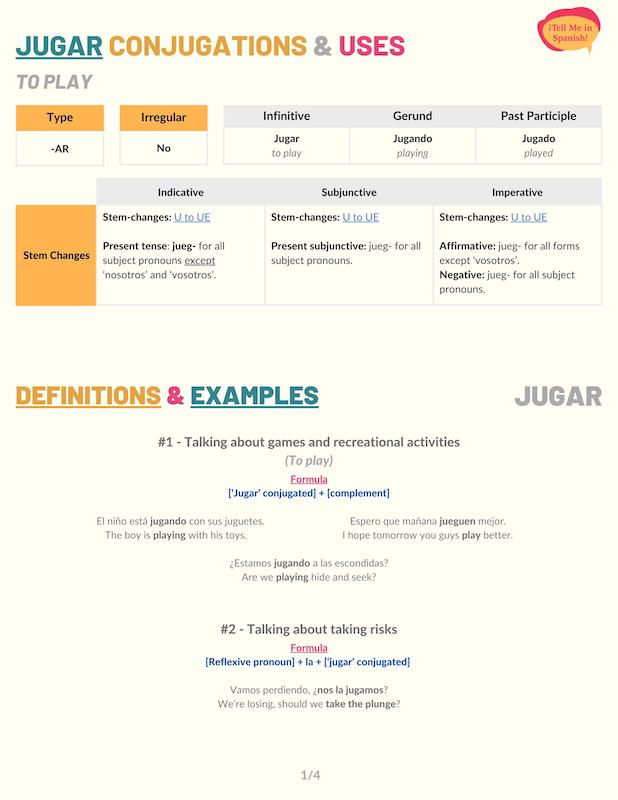
Download the PDF containing all of jugar’s conjugation tables, verb characteristics, and uses so you can study it at your own pace!
Practice Quiz: Jugar Conjugation
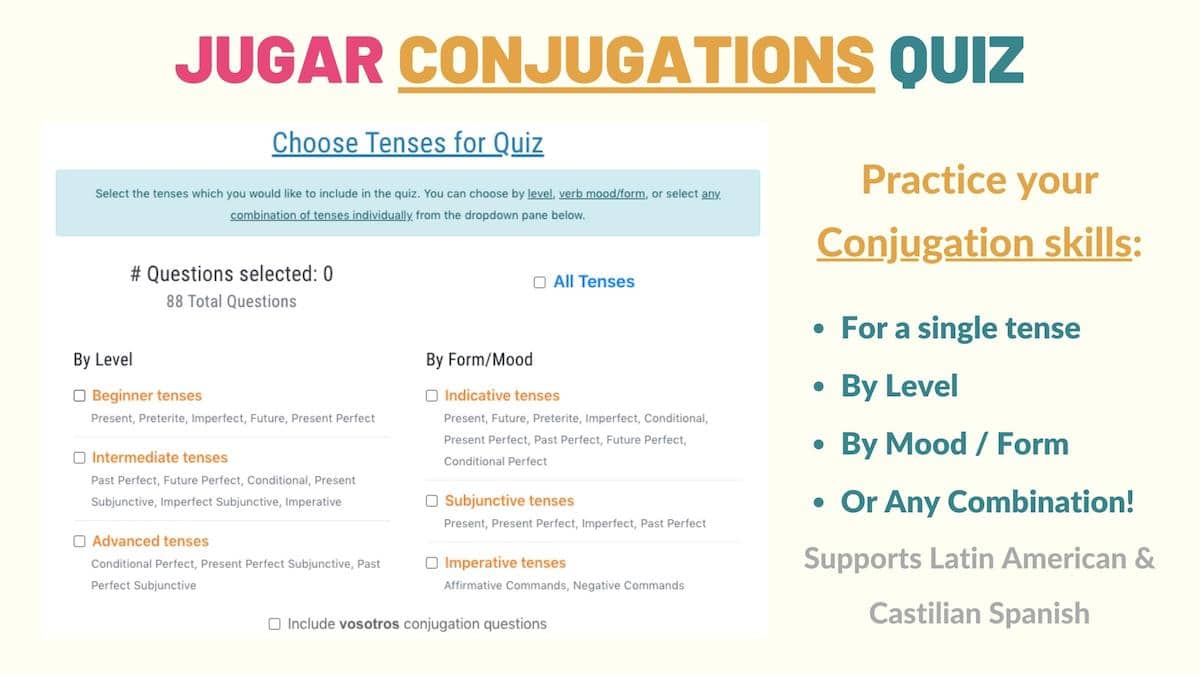
Click here to take the jugar conjugation practice quiz and put your knowledge to the test!