
Abrir is one of the few regular -IR verbs. Since this word is used in daily conversations and can help you practice this group of verbs, we’ll review the most important abrir conjugation patterns you need to know to learn fluent Spanish. Here is what we’ll go over:
- Abrir Overview
- Indicative Tenses of Abrir Conjugations
- Subjunctive Tenses of Abrir Conjugations
- Imperative (Commands) of Abrir Conjugations
- Uses & Examples
- Download Abrir Conjugation Tables & Uses Cheat sheets
- Abrir Conjugation Practice Quiz
Overview of Abrir
| Verb Characteristic | Property |
|---|---|
| Verb Type | -IR |
| Irregular | No |
| Infinitive | Abrir |
| Gerund (Present Participle) Form | Abriendo |
| Past Participle Form | Abierto |
| Synonyms | Destapar, empezar, comenzar, sincerarse. |
Depending on the context, abrir means ‘to open’, ‘to open up’, ‘to turn on’, or ‘to unfold’. However, the abrir conjugation charts below contain one translation to keep the tables as organized as possible. Check more about this verb’s uses in the Uses & Meanings section.
Indicative Conjugations of Abrir
Present tense
Use abrir present tense conjugations to say that someone is opening a place, a present, or a water faucet. For example: ¿A qué hora abren la tienda?
| Person | Conjugation | Translation |
|---|---|---|
| Yo | Abro | I open |
| Tú | Abres | You open |
| Él / Ella Usted | Abre | He/She opens You (formal) open |
| Nosotros | Abrimos | We open |
| Vosotros | Abrís | You open |
| Ellos / Ellas Ustedes | Abren | They open You (plural) open |
Preterite tense
Abrir preterite conjugations are also regular. When conjugated to the preterite in Spanish, this verb conveys that someone opened something at a specific time in the past. For instance: Ayer abrimos nuestros regalos.
| Person | Conjugation | Translation |
|---|---|---|
| Yo | Abrí | I opened |
| Tú | Abriste | You opened |
| Él / Ella Usted | Abrió | He/She opened You (formal) opened |
| Nosotros | Abrimos | We opened |
| Vosotros | Abristeis | You opened |
| Ellos / Ellas Ustedes | Abrieron | They opened You (plural) opened |
Imperfect tense
The abrir imperfect conjugations are used to talk about the things people repeatedly opened in the past. Here is an example: Cuando era niña, mi hermana siempre abría mi mochila.
| Person | Conjugation | Translation |
|---|---|---|
| Yo | Abría | I opened I used to open |
| Tú | Abrías | You opened You used to open |
| Él / Ella Usted | Abría | He/She opened He/She used to open You (formal) opened You (formal) used to open |
| Nosotros | Abríamos | We opened We used to open |
| Vosotros | Abríais | You opened You used to open |
| Ellos / Ellas Ustedes | Abrían | They opened They used to open You (plural) opened You (plural) used to open |
Near future
To conjugate to the immediate future in Spanish, you must use the present tense conjugations of ir + a + abrir. These forms of abrir allow you to communicate that someone will open something in the immediate future. For instance: ¿Quién va a abrir la puerta?
| Person | Conjugation | Translation |
|---|---|---|
| Yo | Voy a abrir | I’m going to open |
| Tú | Vas a abrir | You’re going to open |
| Él / Ella Usted | Va a abrir | He/She is going to open You (formal) are going to open |
| Nosotros | Vamos a abrir | We’re going to open |
| Vosotros | Vais a abrir | You’re going to open |
| Ellos / Ellas Ustedes | Van a abrir | They’re going to open You (plural) are going to open |
Future simple tense
Use the future simple conjugations of abrir to say that a person will open something at some time in the future. Algún día, abriré mi propio restaurante.
| Person | Conjugation | Translation |
|---|---|---|
| Yo | Abriré | I will open |
| Tú | Abrirás | You will open |
| Él / Ella Usted | Abrirá | He/She will open You (formal) will open |
| Nosotros | Abriremos | We will open |
| Vosotros | Abriréis | You (formal) will open |
| Ellos / Ellas Ustedes | Abrirán | They will open You (plural) will open |
Conditional tense
When conjugated to the Spanish conditional tense, this verb conveys that someone would open something. This tense can be combined with conditions if you need to express that a condition should be met for this action to happen.
For example: Mis roomies nunca abrirían algo que no es suyo.
| Person | Conjugation | Translation |
|---|---|---|
| Yo | Abriría | I would open |
| Tú | Abrirías | You would open |
| Él / Ella Usted | Abriría | He/She would open You (formal) would open |
| Nosotros | Abriríamos | We would open |
| Vosotros | Abriríais | You would open |
| Ellos / Ellas Ustedes | Abrirían | They would open You (plural) would open |
Present perfect tense
Haber present tense conjugations + past participle of ‘abrir’ (abierto) is the formula you must use to conjugate to the present perfect tense in Spanish. These forms of abrir allow you to say whether someone has opened something or not. For example: Todavía no hemos abierto las ventanas.
| Person | Conjugation | Translation |
|---|---|---|
| Yo | He abierto | I have opened |
| Tú | Has abierto | You have opened |
| Él / Ella Usted | Ha abierto | He/She has opened You (formal) have opened |
| Nosotros | Hemos abierto | We have opened |
| Vosotros | Habéis abierto | You have opened |
| Ellos / Ellas Ustedes | Han abierto | They have opened You (plural) have opened |
Take Note: Abrir is one of the few verbs with an irregular past participle form in Spanish. This is the only irregularity of this verb.
Past perfect
Conjugate abrir to the past perfect tense to explain that a person had opened something before a past reference point. This tense is formed by using haber imperfect conjugations + abierto. For example: Antes de las 9, Sally había abierto todos sus paquetes.
| Person | Conjugation | Translation |
|---|---|---|
| Yo | Había abierto | I had opened |
| Tú | Habías abierto | You had opened |
| Él / Ella Usted | Había abierto | He/She had opened You (formal) had opened |
| Nosotros | Habíamos abierto | We had opened |
| Vosotros | Habíais abierto | You had opened |
| Ellos / Ellas Ustedes | Habían abierto | They had opened You (plural) had opened |
Future perfect
The future perfect forms of this verb are formed with haber (future tense) + past participle verb. These abrir conjugations express that a person will have opened something by or before a time in the future. For example: Antes del fin de mes, habremos abierto todos estos archivos.
| Person | Conjugation | Translation |
|---|---|---|
| Yo | Habré abierto | I will have opened |
| Tú | Habrás abierto | You will have opened |
| Él / Ella Usted | Habrá abierto | He/She will have opened You (formal) will have opened |
| Nosotros | Habremos abierto | We will have opened |
| Vosotros | Habréis abierto | You will have opened |
| Ellos / Ellas Ustedes | Habrán abierto | They will have opened You (plural) will have opened |
Conditional perfect
The Spanish conditional tense of this verb allows you to say that a person would have opened something such as a door, faucet, present, container, or business if a past condition had occurred. For example: Si hubiéramos sabido que eras tú, no habríamos abierto la puerta.
| Person | Conjugation | Translation |
|---|---|---|
| Yo | Habría abierto | I would have opened |
| Tú | Habrías abierto | You would have opened |
| Él / Ella Usted | Habría abierto | He/She would have opened You (formal) would have opened |
| Nosotros | Habríamos abierto | We would have opened |
| Vosotros | Habríais abierto | You would have opened |
| Ellos / Ellas Ustedes | Habrían abierto | They would have opened You (plural) would have opened |
Progressive tenses
The Spanish progressive tenses are formed with estar indicative conjugations + a present participle verb (abriendo in this case). These conjugations of abrir allow you to say that someone is opening something at the moment in time of speaking. For example: Mi papá está abriendo el regalo que le trajimos.
| Progressive Tense | Formula | Translation Example |
|---|---|---|
| Present | Estar (present) + abriendo | I am opening |
| Preterite | Estar (preterite) + abriendo | You were opening |
| Imperfect | Estar (imperfect) + abriendo | He was opening |
| Future | Estar (future) + abriendo | We will be opening |
| Conditional | Estar (conditional) + abriendo | They would be opening |
Abrir Subjunctive Conjugations
A verb conjugated to one of the subjunctive tenses is used to express someone’s hopes, expectations, wishes, advice, recommendations, demands, doubts, or hypothetical situations. In the following sections, we’ll review abrir conjugation charts for these tenses.
Present subjunctive
The present subjunctive forms of abrir allow you to mention a person’s suggestions, hopes, or demands about someone opening something. For instance: Tengan cuidado cuando abran la puerta.
| Person | Conjugation | Translation |
|---|---|---|
| Yo | Abra | I open |
| Tú | Abras | You open |
| Él / Ella Usted | Abra | He/She opens You (formal) open |
| Nosotros | Abramos | We open |
| Vosotros | Abráis | You open |
| Ellos / Ellas Ustedes | Abran | They open You (plural) open |
Present perfect subjunctive
Use the present subjunctive forms of haber + abierto to build the present perfect subjunctive tense. These conjugations allow you to express wishes or uncertainty about whether someone has already opened something or not. Quien haya abierto mi correo va a tener problemas.
| Person | Conjugation | Translation |
|---|---|---|
| Yo | Haya abierto | I have opened |
| Tú | Hayas abierto | You have opened |
| Él / Ella Usted | Haya abierto | He/She has opened You (formal) have opened |
| Nosotros | Hayamos abierto | We have opened |
| Vosotros | Hayáis abierto | You have opened |
| Ellos / Ellas Ustedes | Hayan abierto | They have opened You (plural) have opened |
Imperfect subjunctive
Conjugate this verb to the imperfect subjunctive if you want to refer to past wishes, requests, expectations, or recommendations you had about a person opening something. For instance: Niños, les dije que sólo abrieran la llave del agua caliente.
Castilian and Latin American Spanish have two different conjugation endings for the imperfect subjunctive tense:
Latin American Spanish version
| Person | Conjugation | Translation |
|---|---|---|
| Yo | Abriera | I opened |
| Tú | Abrieras | You opened |
| Él / Ella Usted | Abriera | He/She opened You (formal) opened |
| Nosotros | Abriéramos | We opened |
| Ellos / Ellas Ustedes | Abrieran | They opened You (plural) opened |
Note: The abrir conjugation for vosotros isn’t included in the chart above because this pronoun is not used in Latin American Spanish.
Castilian Spanish version
| Person | Conjugation | Translation |
|---|---|---|
| Yo | Abriese | I opened |
| Tú | Abrieses | You opened |
| Él / Ella Usted | Abriese | He/She opened You (formal) opened |
| Nosotros | Abriésemos | We opened |
| Vosotros | Abrieseis | You opened |
| Ellos / Ellas Ustedes | Abriesen | They opened You (plural) opened |
Past perfect subjunctive
Conjugate abrir to the past perfect subjunctive to express that someone would have opened something if a past circumstance had taken place. You can also use this tense to say you wish you had or hadn’t opened something. Si hubieras abierto la puerta, no me habría mojado.
| Person | Conjugation | Translation |
|---|---|---|
| Yo | Hubiera abierto | I had opened |
| Tú | Hubieras abierto | You had opened |
| Él / Ella Usted | Hubiera abierto | He/She had opened You (formal) had opened |
| Nosotros | Hubiéramos abierto | We had opened |
| Vosotros | Hubierais abierto | You had opened |
| Ellos / Ellas Ustedes | Hubieran abierto | They had opened You (plural) had opened |


Abrir Imperative Conjugations
The imperative is the mood we use to give commands in Spanish.
Affirmative commands
Conjugate this verb to the Spanish affirmative imperative to order someone to open something. For instance: Chicos, abran sus libros en la página 20.
| Person | Conjugation | Translation |
|---|---|---|
| Tú | Abre | Open |
| Usted | Abra | Open |
| Vosotros | Abrid | Open |
| Ustedes | Abran | Open |
Negative commands
If you wish to command someone not to open something, you must conjugate abrir to the negative imperative in Spanish. Here is an example: No abras el refrigerador si no lo necesitas.
| Person | Conjugation | Translation |
|---|---|---|
| Tú | No abras | Don’t open |
| Usted | No abra | Don’t open |
| Vosotros | No abráis | Don’t open |
| Ustedes | No abran | Don’t open |
Meanings of Abrir & Examples
In the previous sections, we’ve reviewed how to conjugate abrir in Spanish. So, in this section, we’ll learn how to use this verb correctly. Based on the context and the type of words you use, abrir means to:
- Open
- Turn on (only water faucets)
- Open up
- Unfold or unwrap
- Start or set up (businesses)
[Abrir conjugated] + [complement]
Alguien me abrió la bolsa.
Someone opened my bag.
Edith nunca se abre con nadie.
Edith never opens up to anyone.
Mis vecinos van a abrir un restaurante.
My neighbors are going to open a restaurant.
Take Note: Use direct object pronouns when you want to replace the thing someone opens. However, you must use indirect object pronouns if you’re opening something for someone (like a door). Finally, when using Spanish reflexive pronouns, abrir means to open up.
Download Abrir Conjugation Charts & Uses Cheat sheet
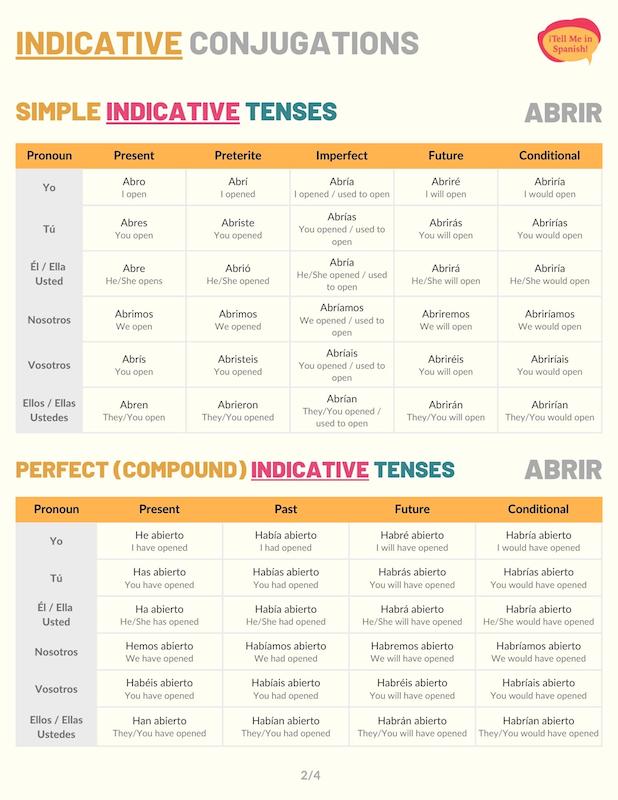
Abrir is one of the most fundamental verbs for Spanish beginners to learn. Since it has an irregular past participle, it can be difficult to remember. I’ve created a cheat sheet PDF you can download which includes all the abrir conjugation charts as well as its meanings and uses so you can study at your own pace.
Practice Quiz: Abrir Conjugation
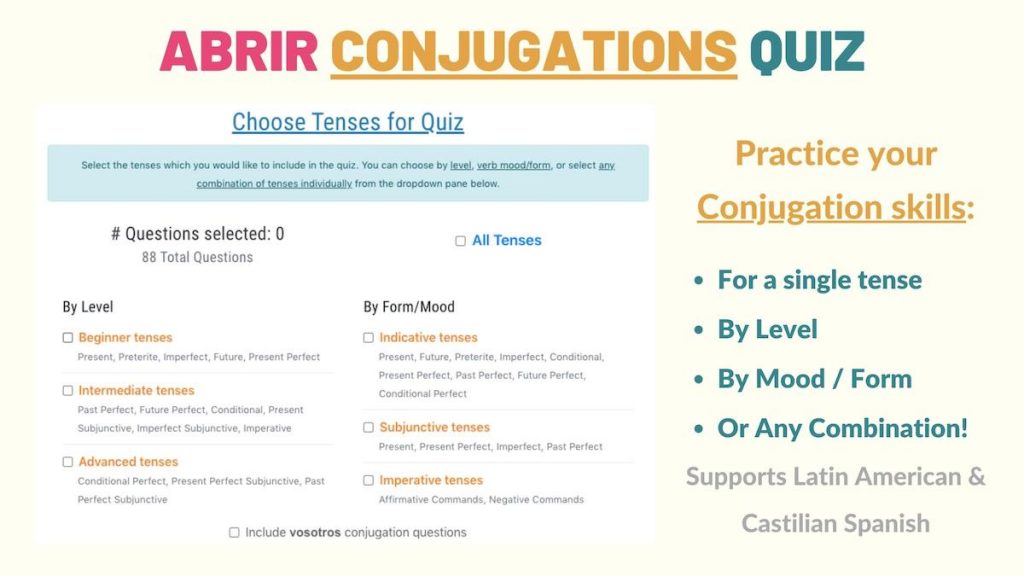
Now that you’ve seen how to conjugate this verb, the next step is to take the abrir conjugation practice quiz. It’s a great way to practice the regular -IR conjugations. You can also select which combination of tenses you want to include in the quiz.