
Cocinar conjugation is regular. Since this is a verb you can use to practice the -AR model and is also basic for your conversations, in this guide, you’ll learn how to conjugate cocinar. Here’s a summary of what we’ll go over:
- Cocinar Overview
- Indicative Tenses of Cocinar Conjugations
- Subjunctive Tenses of Cocinar Conjugations
- Imperative (Commands) of Cocinar Conjugations
- Uses & Examples
- Download Cocinar Conjugation Tables & Uses Cheat sheets
- Cocinar Conjugation Practice Quiz
Overview of Cocinar
| Verb Characteristic | Property |
|---|---|
| Verb Type | -AR |
| Irregular | No |
| Infinitive | Cocinar |
| Gerund (Present Participle) Form | Cocinando |
| Past Participle Form | Cocinado |
| Synonyms | Guisar, cocer, preparar. |
Indicative Conjugations of Cocinar
Present tense
To conjugate cocinar to the present Spanish tense, you must add the corresponding -AR endings to the verb’s root. This verb’s indicative present conjugations communicate that people cook or how they do this activity. For instance: Vosotras cocináis muy bien.
| Person | Conjugation | Translation |
|---|---|---|
| Yo | Cocino | I cook |
| Tú | Cocinas | You cook |
| Él / Ella Usted | Cocina | He/She cooks You (formal) cook |
| Nosotros | Cocinamos | We cook |
| Vosotros | Cocináis | You cook |
| Ellos / Ellas Ustedes | Cocinan | They cook You (plural) cook |
Preterite tense
Use the preterite conjugations of cocinar to say that someone cooked at a specific moment in the past. For example: Ayer cocinamos varias cosas para la semana.
| Person | Conjugation | Translation |
|---|---|---|
| Yo | Cociné | I cooked |
| Tú | Cocinaste | You cooked |
| Él / Ella Usted | Cocinó | He/She cooked You (formal) cooked |
| Nosotros | Cocinamos | We cooked |
| Vosotros | Cocinasteis | You cooked |
| Ellos / Ellas Ustedes | Cocinaron | They cooked You (plural) cooked |
Imperfect tense
Cocinar imperfect conjugation conveys that a person cooked for an extended period of time in the past. In this case, you can also use the imperfect tense in Spanish to describe how people used to cook. For example: Cuando era niña, mis papás cocinaban todos los días.
| Person | Conjugation | Translation |
|---|---|---|
| Yo | Cocinaba | I cooked I used to cook |
| Tú | Cocinabas | You cooked You used to cook |
| Él / Ella Usted | Cocinaba | He/She cooked He/She used to cook You (formal) cooked You (formal) used to cook |
| Nosotros | Cocinábamos | We cooked We used to cook |
| Vosotros | Cocinabais | You cooked You used to cook |
| Ellos / Ellas Ustedes | Cocinaban | They cooked They used to cook You (plural) cooked You (plural) used to cook |
Near future
Ir present tense conjugations + a + cocinar is how you conjugate this verb to the immediate or near future in Spanish. These forms allow you to say that a person will cook something soon in the future. For instance: Hoy vamos a cocinar pollo.
| Person | Conjugation | Translation |
|---|---|---|
| Yo | Voy a cocinar | I’m going to cook |
| Tú | Vas a cocinar | You’re going to cook |
| Él / Ella Usted | Va a cocinar | He/She is going to cook You (formal) are going to cook |
| Nosotros | Vamos a cocinar | We’re going to cook |
| Vosotros | Vais a cocinar | You’re going to cook |
| Ellos / Ellas Ustedes | Van a cocinar | They’re going to cook You (plural) are going to cook |
Future simple tense
With this verb, the future simple in Spanish conveys that someone will cook something at some point in the future. Here is an example: Algún día, cocinaré tan delicioso como mi abuela.
| Person | Conjugation | Translation |
|---|---|---|
| Yo | Cocinaré | I will cook |
| Tú | Cocinarás | You will cook |
| Él / Ella Usted | Cocinará | He/She will cook You (formal) will cook |
| Nosotros | Cocinaremos | We will cook |
| Vosotros | Cocinaréis | You (formal) will cook |
| Ellos / Ellas Ustedes | Cocinarán | They will cook You (plural) will cook |
Conditional tense
Conjugate cocinar to the conditional tense in Spanish expresses that someone would cook. You can combine this tense with conditions or ask someone politely to cook something for you. For example: Mamá, ¿me cocinarías el pollo que me gusta?
| Person | Conjugation | Translation |
|---|---|---|
| Yo | Cocinaría | I would cook |
| Tú | Cocinarías | You would cook |
| Él / Ella Usted | Cocinaría | He/She would cook You (formal) would cook |
| Nosotros | Cocinaríamos | We would cook |
| Vosotros | Cocinaríais | You would cook |
| Ellos / Ellas Ustedes | Cocinarían | They would cook You (plural) would cook |
Present perfect tense
To form the present perfect in Spanish, you must use the present forms of haber + cocinado (verb in past participle). These cocinar conjugations explain whether someone has cooked or not. For instance: ¿No han cocinado la carne?
| Person | Conjugation | Translation |
|---|---|---|
| Yo | He cocinado | I have cooked |
| Tú | Has cocinado | You have cooked |
| Él / Ella Usted | Ha cocinado | He/She has cooked You (formal) have cooked |
| Nosotros | Hemos cocinado | We have cooked |
| Vosotros | Habéis cocinado | You have cooked |
| Ellos / Ellas Ustedes | Han cocinado | They have cooked You (plural) have cooked |
Past perfect
Use the past perfect forms of cocinar to say that someone had or hadn’t cooked something before another past reference point. To form this tense, use haber (imperfect tense) + cocinado (verb in past participle form). Cuando llegué, mis amigas ya habían cocinado.
| Person | Conjugation | Translation |
|---|---|---|
| Yo | Había cocinado | I had cooked |
| Tú | Habías cocinado | You had cooked |
| Él / Ella Usted | Había cocinado | He/She had cooked You (formal) had cooked |
| Nosotros | Habíamos cocinado | We had cooked |
| Vosotros | Habíais cocinado | You had cooked |
| Ellos / Ellas Ustedes | Habían cocinado | They had cooked You (plural) had cooked |
Future perfect
Conjugate this verb to the future perfect tense to talk about what people will have cooked. For example: ¿Qué habrá cocinado mi mamá para la cena?
| Person | Conjugation | Translation |
|---|---|---|
| Yo | Habré cocinado | I will have cooked |
| Tú | Habrás cocinado | You will have cooked |
| Él / Ella Usted | Habrá cocinado | He/She will have cooked You (formal) will have cooked |
| Nosotros | Habremos cocinado | We will have cooked |
| Vosotros | Habréis cocinado | You will have cooked |
| Ellos / Ellas Ustedes | Habrán cocinado | They will have cooked You (plural) will have cooked |
Conditional perfect
The conditional perfect tense of cocinar conveys that someone would have cooked as long as a past circumstance had occurred. For instance: Si me hubieras dicho, yo habría cocinado la cena.
| Person | Conjugation | Translation |
|---|---|---|
| Yo | Habría cocinado | I would have cooked |
| Tú | Habrías cocinado | You would have cooked |
| Él / Ella Usted | Habría cocinado | He/She would have cooked You (formal) would have cooked |
| Nosotros | Habríamos cocinado | We would have cooked |
| Vosotros | Habríais cocinado | You would have cooked |
| Ellos / Ellas Ustedes | Habrían cocinado | They would have cooked You (plural) would have cooked |
Progressive tenses
Conjugations of estar + cocinando (gerund form) is the formula used to build the progressive tenses in Spanish. Use these conjugations to say that someone is cooking at the moment of speaking. Or, in the case of the past tenses (imperfect or preterite), to express that someone was cooking when something happened.
For example: A las 9, Tina todavía estaba cocinando.
| Progressive Tense | Formula | Translation Example |
|---|---|---|
| Present | Estar (present) + cocinando | I am cooking |
| Preterite | Estar (preterite) + cocinando | You were cooking |
| Imperfect | Estar (imperfect) + cocinando | He was cooking |
| Future | Estar (future) + cocinando | We will be cooking |
| Conditional | Estar (conditional) + cocinando | They would be cooking |
Cocinar Subjunctive Conjugations
Use the Spanish subjunctive mood’s tenses to refer to someone’s hopes, wishes, demands, advice, doubts, or hypothetical situations. In the sections below, we’ll go over the cocinar conjugation charts for the key subjunctive tenses.
Present subjunctive
As shown in the cocinar conjugation chart below, this verb’s present subjunctive forms are regular. We use this tense to mention any suggestions or requests about someone cooking. For example: Quiero que cocines el pollo que me gusta.
| Person | Conjugation | Translation |
|---|---|---|
| Yo | Cocine | I cook |
| Tú | Cocines | You cook |
| Él / Ella Usted | Cocine | He/She cooks You (formal) cook |
| Nosotros | Cocinemos | We cook |
| Vosotros | Cocinéis | You cook |
| Ellos / Ellas Ustedes | Cocinen | They cook You (plural) cook |
Present perfect subjunctive
The Spanish present perfect subjunctive of ‘cocinar’ is formed with haber (present subjunctive) + cocinado. In this tense, this verb is used to wonder about what someone has cooked. For instance: ¿Qué crees que hayan cocinado en la casa de mi tía?
| Person | Conjugation | Translation |
|---|---|---|
| Yo | Haya cocinado | I have cooked |
| Tú | Hayas cocinado | You have cooked |
| Él / Ella Usted | Haya cocinado | He/She has cooked You (formal) have cooked |
| Nosotros | Hayamos cocinado | We have cooked |
| Vosotros | Hayáis cocinado | You have cooked |
| Ellos / Ellas Ustedes | Hayan cocinado | They have cooked You (plural) have cooked |
Imperfect subjunctive
Conjugate this verb to the imperfect subjunctive to talk about past wishes, demands, suggestions, or expectations you had about someone cooking. For example: Me gustaría que cocinaras más rápido.
In Spanish, there are two ways to conjugate the imperfect subjunctive:
Latin American Spanish version
| Person | Conjugation | Translation |
|---|---|---|
| Yo | Cocinara | I cooked |
| Tú | Cocinaras | You cooked |
| Él / Ella Usted | Cocinara | He/She cooked You (formal) cooked |
| Nosotros | Cocináramos | We cooked |
| Ellos / Ellas Ustedes | Cocinaran | They cooked You (plural) cooked |
Note: Latin American Spanish doesn’t use the pronoun vosotros. Therefore, this conjugation has been excluded from the previous conjugations chart.
Castilian Spanish version
| Person | Conjugation | Translation |
|---|---|---|
| Yo | Cocinase | I cooked |
| Tú | Cocinases | You cooked |
| Él / Ella Usted | Cocinase | He/She cooked You (formal) cooked |
| Nosotros | Cocinásemos | We cooked |
| Vosotros | Cocinaseis | You cooked |
| Ellos / Ellas Ustedes | Cocinasen | They cooked You (plural) cooked |
Past perfect subjunctive
Cocinar conjugated to the past perfect subjunctive expresses that someone would have cooked if a past condition was fulfilled. These conjugations are also used to show regret for cooking or not cooking. Si me hubieras dicho que ibas a venir, hubiera cocinado tu comida favorita.
| Person | Conjugation | Translation |
|---|---|---|
| Yo | Hubiera cocinado | I had cooked |
| Tú | Hubieras cocinado | You had cooked |
| Él / Ella Usted | Hubiera cocinado | He/She had cooked You (formal) had cooked |
| Nosotros | Hubiéramos cocinado | We had cooked |
| Vosotros | Hubierais cocinado | You had cooked |
| Ellos / Ellas Ustedes | Hubieran cocinado | They had cooked You (plural) had cooked |


Cocinar Imperative Conjugations
If you need to give commands in Spanish, you must conjugate to the imperative mood.
Affirmative commands
Cocinar affirmative commands conjugations are regular. We use this verb’s imperative forms to order someone to cook something. For example: Por favor, cocina otra cosa.
| Person | Conjugation | Translation |
|---|---|---|
| Tú | Cocina | Cook |
| Usted | Cocine | Cook |
| Vosotros | Cocinad | Cook |
| Ustedes | Cocinen | Cook |
Negative commands
On the other hand, you can use the negative imperative conjugations to command someone not to cook. For instance: No cocines con tanta sal.
| Person | Conjugation | Translation |
|---|---|---|
| Tú | No cocines | Don’t cook |
| Usted | No cocine | Don’t cook |
| Vosotros | No cocinéis | Don’t cook |
| Ustedes | No cocinen | Don’t cook |
Meanings of Cocinar & Examples
So, now that you know how to conjugate cocinar in Spanish, in this section, you’ll learn how to apply this verb correctly.
Use Spanish direct object pronouns when replacing the dish or thing you’re cooking. However, if you’re talking about cooking for someone, you must use indirect object pronouns.
(Object pronoun) + [cocinar conjugated]
Mi mamá ha cocinado muy bien.
My mom has always cooked very well
¿Ustedes que cocinarán para Navidad?
What will guys cook for Christmas?
¿Y las verduras? ¿Cómo las cocino?
And the vegetables? How do I cook them?
¿Qué les vas a cocinar a tus suegros?
What are you going to cook for your in-laws?
Take Note: You can use expressions like al vapor (steamed), a la parrilla (grilled), or a fuego lento (on a slow burn/roast) to refer to the cooking method you use to prepare something.
Download Cocinar Conjugation Charts & Uses Cheat sheet
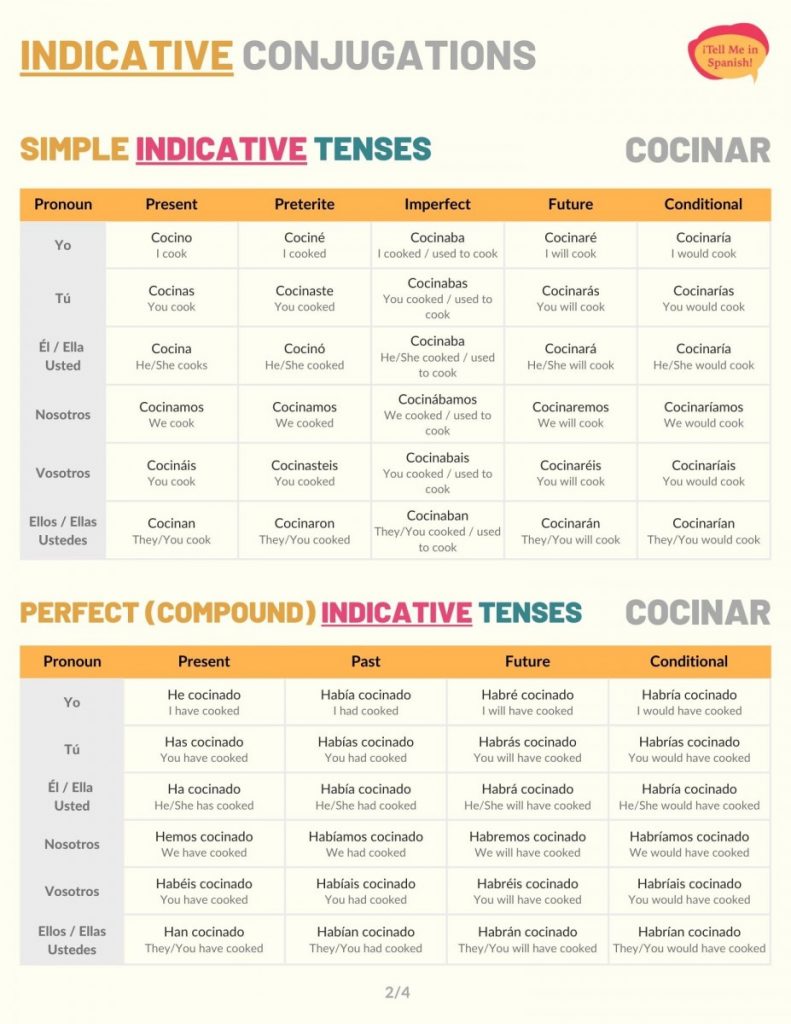
I’ve created a cocinar cheat sheet PDF which you can download for free. It contains all the cocinar conjugation charts as well as its definition with examples of how to apply this verb in daily conversations.
Practice Quiz: Cocinar Conjugation
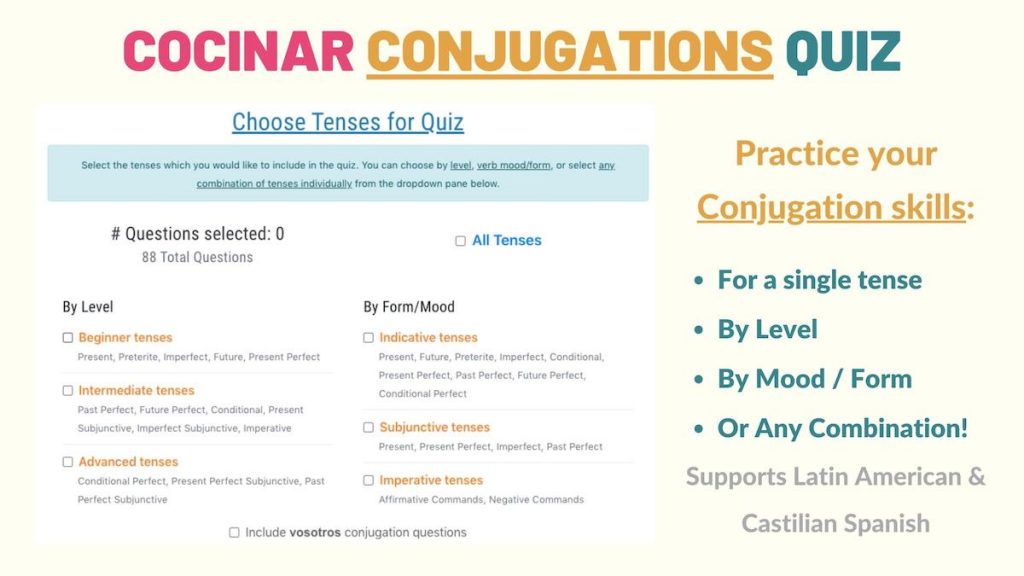
Now that you’ve learned how to conjugate this verb, the next step is to take the cocinar conjugation practice quiz which will test your skills in using the regular -AR verb patterns.