Creer is a basic -ER verb with stem changes in some past tenses. Since, in Spanish, we use this verb to express our opinions and beliefs, you need to know how to conjugate it. So, in this guide, we’ll go over the creer conjugation patterns you need to master Spanish. Here is a summary of what we’ll cover:
- Creer Overview
- Indicative Tenses of Creer Conjugations
- Subjunctive Tenses of Creer Conjugations
- Imperative (Commands) of Creer Conjugations
- Uses & Examples
- Download Creer Conjugation Tables & Uses Cheat sheets
- Creer Conjugation Practice Quiz
Overview of Creer
| Verb Characteristic | Property |
|---|---|
| Verb Type | -ER |
| Irregular | No |
| Infinitive | Creer |
| Gerund (Present Participle) Form | Creyendo |
| Past Participle Form | Creído |
| Synonyms | Pensar, opinar, suponer. |
Stem Changes:
- Preterite: crey for the third-person singular and plural.
- Imperfect Subjunctive: creye for all subject pronouns.
When providing opinions, creer means ‘to think’ or ‘to believe’. However, the creer conjugation charts below only use one translation to keep things as organized as possible. You can check how to use this verb in the section Uses & Meanings.
Indicative Conjugations of Creer
Present tense
When conjugated to the present indicative tense in Spanish, creer communicates someone’s beliefs or opinions about a particular topic. For example: Creo que Matt está enojado contigo.
| Person | Conjugation | Translation |
|---|---|---|
| Yo | Creo | I believe |
| Tú | Crees | You believe |
| Él / Ella Usted | Cree | He/She believes You (formal) believe |
| Nosotros | Creemos | We believe |
| Vosotros | Creéis | You believe |
| Ellos / Ellas Ustedes | Creen | They believe You (plural) believe |
Preterite tense
Creer preterite conjugations have a small change for the third-person singular and plural. With these subject pronouns, use the stem crey. The past preterite tense forms of creer express what a person thought or believed at some point in the past. For instance: Creí que la cita era a las 8.
| Person | Conjugation | Translation |
|---|---|---|
| Yo | Creí | I believed |
| Tú | Creíste | You believed |
| Él / Ella Usted | Creyó | He/She believed You (formal) believed |
| Nosotros | Creímos | We believed |
| Vosotros | Creísteis | You believed |
| Ellos / Ellas Ustedes | Creyeron | They believed You (plural) believed |
Take Note: In the preterite tense, we use the stem crey for certain subjects to keep a consistent pronunciation (creyó instead of creío).
Imperfect tense
Conjugate creer to the Spanish past imperfect to refer to the things people used to believe or thought for a long time in the past. For example: Antes, la gente no creía que la tierra era redonda.
| Person | Conjugation | Translation |
|---|---|---|
| Yo | Creía | I believed I used to believe |
| Tú | Creías | You believed You used to believe |
| Él / Ella Usted | Creía | He/She believed He/She used to believe You (formal) believed You (formal) used to believe |
| Nosotros | Creíamos | We believed We used to believe |
| Vosotros | Creíais | You believed You used to believe |
| Ellos / Ellas Ustedes | Creían | They believed They used to believe You (plural) believed You (plural) used to believe |
Near future
Ir (present tense) + a + creer is the formula used to conjugate to the near future in Spanish. We use these creer conjugations to say that a person will think or believe something soon in the future. For example: Para la próxima, no te vamos a creer.
| Person | Conjugation | Translation |
|---|---|---|
| Yo | Voy a creer | I’m going to believe |
| Tú | Vas a creer | You’re going to believe |
| Él / Ella Usted | Va a creer | He/She is going to believe You (formal) are going to believe |
| Nosotros | Vamos a creer | We’re going to believe |
| Vosotros | Vais a creer | You’re going to believe |
| Ellos / Ellas Ustedes | Van a creer | They’re going to believe You (plural) are going to believe |
Future simple tense
The future simple forms of creer convey that someone will believe or think something at some point in the future. Here is a sentence: Les creeré cuando lo vea con mis propios ojos.
| Person | Conjugation | Translation |
|---|---|---|
| Yo | Creeré | I will believe |
| Tú | Creerás | You will believe |
| Él / Ella Usted | Creerá | He/She will believe You (formal) will believe |
| Nosotros | Creeremos | We will believe |
| Vosotros | Creeréis | You (formal) will believe |
| Ellos / Ellas Ustedes | Creerán | They will believe You (plural) will believe |
Conditional tense
As shown in the creer conjugation chart below, this verb is regular when conjugated to the Spanish conditional tense. Use these forms to say that someone would believe or think something. For instance: ¿Me creerías si te dijera que no sé?
| Person | Conjugation | Translation |
|---|---|---|
| Yo | Creería | I would believe |
| Tú | Creerías | You would believe |
| Él / Ella Usted | Creería | He/She would believe You (formal) would believe |
| Nosotros | Creeríamos | We would believe |
| Vosotros | Creeríais | You would believe |
| Ellos / Ellas Ustedes | Creerían | They would believe You (plural) would believe |
Present perfect tense
In Spanish, we use haber (present form) + creído (past participle) to form the present perfect tense. With these forms, creer conveys that someone has or hasn’t believed something. For example: Nunca he creído que…
| Person | Conjugation | Translation |
|---|---|---|
| Yo | He creído | I have believed |
| Tú | Has creído | You have believed |
| Él / Ella Usted | Ha creído | He/She has believed You (formal) have believed |
| Nosotros | Hemos creído | We have believed |
| Vosotros | Habéis creído | You have believed |
| Ellos / Ellas Ustedes | Han creído | They have believed You (plural) have believed |
Take Note: When forming past participles in Spanish, we use the accented ending -ído with verbs whose root ends in a vowel. We do this to avoid having two vocalic sounds in a row.
Past perfect
The past perfect tense in Spanish is formed with haber (imperfect form) + past participle form of ‘creer’. When using the past perfect, this verb communicates that someone had or hadn’t believed something. Hasta este momento, nunca les habíamos creído.
| Person | Conjugation | Translation |
|---|---|---|
| Yo | Había creído | I had believed |
| Tú | Habías creído | You had believed |
| Él / Ella Usted | Había creído | He/She had believed You (formal) had believed |
| Nosotros | Habíamos creído | We had believed |
| Vosotros | Habíais creído | You had believed |
| Ellos / Ellas Ustedes | Habían creído | They had believed You (plural) had believed |
Future perfect
The Spanish future perfect of creer communicates that someone will have believed something by or before a specific future time frame. These forms can also express that someone might have thought or believed someone or something.
For instance: ¿Nos habrán creído?
| Person | Conjugation | Translation |
|---|---|---|
| Yo | Habré creído | I will have believed |
| Tú | Habrás creído | You will have believed |
| Él / Ella Usted | Habrá creído | He/She will have believed You (formal) will have believed |
| Nosotros | Habremos creído | We will have believed |
| Vosotros | Habréis creído | You will have believed |
| Ellos / Ellas Ustedes | Habrán creído | They will have believed You (plural) will have believed |
Conditional perfect
When conjugated to the conditional perfect tense, this verb allows you to say that someone would have believed or thought something if a past condition had been fulfilled. Check this example: Si no dijeras tantas mentiras, Julia te habría creído.
| Person | Conjugation | Translation |
|---|---|---|
| Yo | Habría creído | I would have believed |
| Tú | Habrías creído | You would have believed |
| Él / Ella Usted | Habría creído | He/She would have believed You (formal) would have believed |
| Nosotros | Habríamos creído | We would have believed |
| Vosotros | Habríais creído | You would have believed |
| Ellos / Ellas Ustedes | Habrían creído | They would have believed You (plural) would have believed |
Progressive tenses
Use estar conjugations + a present participle verb (creyendo, in this case) to form the progressive tenses of this verb. With these tenses, you can convey that a person is believing someone or something at the moment of speaking.
For example: No estoy creyendo nada de lo que dices.
| Progressive Tense | Formula | Translation Example |
|---|---|---|
| Present | Estar (present) + creyendo | I am believing |
| Preterite | Estar (preterite) + creyendo | You were believing |
| Imperfect | Estar (imperfect) + creyendo | He was believing |
| Future | Estar (future) + creyendo | We will be believing |
| Conditional | Estar (conditional) + creyendo | They would be believing |
Creer Subjunctive Conjugations
In Spanish, we must use the subjunctive mood when talking about hopes, demands, recommendations, expectations, doubts, or hypothetical situations. In the sections below, you’ll find the creer conjugation charts for the most common subjunctive tenses.
Present subjunctive
In the present subjunctive tense, creer is a regular verb. Use these forms to hope, recommend, or ask someone to believe a person or something. For example: ¿En serio esperas que creamos lo que no estás diciendo?
| Person | Conjugation | Translation |
|---|---|---|
| Yo | Crea | I believe |
| Tú | Creas | You believe |
| Él / Ella Usted | Crea | He/She believes You (formal) believe |
| Nosotros | Creamos | We believe |
| Vosotros | Creáis | You believe |
| Ellos / Ellas Ustedes | Crean | They believe You (plural) believe |
Present perfect subjunctive
In Spanish, the present perfect subjunctive of ‘creer’ is formed with haber (present subjunctive forms) + creído. This tense allows you to wish or express uncertainty about whether someone has already believed something or not. Ojalá que mis papás me hayan creído.
| Person | Conjugation | Translation |
|---|---|---|
| Yo | Haya creído | I have believed |
| Tú | Hayas creído | You have believed |
| Él / Ella Usted | Haya creído | He/She has believed You (formal) have believed |
| Nosotros | Hayamos creído | We have believed |
| Vosotros | Hayáis creído | You have believed |
| Ellos / Ellas Ustedes | Hayan creído | They have believed You (plural) have believed |
Imperfect subjunctive
The imperfect subjunctive tense of creer is formed with the stem crey. Use this tense to talk about past recommendations, hypotheses, requests, or expectations you had regarding someone believing something or someone else. Si creyera todo lo que la gente dice, tendría muchos problemas.
Depending on the type of Spanish – Castilian vs Latin American – you use, the imperfect subjunctive tense has two conjugation models:
Latin American Spanish version
| Person | Conjugation | Translation |
|---|---|---|
| Yo | Creyera | I believed |
| Tú | Creyeras | You believed |
| Él / Ella Usted | Creyera | He/She believed You (formal) believed |
| Nosotros | Creyéramos | We believed |
| Ellos / Ellas Ustedes | Creyeran | They believed You (plural) believed |
Note: The table above doesn’t include the conjugation for vosotros since this pronoun is not used in Latin American Spanish.
Castilian Spanish version
| Person | Conjugation | Translation |
|---|---|---|
| Yo | Creyese | I believed |
| Tú | Creyeses | You believed |
| Él / Ella Usted | Creyese | He/She believed You (formal) believed |
| Nosotros | Creyésemos | We believed |
| Vosotros | Creyeseis | You believed |
| Ellos / Ellas Ustedes | Creyesen | They believed You (plural) believed |
Past perfect subjunctive
When conjugated to the past perfect subjunctive, creer expresses that someone would have believed something if a past condition had occurred. You can also use these conjugations to show regret for believing or not believing something.
For example: Esto no habría pasado si te hubiéramos creído.
| Person | Conjugation | Translation |
|---|---|---|
| Yo | Hubiera creído | I had believed |
| Tú | Hubieras creído | You had believed |
| Él / Ella Usted | Hubiera creído | He/She had believed You (formal) had believed |
| Nosotros | Hubiéramos creído | We had believed |
| Vosotros | Hubierais creído | You had believed |
| Ellos / Ellas Ustedes | Hubieran creído | They had believed You (plural) had believed |


Creer Imperative Conjugations
To give commands in Spanish, you must use a verb in its imperative form. Use the affirmative imperative to order someone to perform an action or activity or negative commands to ask them not to perform it.
Affirmative commands
Creer affirmative commands allow you to compel people to believe something or someone. For instance: Por favor, créanme, les estoy diciendo la verdad.
| Person | Conjugation | Translation |
|---|---|---|
| Tú | Cree | Believe |
| Usted | Crea | Believe |
| Vosotros | Creed | Believe |
| Ustedes | Crean | Believe |
Take Note: Direct, indirect, or double object pronouns in Spanish, must always be attached to affirmative imperatives. In this guide, you can learn more about placing pronouns with commands.
Negative commands
On the other hand, you must use the negative imperative of ‘creer’ to compel people not to believe something or someone. No creas todo lo que te dicen.
| Person | Conjugation | Translation |
|---|---|---|
| Tú | No creas | Don’t believe |
| Usted | No crea | Don’t believe |
| Vosotros | No creáis | Don’t believe |
| Ustedes | No crean | Don’t believe |
Meanings of Creer & Examples
Now that you know how to conjugate creer in Spanish, check these examples and structures to learn how to use this verb correctly.
As you’ll see in the sentences below, this verb works similarly to ‘believe’ and ‘to think’.
[Creer conjugated] + [que] + [verb conjugated]
Creímos que estabas enfermo.
We thought you were sick.
Mi hermanito cree que eres mi novio.
My baby brother believes that you’re my boyfriend.
Take Note: Use the Spanish relative pronoun que to explain what someone believes.
[Indirect object pronoun] + [creer conjugated]
¿Cuándo me vas a creer?
When are you going to believe me?
Nunca les hemos creído.
We have never believed them.
No te creo que hayas visto a Brad Pitt.
I don’t believe that you have seen Brad Pitt.
Take Note: If you’re using this verb to express that you believe someone, you can use indirect object pronouns in Spanish. As you can see in example #3, you can build more complex sentences by combining pronouns.
Download Creer Conjugation Tables & Uses Cheat sheets
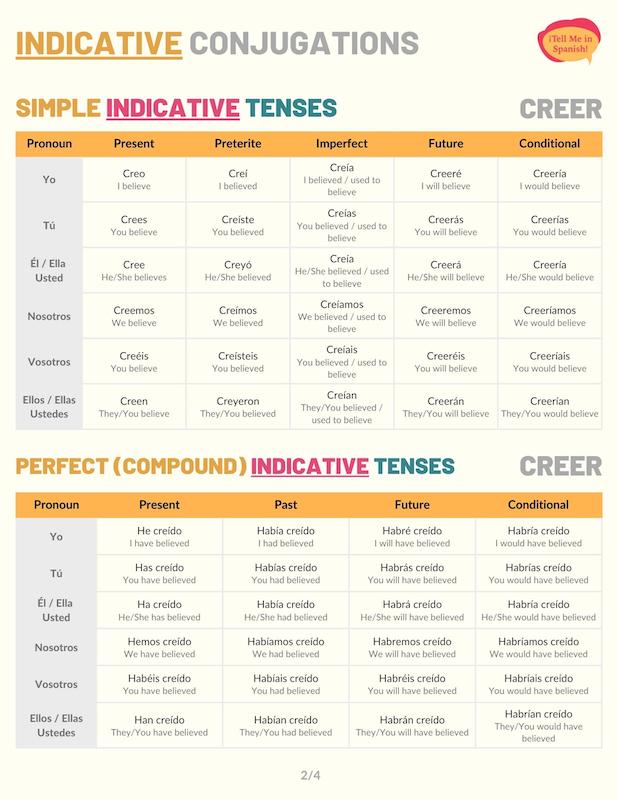
If you’d like, you can download a copy of the PDF cheat sheets for this verb which includes all the creer conjugation charts as well as example sentences of its meanings and uses.
Practice Quiz: Creer Conjugation
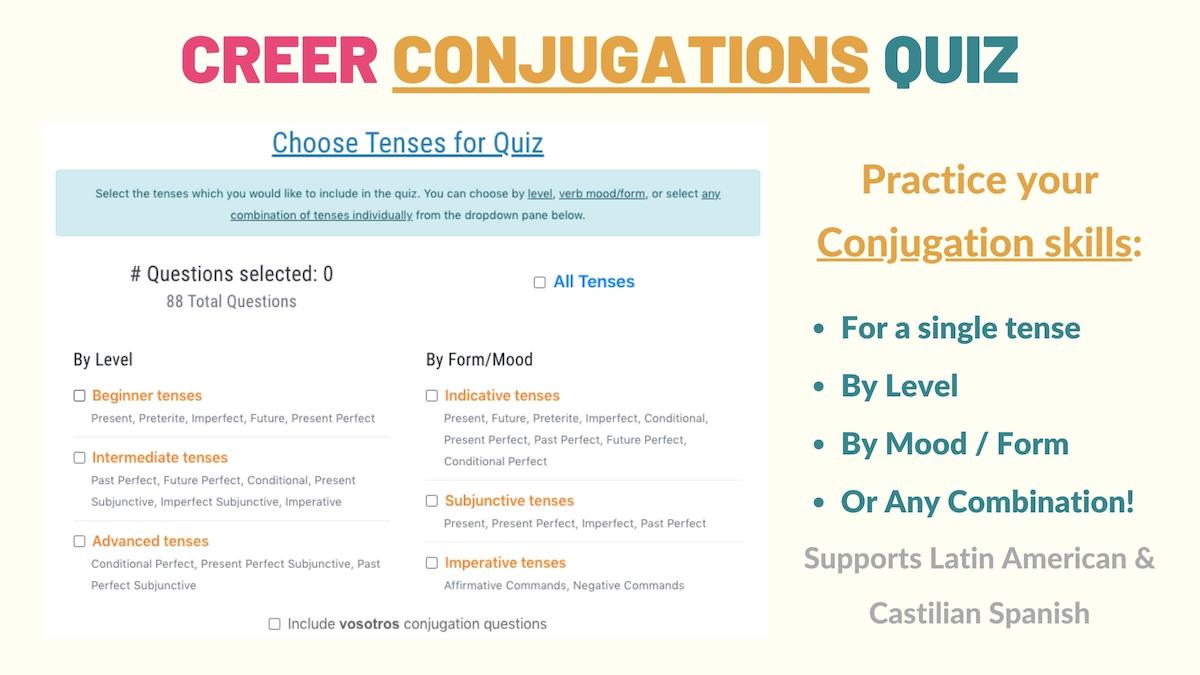
Congratulations! You’ve now learned how to conjugate creer in Spanish. The next step is to drill yourself on all the different regular and stem-changing forms of this verb by taking the creer conjugation practice quiz.