Caer is a common irregular -ER verb in many tenses. However, it’s an important verb that can help you convey useful information in Spanish. So, in this guide, we’ll learn how to conjugate caer in Spanish along with its most common uses. Here’s an overview of what we’ll cover:
- Caer Overview
- Indicative Tenses of Caer Conjugations
- Subjunctive Tenses of Caer Conjugations
- Imperative (Commands) of Caer Conjugations
- Uses & Examples
- Download Caer Conjugation Tables & Uses Cheat sheets
- Caer Conjugation Practice Quiz
Since the verb ‘caer’ has multiple meanings, the explanations and examples for each conjugation chart will only describe its use for one of its meanings in order to keep descriptions brief. However, using its other meaning does not change how it’s conjugated.
Overview of Caer
| Verb Characteristic | Property |
|---|---|
| Verb Type | -ER |
| Irregular | No |
| Infinitive | Caer |
| Gerund (Present Participle) Form | Cayendo |
| Past Participle Form | Caído |
| Synonyms | Hundirse, abatirse, tropezar, agradar. |
Stem Changes: E to IE
- Present: caig (only ‘yo’).
- Preterite: cay for third person singular and plural.
- Present subjunctive: caig for all subject pronouns.
- Imperfect Subjuntive: cay for all subject pronouns.
- Affirmative imperative: caig only for ‘usted’ and ‘ustedes’.
- Negative imperative: caig for all subject pronouns.
Indicative Conjugations of Caer
Present tense
Caer conjugations in the present tense are regular, except for ‘yo’. In this tense, caer expresses that someone or something falls. For example: Mi hermanita se cae todo el tiempo.
| Person | Conjugation | Translation |
|---|---|---|
| Yo | Caigo | I fall |
| Tú | Caes | You fall |
| Él / Ella Usted | Cae | He/She falls You (formal) fall |
| Nosotros | Caemos | We fall |
| Vosotros | Caéis | You fall |
| Ellos / Ellas Ustedes | Caen | They fall You (plural) fall |
Preterite tense
Caer preterite conjugations are irregular. Notice that most conjugation endings have an accent mark. Additionally, with the third person singular and plural, we must replace ‘i’ with ‘y’ to keep pronunciation consistent.
The past preterite of caer communicates that someone or something fell at a specific time in the past. Ayer me caí de la bicicleta.
| Person | Conjugation | Translation |
|---|---|---|
| Yo | Caí | I fell |
| Tú | Caíste | You fell |
| Él / Ella Usted | Cayó | He/She fell You (formal) fell |
| Nosotros | Caímos | We fell |
| Vosotros | Caísteis | You fell |
| Ellos / Ellas Ustedes | Cayeron | They fell You (plural) fell |
Imperfect tense
Caer conjugated to the past imperfect tense conveys that something or someone fell repeatedly in the past. You can also use these forms when it’s unclear when someone fell. Mi hermano siempre se caía de la cama.
| Person | Conjugation | Translation |
|---|---|---|
| Yo | Caía | I fell I used to fall |
| Tú | Caías | You fell You used to fall |
| Él / Ella Usted | Caía | He/She fell He/She used to fall You (formal) fell You (formal) used to fall |
| Nosotros | Caíamos | We fell We used to fall |
| Vosotros | Caíais | You fell You used to fall |
| Ellos / Ellas Ustedes | Caían | They fell They used to fall You (plural) fell You (plural) used to fall |
Near future
Use the near future of ‘caer’ to express that someone or something is about to fall. For instance: Cuidado, te vas a caer. The near future is formed with ir (present tense) + a + caer and can be translated as “going to fall”.
| Person | Conjugation | Translation |
|---|---|---|
| Yo | Voy a caer | I’m going to fall |
| Tú | Vas a caer | You’re going to fall |
| Él / Ella Usted | Va a caer | He/She is going to fall You (formal) are going to fall |
| Nosotros | Vamos a caer | We’re going to fall |
| Vosotros | Vais a caer | You’re going to fall |
| Ellos / Ellas Ustedes | Van a caer | They’re going to fall You (plural) are going to fall |
Future simple tense
In the future tense, caer is a regular verb. Use the future conjugations to express that something or someone will fall at some point in the future. Ten cuidado o te caerás.
| Person | Conjugation | Translation |
|---|---|---|
| Yo | Caeré | I will fall |
| Tú | Caerás | You will fall |
| Él / Ella Usted | Caerá | He/She will fall You (formal) will fall |
| Nosotros | Caeremos | We will fall |
| Vosotros | Caeréis | You (formal) will fall |
| Ellos / Ellas Ustedes | Caerán | They will fall You (plural) will fall |
Conditional tense
The conditional conjugations of caer convey that something or someone would fall or like someone if certain circumstances are met. Si fuera más amable, la chica nueva nos caería mejor.
| Person | Conjugation | Translation |
|---|---|---|
| Yo | Caería | I would fall |
| Tú | Caerías | You would fall |
| Él / Ella Usted | Caería | He/She would fall You (formal) would fall |
| Nosotros | Caeríamos | We would fall |
| Vosotros | Caeríais | You would fall |
| Ellos / Ellas Ustedes | Caerían | They would fall You (plural) would fall |
Present perfect tense
Haber in the present tense + caído (past participle) is the formula of the Spanish present perfect tense. These conjugations communicate that someone or something has or hasn’t fallen. For instance: ¿Alguna vez te has caído de la bici?
| Person | Conjugation | Translation |
|---|---|---|
| Yo | He caído | I have fallen |
| Tú | Has caído | You have fallen |
| Él / Ella Usted | Ha caído | He/She has fallen You (formal) have fallen |
| Nosotros | Hemos caído | We have fallen |
| Vosotros | Habéis caído | You have fallen |
| Ellos / Ellas Ustedes | Han caído | They have fallen You (plural) have fallen |
Past perfect
The past perfect conjugations of ‘caer’ are used to express that something or someone had fallen before some other reference point in the past. Cuando llegué, la niña se había caído de la silla. To form the past perfect, use the imperfect form of ‘haber’ and the past participle form of ‘caer’.
| Person | Conjugation | Translation |
|---|---|---|
| Yo | Había caído | I had fallen |
| Tú | Habías caído | You had fallen |
| Él / Ella Usted | Había caído | He/She had fallen You (formal) had fallen |
| Nosotros | Habíamos caído | We had fallen |
| Vosotros | Habíais caído | You had fallen |
| Ellos / Ellas Ustedes | Habían caído | They had fallen You (plural) had fallen |
Take Note: Like ‘caer’, there are verbs whose past participles have an accent. Check my guide on forming Spanish past participles to learn when this happens.
Future perfect
Caer to the future perfect tense expresses that someone or something will have fallen by or before a certain time in the future. These conjugations are also used to express that something might have fallen. For instance: ¿Se te habrán caído las llaves?
| Person | Conjugation | Translation |
|---|---|---|
| Yo | Habré caído | I will have fallen |
| Tú | Habrás caído | You will have fallen |
| Él / Ella Usted | Habrá caído | He/She will have fallen You (formal) will have fallen |
| Nosotros | Habremos caído | We will have fallen |
| Vosotros | Habréis caído | You will have fallen |
| Ellos / Ellas Ustedes | Habrán caído | They will have fallen You (plural) will have fallen |
Conditional perfect
The conditional perfect conjugations of caer are used to convey that something or someone would have fallen as long as a past condition had been met. For instance: Si hubieras tenido cuidado, no te habrías caído.
| Person | Conjugation | Translation |
|---|---|---|
| Yo | Habría caído | I would have fallen |
| Tú | Habrías caído | You would have fallen |
| Él / Ella Usted | Habría caído | He/She would have fallen You (formal) would have fallen |
| Nosotros | Habríamos caído | We would have fallen |
| Vosotros | Habríais caído | You would have fallen |
| Ellos / Ellas Ustedes | Habrían caído | They would have fallen You (plural) would have fallen |
Progressive tenses
Use the progressive tenses of caer to express something or someone is falling at the moment of speaking. Or, in the case of past forms (preterite and imperfect), to communicate that a past action was in progress when something fell. For example: Me estoy cayendo de la silla.
Spanish progressive tenses are conjugated by using the formula estar + present participle of caer.
| Progressive Tense | Formula | Translation Example |
|---|---|---|
| Present | Estar (present) + cayendo | I am falling |
| Preterite | Estar (preterite) + cayendo | You were falling |
| Imperfect | Estar (imperfect) + cayendo | He was falling |
| Future | Estar (future) + cayendo | We will be falling |
| Conditional | Estar (conditional) + cayendo | They would be falling |
Take Note: Notice that the present participle of caer is ‘cayendo’. The ending ‘-yendo’ is only used to form the present participle of certain -ER and -IR verbs.
Caer Subjunctive Conjugations
In Spanish, the subjunctive is used to talk about wishes, hypothetical situations or express uncertainty. The conjugation charts below show the subjunctive forms of caer. Keep in mind that the Caer subjunctive conjugations are irregular.
Present subjunctive
Use the stem caig to conjugate caer to the present subjunctive tense. The present subjunctive of ‘caer’ can be used to express our wishes for someone to fall or not fall. For example: Espero que no nos caigamos.
| Person | Conjugation | Translation |
|---|---|---|
| Yo | Caiga | I fall |
| Tú | Caigas | You fall |
| Él / Ella Usted | Caiga | He/She falls You (formal) fall |
| Nosotros | Caigamos | We fall |
| Vosotros | Caigáis | You fall |
| Ellos / Ellas Ustedes | Caigan | They fall You (plural) fall |
Present perfect subjunctive
Haber in the present subjunctive + caído is the formula to build the present perfect subjunctive of ‘caer’. When using this tense, ‘caer’ conveys uncertainty about someone falling. ¿Crees que alguien se haya caído?
| Person | Conjugation | Translation |
|---|---|---|
| Yo | Haya caído | I have fallen |
| Tú | Hayas caído | You have fallen |
| Él / Ella Usted | Haya caído | He/She has fallen You (formal) have fallen |
| Nosotros | Hayamos caído | We have fallen |
| Vosotros | Hayáis caído | You have fallen |
| Ellos / Ellas Ustedes | Hayan caído | They have fallen You (plural) have fallen |
Imperfect subjunctive
Use the imperfect subjunctive conjugations of ‘caer’ to refer to past suggestions, wishes or expectations you had about someone or something falling. No quería que los niños se cayeran.
The imperfect subjunctive has two conjugation models depending on which type of Spanish you’re using:
Latin American Spanish version
| Person | Conjugation | Translation |
|---|---|---|
| Yo | Cayera | I fell |
| Tú | Cayeras | You fell |
| Él / Ella Usted | Cayera | He/She fell You (formal) fell |
| Nosotros | Cayéramos | We fell |
| Ellos / Ellas Ustedes | Cayeran | They fell You (plural) fell |
Note: The table above doesn’t include caer’s conjugation for vosotros as this pronoun is not used in Latin American Spanish.
Castilian Spanish version
| Person | Conjugation | Translation |
|---|---|---|
| Yo | Cayese | I fell |
| Tú | Cayeses | You fell |
| Él / Ella Usted | Cayese | He/She fell You (formal) fell |
| Nosotros | Cayésemos | We fell |
| Vosotros | Cayeseis | You fell |
| Ellos / Ellas Ustedes | Cayeran | They fell You (plural) fell |
Past perfect subjunctive
In the past perfect subjunctive, caer conveys that someone or something would have fallen if a past circumstance was met. You can also use these conjugations to express regrets or hypothetical results if someone had fallen.
For example: Si nos hubiéramos caído, nos habríamos roto un brazo.
| Person | Conjugation | Translation |
|---|---|---|
| Yo | Hubiera caído | I had fallen |
| Tú | Hubieras caído | You had fallen |
| Él / Ella Usted | Hubiera caído | He/She had fallen You (formal) had fallen |
| Nosotros | Hubiéramos caído | We had fallen |
| Vosotros | Hubierais caído | You had fallen |
| Ellos / Ellas Ustedes | Hubieran caído | They had fallen You (plural) had fallen |


Caer Imperative Conjugations
The imperative is used to give commands in Spanish. Put it another way, it’s used to tell people what to do (affirmative imperative) and what not to do (negative imperative).
Affirmative commands
The affirmative imperative of ‘caer’ is used to command or instruct someone to fall in a certain way. For example: Caed en el colchón. ‘Usted’ and ‘ustedes’ use the irregular stem ‘caig’.
| Person | Conjugation | Translation |
|---|---|---|
| Tú | Cae | Fall |
| Usted | Caiga | Fall |
| Vosotros | Caed | Fall |
| Ustedes | Caigan | Fall |
Negative commands
Use the negative imperative to order someone to not fall for something. For example: No caigas en sus mentiras. Since they’re based on the present subjunctive, all the negative commands of ‘caer’ are irregular.
| Person | Conjugation | Translation |
|---|---|---|
| Tú | No caigas | Don’t fall |
| Usted | No caiga | Don’t fall |
| Vosotros | No caigáis | Don’t fall |
| Ustedes | No caigan | Don’t fall |
Meanings of Caer & Examples
Now that the caer conjugation charts are fresh in your mind, check the following examples to see the most common applications of this verb.
- Express that something or someone falls or goes down
(Reflexive pronoun) + [caer conjugated]
¿De dónde te caíste?
Where did you fall from?
¡No caigas en su juego!
Don’t fall for his game!
Ojalá no se haya caído el internet.
Hopefully the internet hasn’t gone down.
Take Note: Use reflexive pronouns (caerse) anytime you want to express that a person falls from one place to another.
- Talk about liking or disliking someone
[Indirect object pronoun] + [caer conjugated]
Tu novio nunca me ha caído bien.
I have never liked your boyfriend.
¿Crees que le caeré bien a tu familia?
Do you think your family will like me?
No sabía que Tania te cayera mal.
I didn’t know you didn’t like Tania.
Take Note: When used to talk about liking and disliking people, caer behaves like ‘gustar’. To learn more about these verbs, check my guide on how to conjugate verbs like ‘gustar’.
Download Caer Conjugation Tables & Uses Cheat sheets
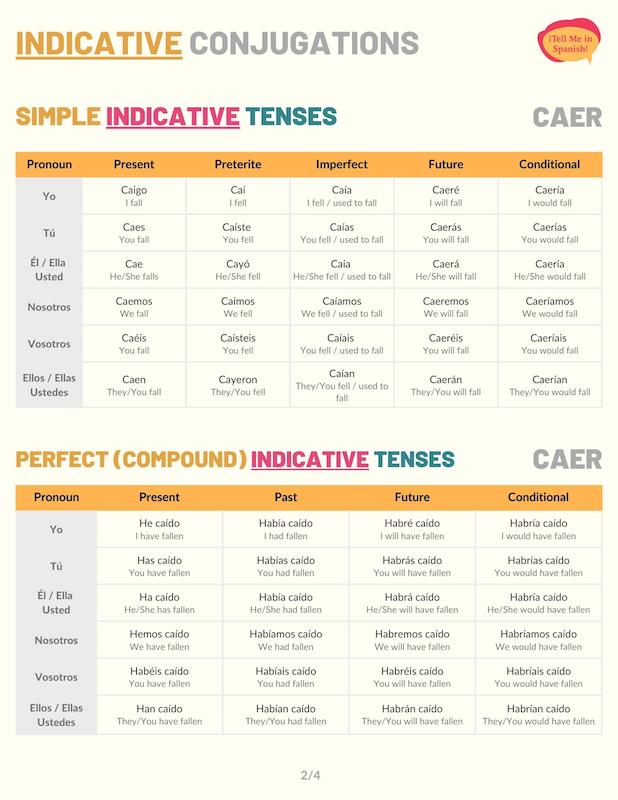
Download a copy of the ‘caer’ cheat sheets PDF. It includes everything you need – conjugation charts for all the tenses, the verb’s meanings, uses, translations, and synonyms.
Practice Quiz: Caer Conjugation
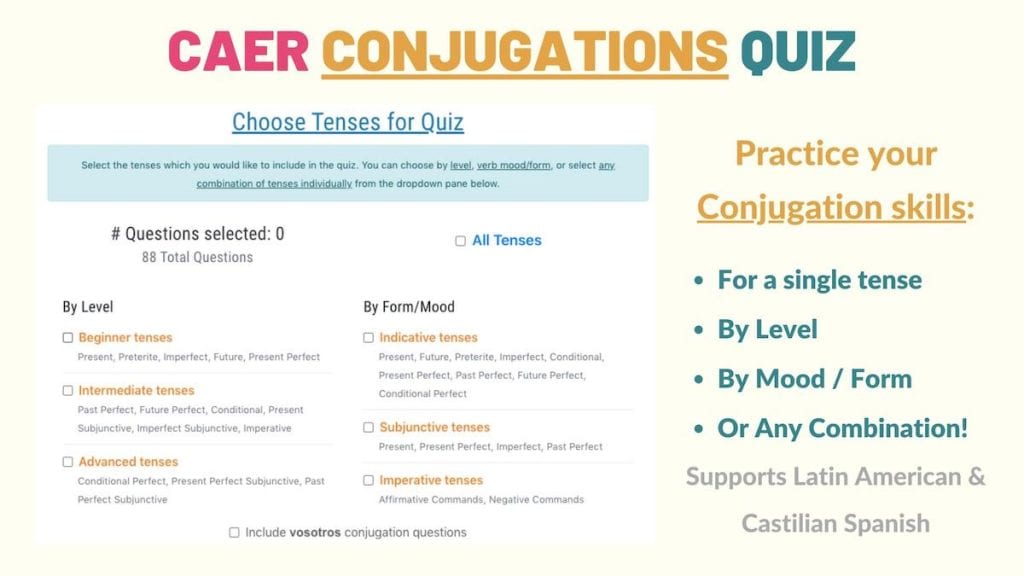
Caer is an irregular verb, so you need to take the time to learn the different stem changes for this verb in the various tenses. If you want to practice your conjugation skills for this verb, take the caer conjugation practice quiz!