Entender conjugation patterns can help you understand -ER verbs and E to IE stem-changing verbs. Since you’ll also use it in daily conversations, in this guide, you’ll learn how to conjugate entender in Spanish. Here’s an overview of what we’ll go over:
- Entender Overview
- Indicative Tenses of Entender Conjugations
- Subjunctive Tenses of Entender Conjugations
- Imperative (Commands) of Entender Conjugations
- Uses & Examples
- Download Entender Conjugation Tables & Uses Cheat sheets
- Entender Conjugation Practice Quiz
Overview of Entender
| Verb Characteristic | Property |
|---|---|
| Verb Type | -ER |
| Irregular | No |
| Infinitive | Entender |
| Gerund (Present Participle) Form | Entendiendo |
| Past Participle Form | Entendido |
| Synonyms | Comprender, captar. |
Stem Changes: E to IE
- Present: entiend for all subjects except ‘nosotros’ and ‘vosotros’.
- Present subjunctive: entiend for all subjects except ‘nosotros’ and ‘vosotros’.
- Affirmative commands: entiend for all pronouns except ‘vosotros’.
- Negative commands: entiend for all subjects pronouns except ‘vosotros’.
Indicative Conjugations of Entender
Present tense
Entender present tense conjugations have an E to IE stem change for all subject pronouns, except ‘nosotros’ and ‘vosotros’. We use entender’s present forms to refer to the topics or things someone currently understands. For example: No entiendo lo que dices.
| Person | Conjugation | Translation |
|---|---|---|
| Yo | Entiendo | I understand |
| Tú | Entiendes | You understand |
| Él / Ella Usted | Entiende | He/She understands You (formal) understand |
| Nosotros | Entendemos | We understand |
| Vosotros | Entendéis | You understand |
| Ellos / Ellas Ustedes | Entienden | They understand You (plural) understand |
Preterite tense
As shown in the conjugation chart below, entender’s preterite conjugations are regular. Use the preterite form of ‘entender’ to explain the things someone understood in the past. For instance: ¿Qué dijiste? No te entendimos.
| Person | Conjugation | Translation |
|---|---|---|
| Yo | Entendí | I understood |
| Tú | Entendiste | You understood |
| Él / Ella Usted | Entendió | He/She understood You (formal) understood |
| Nosotros | Entendimos | We understood |
| Vosotros | Entendisteis | You understood |
| Ellos / Ellas Ustedes | Entendieron | They understood You (plural) understood |
Imperfect tense
In Spanish, entender imperfect conjugations refer to things someone used to understand (or didn’t understand) for an extended period of time in the past. For example: Cuando era niña, yo no entendía muchas cosas.
| Person | Conjugation | Translation |
|---|---|---|
| Yo | Entendía | I understood I used to understand |
| Tú | Entendías | You understood You used to understand |
| Él / Ella Usted | Entendía | He/She understood He/She used to understand You (formal) understood You (formal) used to understand |
| Nosotros | Entendíamos | We understood We used to understand |
| Vosotros | Entendíais | You understood You used to understand |
| Ellos / Ellas Ustedes | Entendían | They understood They used to understand You (plural) understood You (plural) used to understand |
Near future
In Spanish, the near or immediate future is formed with ir (present tense) + a + infinitive verb (entender, in this case) and can be translated as “going to understand”. We use these forms to say that a person will understand something soon in the future. Sé que me vas a entender.
| Person | Conjugation | Translation |
|---|---|---|
| Yo | Voy a entender | I’m going to understand |
| Tú | Vas a entender | You’re going to understand |
| Él / Ella Usted | Va a entender | He/She is going to understand You (formal) are going to understand |
| Nosotros | Vamos a entender | We’re going to understand |
| Vosotros | Vais a entender | You’re going to understand |
| Ellos / Ellas Ustedes | Van a entender | They’re going to understand You (plural) are going to understand |
Future simple tense
When conjugated to the Spanish future simple tense, entender communicates that a person will understand something or someone at some moment in the future. For example: Nunca entenderé por qué terminaste con Joan.
| Person | Conjugation | Translation |
|---|---|---|
| Yo | Entenderé | I will understand |
| Tú | Entenderás | You will understand |
| Él / Ella Usted | Entenderá | He/She will understand You (formal) will understand |
| Nosotros | Entenderemos | We will understand |
| Vosotros | Entenderéis | You (formal) will understand |
| Ellos / Ellas Ustedes | Entenderán | They will understand You (plural) will understand |
Conditional tense
In the Spanish conditional tense, entender is used to talk about things, people, or situations someone would understand. Here is an example: Si me contaras qué pasó, entendería mejor.
| Person | Conjugation | Translation |
|---|---|---|
| Yo | Entendería | I would understand |
| Tú | Entenderías | You would understand |
| Él / Ella Usted | Entendería | He/She would understand You (formal) would understand |
| Nosotros | Entenderíamos | We would understand |
| Vosotros | Entenderíais | You would understand |
| Ellos / Ellas Ustedes | Entenderían | They would understand You (plural) would understand |
Present perfect tense
The present perfect in Spanish is formed with haber in the present tense + entendido (past participle). Use these entender conjugations to explain what someone has or hasn’t understood. ¿Han entendido lo que les dije?
| Person | Conjugation | Translation |
|---|---|---|
| Yo | He entendido | I have understood |
| Tú | Has entendido | You have understood |
| Él / Ella Usted | Ha entendido | He/She has understood You (formal) have understood |
| Nosotros | Hemos entendido | We have understood |
| Vosotros | Habéis entendido | You have understood |
| Ellos / Ellas Ustedes | Han entendido | They have understood You (plural) have understood |
Past perfect
The Spanish past perfect tense of entender allows you to express that someone had or hadn’t understood something before some other reference point in the past. For example: Perdóname, nunca había entendido lo que querías decirme.
| Person | Conjugation | Translation |
|---|---|---|
| Yo | Había entendido | I had understood |
| Tú | Habías entendido | You had understood |
| Él / Ella Usted | Había entendido | He/She had understood You (formal) had understood |
| Nosotros | Habíamos entendido | We had understood |
| Vosotros | Habíais entendido | You had understood |
| Ellos / Ellas Ustedes | Habían entendido | They had understood You (plural) had understood |
Future perfect
In the future perfect, entender communicates that a person will have understood something or someone by or before a certain time in the future. These forms can also express that someone might have understood something. For example: ¿Habrá entendido lo que quise decir?
| Person | Conjugation | Translation |
|---|---|---|
| Yo | Habré entendido | I will have understood |
| Tú | Habrás entendido | You will have understood |
| Él / Ella Usted | Habrá entendido | He/She will have understood You (formal) will have understood |
| Nosotros | Habremos entendido | We will have understood |
| Vosotros | Habréis entendido | You will have understood |
| Ellos / Ellas Ustedes | Habrán entendido | They will have understood You (plural) will have understood |
Conditional perfect
When conjugated to the Spanish conditional perfect, entender communicates that you would have understood something or someone if a past action had been met. Here is a sentence: Si me hubieras dado mejores ejemplos, habría entendido todo.
| Person | Conjugation | Translation |
|---|---|---|
| Yo | Habría entendido | I would have understood |
| Tú | Habrías entendido | You would have understood |
| Él / Ella Usted | Habría entendido | He/She would have understood You (formal) would have understood |
| Nosotros | Habríamos entendido | We would have understood |
| Vosotros | Habríais entendido | You would have understood |
| Ellos / Ellas Ustedes | Habrían entendido | They would have understood You (plural) would have understood |
Progressive tenses
In Spanish, the progressive forms of entender express that someone understands something at the moment of speaking. For example: Creo que ya me estás entendiendo.
| Progressive Tense | Formula | Translation Example |
|---|---|---|
| Present | Estar (present) + entendiendo | I am understanding |
| Preterite | Estar (preterite) + entendiendo | You were understanding |
| Imperfect | Estar (imperfect) + entendiendo | He was understanding |
| Future | Estar (future) + entendiendo | We will be understanding |
| Conditional | Estar (conditional) + entendiendo | They would be understanding |
Entender Subjunctive Conjugations
In Spanish, the subjunctive tenses communicate uncertainty, wishes, suggestions, requests, expectations, or refer to hypothetical situations. In the sections below, you’ll find the entender conjugation charts for the subjunctive tenses. Notice that, in this mood, entender is a stem-changing verb.
Present subjunctive
In the present subjunctive, entender is an E to IE stem-changing verb. However, these spelling changes do not apply to ‘nosotros’ and ‘vosotros’. Use entender subjunctive conjugations to request or hope that someone understands something.
For instance: No espero que me entiendas.
| Person | Conjugation | Translation |
|---|---|---|
| Yo | Entienda | I understand |
| Tú | Entiendas | You understand |
| Él / Ella Usted | Entienda | He/She understand You (formal) understand |
| Nosotros | Entendamos | We understand |
| Vosotros | Entendáis | You understand |
| Ellos / Ellas Ustedes | Entiendan | They understand |
Present perfect subjunctive
Haber in the present subjunctive + entendido is how you form the present perfect subjunctive of ‘entender’. We use these conjugations to wonder or wish someone has already understood something. No creo que Tina te haya entendido.
| Person | Conjugation | Translation |
|---|---|---|
| Yo | Haya entendido | I have understood |
| Tú | Hayas entendido | You have understood |
| Él / Ella Usted | Haya entendido | He/She has understood You (formal) have understood |
| Nosotros | Hayamos entendido | We have understood |
| Vosotros | Hayáis entendido | You have understood |
| Ellos / Ellas Ustedes | Hayan entendido | They have understood You (plural) have understood |
Imperfect subjunctive
The imperfect subjunctive forms of ‘entender’ discuss past suggestions, requests, wishes, or expectations you had about someone understanding something. Me pidió que la entendiera, pero no puedo.
Depending on the type of Spanish you use, there are two conjugation models for the imperfect subjunctive:
Latin American Spanish version
| Person | Conjugation | Translation |
|---|---|---|
| Yo | Entendiera | I understood |
| Tú | Entendieras | You understood |
| Él / Ella Usted | Entendiera | He/She understood You (formal) understood |
| Nosotros | Entendiéramos | We understood |
| Ellos / Ellas Ustedes | Entendieran | They understood You (plural) understood |
Note: The previous conjugation table doesn’t include the conjugation for vosotros since this pronoun is not used in Latin American Spanish.
Castilian Spanish version
| Person | Conjugation | Translation |
|---|---|---|
| Yo | Entendiese | I understood |
| Tú | Entendieses | You understood |
| Él / Ella Usted | Entendiese | He/She understood You (formal) understood |
| Nosotros | Entendiésemos | We understood |
| Vosotros | Entendieseis | You understood |
| Ellos / Ellas Ustedes | Entendiesen | They understood You (plural) understood |
Past perfect subjunctive
In the past perfect subjunctive, entender conveys that someone would have understood something if a past action was completed. Additionally, these conjugations also refer to regrets or hypothetical results if someone had understood something.
For example: Dudo que me hubieras entendido.
| Person | Conjugation | Translation |
|---|---|---|
| Yo | Hubiera entendido | I had understood |
| Tú | Hubieras entendido | You had understood |
| Él / Ella Usted | Hubiera entendido | He/She had understood You (formal) had understood |
| Nosotros | Hubiéramos entendido | We had understood |
| Vosotros | Hubierais entendido | You had understood |
| Ellos / Ellas Ustedes | Hubieran entendido | They had understood You (plural) had understood |


Entender Imperative Conjugations
Commands in Spanish are the conjugations we use to instruct someone to do or not to do something. Notice that these entender conjugations have stem changes.
Affirmative commands
The affirmative commands of entender also have an E to IE stem change, which is not applied to ‘vosotros’. Use the affirmative imperative to command people to understand something. Señora, entienda, no puedo ayudarla.
| Person | Conjugation | Translation |
|---|---|---|
| Tú | Entiende | Understand |
| Usted | Entienda | Understand |
| Vosotros | Entended | Understand |
| Ustedes | Entiendan | Understand |
Negative commands
Since the Spanish negative commands are based on the present subjunctive conjugations, these imperative forms have stem changes. In theory, these entender conjugations command people not to understand something.
In practice, we don’t use these commands because we cannot order people not to understand something.
| Person | Conjugation | Translation |
|---|---|---|
| Tú | No entiendas | Don’t understand |
| Usted | No entienda | Don’t understand |
| Vosotros | No entendáis | Don’t understand |
| Ustedes | No entiendan | Don’t understand |
Meanings of Entender & Examples
Now that you learned how to conjugate entender, below are some examples of how to use this verb:
[Entender conjugated] + [complement]
Ellos no han entendido el pronombre se.
They haven’t understood the pronoun se.
Por favor, entiéndeme. No sabía qué hacer.
Please, understand me. I didn’t know what to do.
When talking about understanding a person (a manner of empathizing with them), entender can work with direct object pronouns. However, you’ll need indirect object pronouns when expressing that you didn’t understand what someone said.
¿Qué dijo? No le entendí.
What did she say? I didn’t understand her.
Take Note: In daily conversations, entender is more frequently used than its more formal synonym comprender.
Download Entender Conjugation Tables & Uses Cheat sheets
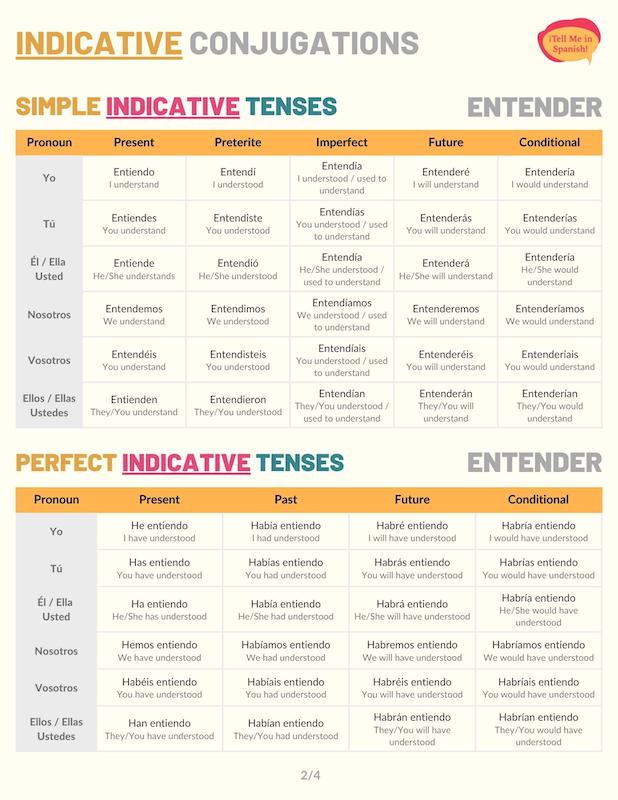
If you’d like to refer back to this guide on conjugating entender, I’ve created a downloadable PDF including all the entender conjugation charts, meanings and uses.
Practice Quiz: Entender Conjugation
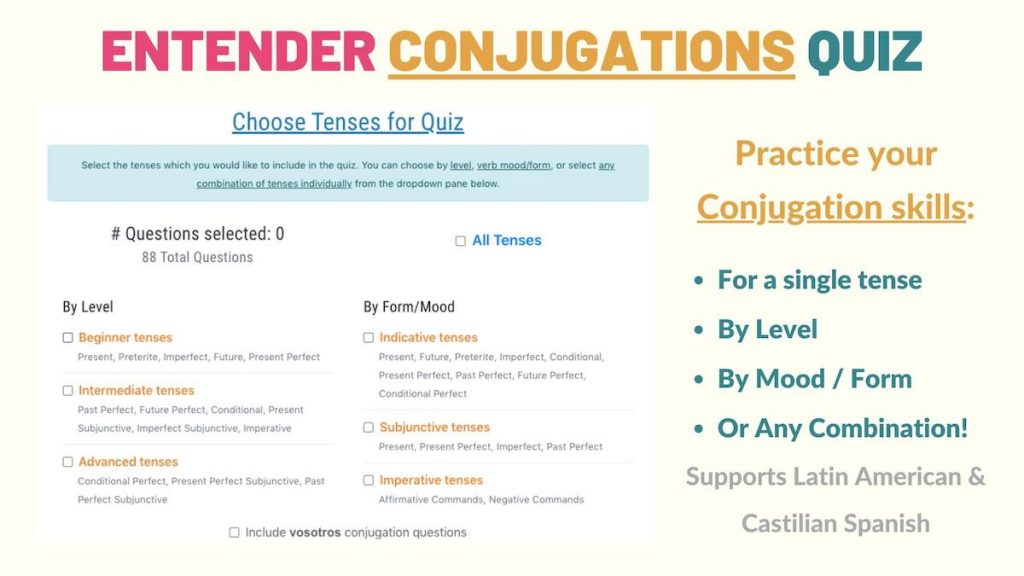
If you’re confident after review this guide that you know how to conjugate entender in Spanish, the best way to commit its stem changes and conjugations to long term memory is through practice. Take the entender conjugation quiz to practice conjugating it in all the tenses.