Hacer is one of the Spanish -ER verbs that you’ll use daily. But since it’s a highly irregular verb, in this guide, we’ll go over the most important hacer conjugation charts. Here is a quick overview of what you’ll learn:
- Hacer Overview
- Indicative Tenses of Hacer Conjugations
- Subjunctive Tenses of Hacer Conjugations
- Imperative (Commands) of Hacer Conjugations
- Uses & Examples
- Download Hacer Conjugation Tables & Uses Cheat sheets
- Hacer Conjugation Practice Quiz
Overview of Hacer
| Verb Characteristic | Property |
|---|---|
| Verb Type | -ER |
| Irregular | Yes |
| Infinitive | Hacer |
| Gerund (Present Participle) Form | Haciendo |
| Past Participle Form | Hecho |
| Synonyms | Realizar, elaborar, producir. |
Stem Changes: E to IE
- Present: hag only ‘yo’.
- Preterite: hic for all subjects except for ‘ella’, ‘él’, ‘usted’, hiz for ‘ella’, ‘él’, ‘usted’.
- Future & Conditional: har for all subject pronouns.
- Present Subjunctive: hag for all subject pronouns.
- Affirmative Imperative: haz only for ‘tú’, hag for ‘usted’ and ‘ustedes’,
- Negative Imperative: hag for all subject pronouns.
In Spanish, hacer means ‘to do’, ‘to make’, ‘to be’, and ‘ago’, among other applications. The conjugations charts below only have one translation to keep the tables as organized as possible. You can learn more about the meanings of ‘hacer’ in the section Uses & Meanings.
Indicative Conjugations of Hacer
Present tense
The conjugations of hacer in the present tense are irregular. Use hag for the form ‘yo’ and hac for the remaining pronouns. In this tense, hacer refers to the things people currently do or make. For instance: Mi mamá hace un pastel riquísimo.
| Person | Conjugation | Translation |
|---|---|---|
| Yo | Hago | I do |
| Tú | Haces | You do |
| Él / Ella Usted | Hace | He/She does You (formal) do |
| Nosotros | Hacemos | We do |
| Vosotros | Hacéis | You do |
| Ellos / Ellas Ustedes | Hacen | They do You (plural) do |
Preterite tense
Hacer’s preterite conjugations are formed with two different stems. Hiz for the third person singular and hic for ‘tú’, ‘nosotros’, ‘vosotros’, ‘ellas’, ‘ellos’, and ‘ustedes’. You can check these irregularities in this preterite conjugation chart.
Use these forms of hacer to talk about the things people did or made at a specific moment in the past. For example: ¿Qué hicieron ayer?
| Person | Conjugation | Translation |
|---|---|---|
| Yo | Hice | I did |
| Tú | Hiciste | You did |
| Él / Ella Usted | Hizo | He/She did You (formal) did |
| Nosotros | Hicimos | We did |
| Vosotros | Hicisteis | You did |
| Ellos / Ellas Ustedes | Hicieron | They did You (plural) did |
Take Note: Hiz is used to keep the pronunciation consistent. Other Spanish verbs also have consonant changes to maintain their pronunciations.
Imperfect tense
The past imperfect is the only tense in which hacer is a regular verb. We use hacer imperfect conjugations to refer to things or activities people used to do repeatedly in the past. These forms are also used when it’s not clear when something was done.
For instance: Mis primos nunca hacían su tarea.
| Person | Conjugation | Translation |
|---|---|---|
| Yo | Hacía | I did I used to do |
| Tú | Hacías | You did You used to do |
| Él / Ella Usted | Hacía | He/She did He/She used to do You (formal) did You (formal) used to do |
| Nosotros | Hacíamos | We did We used to do |
| Vosotros | Hacíais | You did You used to do |
| Ellos / Ellas Ustedes | Hacían | They did They used to do You (plural) did You (plural) used to do |
Near future
Use the structure ir (present tense) + a + infinitive (in this case, ‘hacer’) to form the near future tense. These conjugations of ‘hacer’ communicate that a person plans to do or make something soon in the future. For example: ¿Qué van a hacer este viernes?
| Person | Conjugation | Translation |
|---|---|---|
| Yo | Voy a hacer | I’m going to do |
| Tú | Vas a hacer | You’re going to do |
| Él / Ella Usted | Va a hacer | He/She is going to do You (formal) are going to do |
| Nosotros | Vamos a hacer | We’re going to do |
| Vosotros | Vais a hacer | You’re going to do |
| Ellos / Ellas Ustedes | Van a hacer | They’re going to do You (plural) are going to do |
Future simple tense
Hacer future tense conjugations are formed with the irregular stem har. Use these conjugations to talk about the things people will make or do at some point in the future. ¿Qué harás mañana?
| Person | Conjugation | Translation |
|---|---|---|
| Yo | Haré | I will do |
| Tú | Harás | You will do |
| Él / Ella Usted | Hará | He/She will do You (formal) will do |
| Nosotros | Haremos | We will do |
| Vosotros | Haréis | You (formal) will do |
| Ellos / Ellas Ustedes | Harán | They will do You (plural) will do |
Conditional tense
The conditional conjugations of hacer are irregular. As shown, in the conjugation chart below, this tense uses the stem har. The conditional of ‘hacer’ expresses what people would do if some circumstances were met. Additionally, you can use these forms to make hypotheses about what people would do.
For instance: No sé qué haría sin ti.
| Person | Conjugation | Translation |
|---|---|---|
| Yo | Haría | I would do |
| Tú | Harías | You would do |
| Él / Ella Usted | Haría | He/She would do You (formal) would do |
| Nosotros | Haríamos | We would do |
| Vosotros | Haríais | You would do |
| Ellos / Ellas Ustedes | Harían | They would do You (plural) would do |
Present perfect tense
Haber in the present tense + hecho (past participle) is the formula to conjugate the present perfect in Spanish. These conjugations of ‘hacer’ refer to the things someone has or hasn’t done. For instance: ¿Por qué han hecho eso?
| Person | Conjugation | Translation |
|---|---|---|
| Yo | He hecho | I have done |
| Tú | Has hecho | You have done |
| Él / Ella Usted | Ha hecho | He/She has done You (formal) have done |
| Nosotros | Hemos hecho | We have done |
| Vosotros | Habéis hecho | You have done |
| Ellos / Ellas Ustedes | Han hecho | They have done You (plural) have done |
Take Note: Hacer is one of the few Spanish verbs with an irregular past participle form.
Past perfect
Use the past perfect conjugations of hacer to talk about what someone had done before another action or point in the past. Cuando llegué, Julián ya había hecho la tarea. To conjugate the past perfect, use the imperfect form of ‘haber’ and the past participle form of ‘hacer’.
| Person | Conjugation | Translation |
|---|---|---|
| Yo | Había hecho | I had done |
| Tú | Habías hecho | You had done |
| Él / Ella Usted | Había hecho | He/She had done You (formal) had done |
| Nosotros | Habíamos hecho | We had done |
| Vosotros | Habíais hecho | You had done |
| Ellos / Ellas Ustedes | Habían hecho | They had done You (plural) had done |
Future perfect
In the future perfect tense, hacer refers to what people will have done or made by or before a certain moment in the future. These conjugations of ‘hacer’ are also used to talk about what someone might have done. No sé qué habrán hecho, pero su jefe está enojado.
| Person | Conjugation | Translation |
|---|---|---|
| Yo | Habré hecho | I will have done |
| Tú | Habrás hecho | You will have done |
| Él / Ella Usted | Habrá hecho | He/She will have done You (formal) will have done |
| Nosotros | Habremos hecho | We will have done |
| Vosotros | Habréis hecho | You will have done |
| Ellos / Ellas Ustedes | Habrán hecho | They will have done You (plural) will have done |
Conditional perfect
When conjugated to the Spanish conditional perfect tense, hacer talks about what someone would have done or made if a past circumstance had been met. You can also use this tense to hypothesize about what someone did or made.
For example: ¿Qué habrías hecho tú en mi lugar?
| Person | Conjugation | Translation |
|---|---|---|
| Yo | Habría hecho | I would have done |
| Tú | Habrías hecho | You would have done |
| Él / Ella Usted | Habría hecho | He/She would have done You (formal) would have done |
| Nosotros | Habríamos hecho | We would have done |
| Vosotros | Habríais hecho | You would have done |
| Ellos / Ellas Ustedes | Habrían hecho | They would have done You (plural) would have done |
Progressive tenses
The progressive tenses of hacer allow you to express that someone is doing or making something at the moment of speaking. For instance: ¿Qué están haciendo? The progressive tenses are formed with estar + haciendo (present participle).
| Progressive Tense | Formula | Translation Example |
|---|---|---|
| Present | Estar (present) + haciendo | I am doing |
| Preterite | Estar (preterite) + haciendo | You were doing |
| Imperfect | Estar (imperfect) + haciendo | He was doing |
| Future | Estar (future) + haciendo | We will be doing |
| Conditional | Estar (conditional) + haciendo | They would be doing |
Hacer Subjunctive Conjugations
In Spanish, the subjunctive tenses refer to wishes, requests, suggestions, expectations, doubts, or hypothetical situations. Below are hacer conjugation charts for the most common subjunctive tenses. Be aware that hacer is irregular in these tenses.
Present subjunctive
Hacer present subjunctive conjugations are formed with the irregular stem hag. We use the subjunctive forms of ‘hacer’ to express hopes about someone doing something or requesting a person to perform an action. For instance: Quiero que hagan un mejor esfuerzo.
| Person | Conjugation | Translation |
|---|---|---|
| Yo | Haga | I do |
| Tú | Hagas | You do |
| Él / Ella Usted | Hagan | He/She does You (formal) do |
| Nosotros | Hagamos | We do |
| Vosotros | Hagáis | You do |
| Ellos / Ellas Ustedes | Hagan | They do You (plural) do |
Present perfect subjunctive
Haber in the present subjunctive + hecho is the structure we use to build the present perfect subjunctive of ‘hacer’. Use these conjugations to wonder or wish that a person has already done or made something. For example: Espero que hayan hecho lo que les dije.
| Person | Conjugation | Translation |
|---|---|---|
| Yo | Haya hecho | I have done |
| Tú | Hayas hecho | You have done |
| Él / Ella Usted | Haya hecho | He/She has done You (formal) have done |
| Nosotros | Hayamos hecho | We have done |
| Vosotros | Hayáis hecho | You have done |
| Ellos / Ellas Ustedes | Hayan hecho | They have done You (plural) have done |
Imperfect subjunctive
We use the imperfect subjunctive conjugations of ‘hacer’ to refer to past suggestions, requests, wishes someone had about a person doing or making something. Te pedí que hicieras la salsa.
The imperfect subjunctive has two conjugation models depending on which type of Spanish you’re using:
Latin American Spanish version
| Person | Conjugation | Translation |
|---|---|---|
| Yo | Hiciera | I did |
| Tú | Hicieras | You did |
| Él / Ella Usted | Hiciera | He/She did You (formal) did |
| Nosotros | Hiciéramos | We did |
| Ellos / Ellas Ustedes | Hicieran | They did You (plural) did |
Note: In Latin American Spanish, the pronoun vosotros is not used. As a result, this pronoun has been excluded from the conjugation chart above.
Castilian Spanish version
| Person | Conjugation | Translation |
|---|---|---|
| Yo | Hiciese | I did |
| Tú | Hicieses | You did |
| Él / Ella Usted | Hiciese | He/She did You (formal) did |
| Nosotros | Hiciésemos | We did |
| Vosotros | Hicieseis | You did |
| Ellos / Ellas Ustedes | Hiciesen | They did You (plural) did |
Past perfect subjunctive
In the past perfect subjunctive, hacer expresses that someone would have done or made something if a past circumstance was met. Additionally, these conjugations also express regret for something you had or hadn’t done.
For example: Ojalá no hubiéramos hecho eso.
| Person | Conjugation | Translation |
|---|---|---|
| Yo | Hubiera hecho | I had done |
| Tú | Hubieras hecho | You had done |
| Él / Ella Usted | Hubiera hecho | He/She had done You (formal) had done |
| Nosotros | Hubiéramos hecho | We had done |
| Vosotros | Hubierais hecho | You had done |
| Ellos / Ellas Ustedes | Hubieran hecho | They had done You (plural) had done |


Hacer Imperative Conjugations
In Spanish, we use the imperative conjugations to give orders to people.
Affirmative commands
If you want to order someone to do something, use the affirmative imperative. For instance: Hagan lo que les dije. Hacer affirmative command conjugations are irregular for all subjects except ‘vosotros’. Use haz for ‘tú’ and the stem hag for ‘usted’ and ‘ustedes’.
| Person | Conjugation | Translation |
|---|---|---|
| Tú | Haz | Do |
| Usted | Haga | Do |
| Vosotros | Haced | Do |
| Ustedes | Hagan | Do |
Negative commands
If instead you want to command people not to do something, you must use hacer negative commands conjugations. As shown in the conjugation chart below, these forms are also irregular, and we must use the stem hag to conjugate all the subjects.
| Person | Conjugation | Translation |
|---|---|---|
| Tú | No hagas | Don’t do |
| Usted | No haga | Don’t do |
| Vosotros | No hagáis | Don’t do |
| Ustedes | No hagan | Don’t do |
Meanings of Hacer & Examples
While learning how to conjugate hacer, you may have noticed that this verb is used to talk about the activities or things people do. In this context, it means ‘to do’ or ‘to make’ and it’s applied in a similar way to these English verbs.
- Talk about things and activities people do or make
Mi hermano nunca hacía su tarea.
My brother never did his homework.
Chicas, ¿qué hacen en su tiempo libre?
Girls, what do you do in your free time?
- Describe the weather
[Hacer in third person singular] + (adjective) + [noun]
Ayer hizo mucho calor.
Yesterday was very hot.
No sabía que hiciera tanto frío aquí.
I didn’t know it was so cold here.
Take Note: When using hacer to talk about the weather in Spanish, we only use the conjugations for the third person singular (él, ella, usted). You can conjugate to the present, past, future, or any Spanish tense you need.
- Talk about time
Hace + [quantifier]
Renuncié hace tres años.
I quit three years ago.
¿Hace cuánto me estás esperando?
How long have you been waiting for me?
Take Note: We use the impersonal form hace to express the time that has passed since an action began or ended. When used as a question, hace inquires about the time a person has been doing something.
Download Hacer Conjugation Tables & Uses Cheat sheets
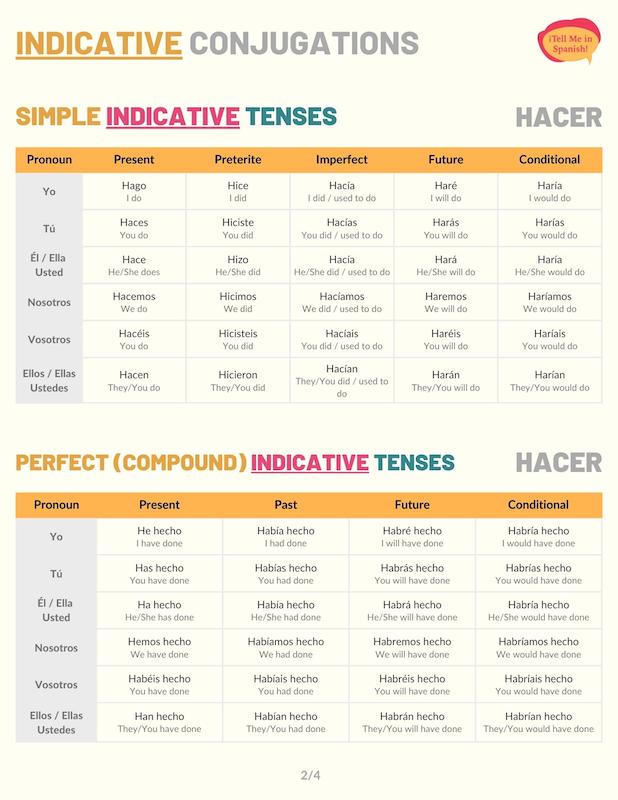
Since hacer is a stem-changing verb and has multiple meanings and uses, it can take some time to learn all the difference aspects of this verb. I’ve created a PDF cheat sheet you can download with all the hacer verb conjugation tables as well as its definitions and example uses.
Practice Quiz: Hacer Conjugation
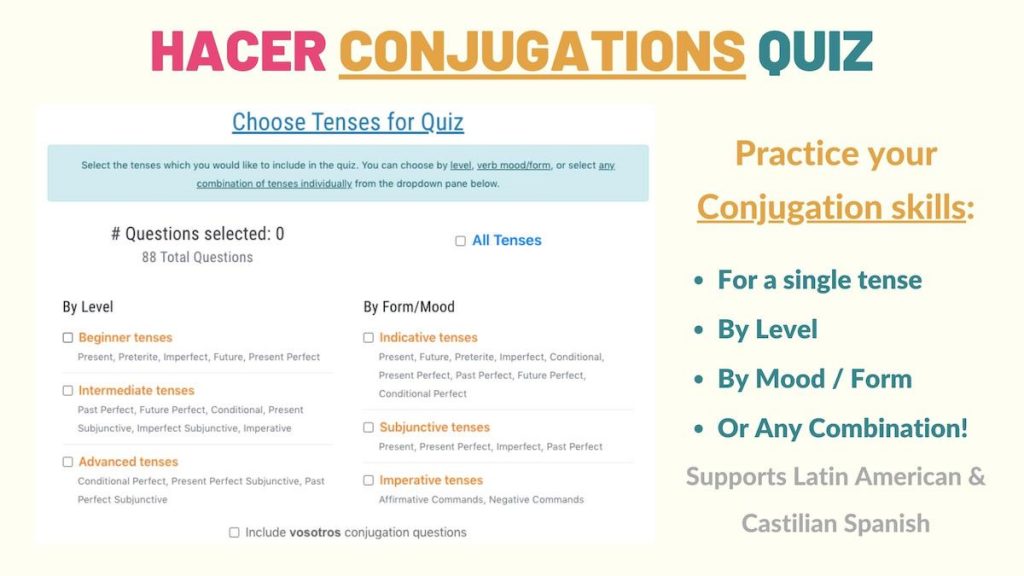
Now that you’ve learned how to conjugate hacer in Spanish, you can practice your skills with all of the various stem changes this verb has with the hacer conjugation practice quiz!