In Spanish, parecer is a crucial -ER verb with multiple applications. However, it has some consonant changes that affect other verbs ending with –cer. So, in this guide, we’ll review parecer conjugation. Here is an overview of what we’ll cover:
- Parecer Overview
- Indicative Tenses of Parecer Conjugations
- Subjunctive Tenses of Parecer Conjugations
- Imperative (Commands) of Parecer Conjugations
- Uses & Examples
- Download Parecer Conjugation Tables & Uses Cheat sheets
- Parecer Conjugation Practice Quiz
Overview of Parecer
| Verb Characteristic | Property |
|---|---|
| Verb Type | -ER |
| Irregular | No |
| Infinitive | Parecer |
| Gerund (Present Participle) Form | Pareciendo |
| Past Participle Form | Parecido |
| Synonyms | Opinar, pensar, asemejarse, aparentar. |
Stem Changes: -CER to ZC
- Present Indicative: parezc only for ‘yo’.
- Present Subjunctive: parezc for all subject pronouns.
- Affirmative Imperative: parezc only for ‘usted’ and ‘ustedes’.
- Negative Imperative: parezc for all subject pronouns.
The verb parecer has numerous meanings in Spanish. The conjugation charts below only have one translation to keep the tables as organized as possible. To learn more about the different uses of parecer, go to the section Uses & Meanings.
Indicative Conjugations of Parecer
Present tense
In the present tense, parecer has a -CER to ZC change for the subject pronoun ‘yo’. Use parecer’s present conjugations to point out the resemblance between two people or explain how someone seems to be. For instance: Tu mamá parece muy amable.
| Person | Conjugation | Translation |
|---|---|---|
| Yo | Parezco | I seem |
| Tú | Pareces | You seem |
| Él / Ella Usted | Parece | He/She seems You (formal) seem |
| Nosotros | Parecemos | We seem |
| Vosotros | Parecéis | You seem |
| Ellos / Ellas Ustedes | Parecen | They seem You (plural) seem |
Preterite tense
Parecer conjugations in the past preterite tense are regular. Use the preterite forms to explain what you thought about something or how something seemed. For instance: Los precios nos parecieron muy caros.
| Person | Conjugation | Translation |
|---|---|---|
| Yo | Parecí | I seemed |
| Tú | Pareciste | You seemed |
| Él / Ella Usted | Pareció | He/She seemed You (formal) seemed |
| Nosotros | Parecimos | We seemed |
| Vosotros | Parecisteis | You seemed |
| Ellos / Ellas Ustedes | Parecieron | They seemed You (plural) seemed |
Imperfect tense
The imperfect conjugations of parecer can be used to communicate how someone or something used to seem in the past. You can also use these forms to refer to the resemblance people or things used to have. For example: Cuando era niña, mi hermana se parecía a mi mamá.
| Person | Conjugation | Translation |
|---|---|---|
| Yo | Parecía | I seemed I used to seem |
| Tú | Parecías | You seemed You used to seem |
| Él / Ella Usted | Parecía | He/She seemed He/She used to seem You (formal) seemed You (formal) used to seem |
| Nosotros | Parecíamos | We seemed We used to seem |
| Vosotros | Parecíais | You seemed You used to seem |
| Ellos / Ellas Ustedes | Parecían | They seemed They used to seem You (plural) seemed You (plural) used to seem |
Near future
To form the near future conjugations of parecer, use ir (present forms) + a + infinitive verb. These conjugations allow you to explain what something or someone is going to look like or a person’s opinion about something. Creo que tus hijos se van a parecer a tu esposo.
| Person | Conjugation | Translation |
|---|---|---|
| Yo | Voy a parecer | I’m going to seem |
| Tú | Vas a parecer | You’re going to seem |
| Él / Ella Usted | Va a parecer | He/She is going to seem You (formal) are going to seem |
| Nosotros | Vamos a parecer | We’re going to seem |
| Vosotros | Vais a parecer | You’re going to seem |
| Ellos / Ellas Ustedes | Van a parecer | They’re going to seem You (plural) are going to seem |
Future simple tense
Use parecer conjugated to the simple future in Spanish to explain that something will look like another person or to say what someone will think about a specific situation. A Roberto no le parecerá bien que usemos su teléfono.
| Person | Conjugation | Translation |
|---|---|---|
| Yo | Pareceré | I will seem |
| Tú | Parecerás | You will seem |
| Él / Ella Usted | Parecerá | He/She will seem You (formal) will seem |
| Nosotros | Pareceremos | We will seem |
| Vosotros | Pareceréis | You (formal) will seem |
| Ellos / Ellas Ustedes | Parecerán | They will seem You (plural) will seem |
Conditional tense
Conjugate parecer to the indicative conditional tense to express that someone or something would seem a certain way. You can also use these forms to ask people politely what they think about a proposal. For example: ¿Le parecería bien si la comunico con mi gerente?
| Person | Conjugation | Translation |
|---|---|---|
| Yo | Parecería | I would seem |
| Tú | Parecerías | You would seem |
| Él / Ella Usted | Parecería | He/She would seem You (formal) would seem |
| Nosotros | Pareceríamos | We would seem |
| Vosotros | Pareceríais | You would seem |
| Ellos / Ellas Ustedes | Parecerían | They would seem You (plural) would seem |
Present perfect tense
To form the present perfect forms of ‘parecer’, use the present indicative conjugations of haber + parecido (verb in past participle). These conjugations allow you to express that someone has seemed a certain way or looked like another person. For example: Julieta nunca se ha parecido a Emma.
| Person | Conjugation | Translation |
|---|---|---|
| Yo | He parecido | I have seemed |
| Tú | Has parecido | You have seemed |
| Él / Ella Usted | Ha parecido | He/She has seemed You (formal) have seemed |
| Nosotros | Hemos parecido | We have seemed |
| Vosotros | Habéis parecido | You have seemed |
| Ellos / Ellas Ustedes | Han parecido | They have seemed You (plural) have seemed |
Past perfect
In Spanish, the past perfect of parecer is used to say that something had or hadn’t seemed a certain way before a past point in time. To build this tense, use the haber in the imperfect tense + the past participle form of ‘parecer’. For example: Dijiste que te había parecido una buena idea.
| Person | Conjugation | Translation |
|---|---|---|
| Yo | Había parecido | I had seemed |
| Tú | Habías parecido | You had seemed |
| Él / Ella Usted | Había parecido | He/She had seemed You (formal) had seemed |
| Nosotros | Habíamos parecido | We had seemed |
| Vosotros | Habíais parecido | You had seemed |
| Ellos / Ellas Ustedes | Habían parecido | They had seemed You (plural) had seemed |
Future perfect
Use parecer’s future perfect forms to explain that something will have seemed or someone will have looked like another person by or before a specific moment. These forms can also be used to ask what something might have seemed to others.
For example: ¿Le habrá parecido una mala idea?
| Person | Conjugation | Translation |
|---|---|---|
| Yo | Habré parecido | I will have seemed |
| Tú | Habrás parecido | You will have seemed |
| Él / Ella Usted | Habrá parecido | He/She will have seemed You (formal) will have seemed |
| Nosotros | Habremos parecido | We will have seemed |
| Vosotros | Habréis parecido | You will have seemed |
| Ellos / Ellas Ustedes | Habrán parecido | They will have seemed You (plural) will have seemed |
Conditional perfect
Conjugate parecer to the conditional perfect tense to communicate that someone would have looked like another person or something would have seemed a certain way if a past condition had occurred. For example: Si mi nariz fuera más pequeña, me habría parecido más a mi abuela.
| Person | Conjugation | Translation |
|---|---|---|
| Yo | Habría parecido | I would have seemed |
| Tú | Habrías parecido | You would have seemed |
| Él / Ella Usted | Habría parecido | He/She would have seemed You (formal) would have seemed |
| Nosotros | Habríamos parecido | We would have seemed |
| Vosotros | Habríais parecido | You would have seemed |
| Ellos / Ellas Ustedes | Habrían parecido | They would have seemed You (plural) would have seemed |
Progressive tenses
The progressive forms of parecer are most frequently used to say or ask for someone’s opinion about something at the moment of speaking. These conjugations are used with estar conjugations + the present participle form of this verb.
For example: ¿Qué les está pareciendo la obra?
| Progressive Tense | Formula | Translation Example |
|---|---|---|
| Present | Estar (present) + pareciendo | I am seeming |
| Preterite | Estar (preterite) + pareciendo | You were seeming |
| Imperfect | Estar (imperfect) + pareciendo | He was seeming |
| Future | Estar (future) + pareciendo | We will be seeming |
| Conditional | Estar (conditional) + pareciendo | They would be seeming |
Parecer Subjunctive Conjugations
The subjunctive mood in Spanish is used to refer to someone’s hopes, expectations, requests, doubts, and advice or to express hypothetical situations. Below are the parecer conjugation charts for the most important subjunctive tenses.
Present subjunctive
Parecer subjunctive conjugation has a -CER to ZC stem change for all subject pronouns. With these conjugations, parecer is used to suggest, ask or wish that something doesn’t seem a certain way or that someone doesn’t like another person.
For example: Espero que nuestras ideas les parezcan bien.
| Person | Conjugation | Translation |
|---|---|---|
| Yo | Parezca | I seem |
| Tú | Parezcas | You seem |
| Él / Ella Usted | Parezca | He/She seems You (formal) seem |
| Nosotros | Parezcamos | We seem |
| Vosotros | Parezcáis | You seem |
| Ellos / Ellas Ustedes | Parezcan | They seem You (plural) seem |
Present perfect subjunctive
The present perfect subjunctive tense is formed by using haber (present subjunctive) + parecido. These parecer conjugations allow you to express wishes or doubt about whether someone had a good or bad opinion about something. No creo que les haya parecido mal.
| Person | Conjugation | Translation |
|---|---|---|
| Yo | Haya parecido | I have seemed |
| Tú | Hayas parecido | You have seemed |
| Él / Ella Usted | Haya parecido | He/She has seemed You (formal) have seemed |
| Nosotros | Hayamos parecido | We have seemed |
| Vosotros | Hayáis parecido | You have seemed |
| Ellos / Ellas Ustedes | Hayan parecido | They have seemed You (plural) have seemed |
Imperfect subjunctive
The Spanish imperfect subjunctive of this verb allows you to talk about past advice, demands, and expectations you had about someone looking like another person. These conjugations can also be used to make hypotheses about how something or someone seems. Paraciera que estás enojada conmigo.
Based on whether you’re learning Castilian or Latin American Spanish, the imperfect subjunctive tense follows a particular conjugation pattern:
Latin American Spanish version
| Person | Conjugation | Translation |
|---|---|---|
| Yo | Pareciera | I seemed |
| Tú | Parecieras | You seemed |
| Él / Ella Usted | Pareciera | He/She seemed You (formal) seemed |
| Nosotros | Pareciéramos | We seemed |
| Ellos / Ellas Ustedes | Parecieran | They seemed You (plural) seemed |
Note: Since vosotros is not used in Latin American Spanish, its parecer conjugation has been omitted from the conjugation chart above.
Castilian Spanish version
| Person | Conjugation | Translation |
|---|---|---|
| Yo | Pareciese | I seemed |
| Tú | Parecieses | You seemed |
| Él / Ella Usted | Pareciese | He/She seemed You (formal) seemed |
| Nosotros | Pareciésemos | We seemed |
| Vosotros | Parecieseis | You seemed |
| Ellos / Ellas Ustedes | Pareciesen | They seemed You (plural) seemed |
Past perfect subjunctive
When conjugated to the past perfect subjunctive, parecer expresses that someone or something would have seemed or looked a certain way. For example: Si hubieran sonreído un poco más, hubieran parecido más amable.
| Person | Conjugation | Translation |
|---|---|---|
| Yo | Hubiera parecido | I had seemed |
| Tú | Hubieras parecido | You had seemed |
| Él / Ella Usted | Hubiera parecido | He/She had seemed You (formal) had seemed |
| Nosotros | Hubiéramos parecido | We had seemed |
| Vosotros | Hubierais parecido | You had seemed |
| Ellos / Ellas Ustedes | Hubieran parecido | They had seemed You (plural) had seemed |


Parecer Imperative Conjugations
The Spanish imperative mood is used to give commands to people. The affirmative imperative allows you to tell them to do something, whereas the negative imperative commands not to do something.
Affirmative commands
This verb’s imperative conjugations have a consonant change for ‘usted’ and ‘ustedes’. You can see this parecer conjugation change in the chart below. These forms can be used to strongly suggest someone to seem a certain way. However, they aren’t very common.
Ahí viene Luisa, pareced enojados.
| Person | Conjugation | Translation |
|---|---|---|
| Tú | Parece | |
| Usted | Parezca | Seem |
| Vosotros | Pareced | Seem |
| Ustedes | Parezcan | Seem |
Negative commands
You can use negative commands to tell someone not to seem a certain way. However, these commands are closer to a suggestion and are not as commonly used. For example: ¡Ay, no parezcan tan emocionados, por favor!
| Person | Conjugation | Translation |
|---|---|---|
| Tú | No parezcas | Don’t seem |
| Usted | No parezca | Don’t seem |
| Vosotros | No parezcáis | Don’t seem |
| Ustedes | No parezcan | Don’t seem |
Meanings of Parecer & Examples
In the sections above, you’ve learned how to conjugate parecer in Spanish. Now, in this section, we’ll review some of this verb’s most common uses. Depending on the Spanish pronouns and conjugations you use, parecer means:
- To look like (use reflexive pronouns)
- To seem or appear (combine with adjectives)
- Apparently or it seems (use impersonal forms)
- To think or find (use indirect object pronouns)
- Sounds good (use adverbs of manner)
[Parecer conjugated] + [complement]
A nosotros nos parece bien.
It sounds good to us.
Cuando te conocí, parecías un poco antipático.
When I met you, you seemed disagreeable.
¿Qué les pareció la película?
What did you guys think about the movie?
Parece que van a cerrar la carretera.
It seems that they’re going to close the highway.
De niño, te parecías mucho a tu papá.
When you were a kid, you looked very much like your dad.
Download Parecer Conjugation Charts & Uses Cheat sheets
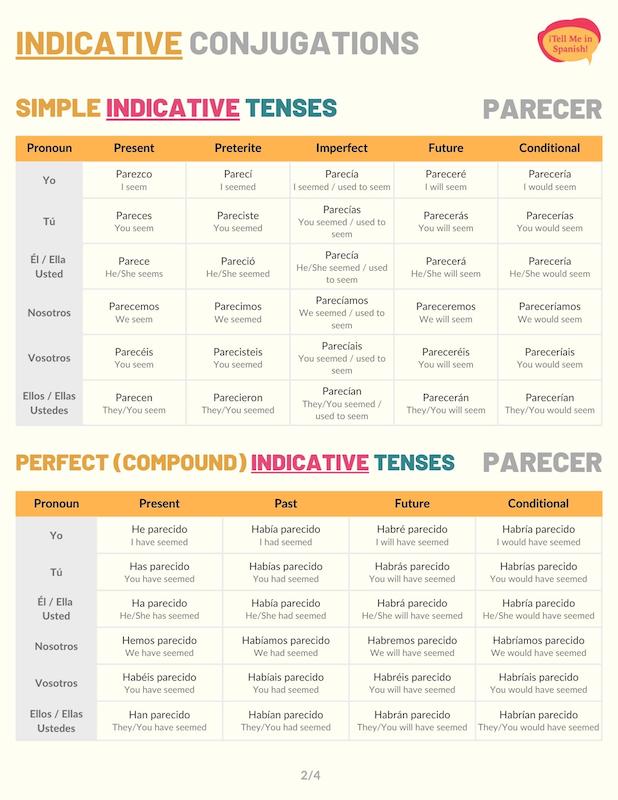
Parecer is an important and common stem-changing verb in Spanish. It’s also highly dynamic with many different uses and meanings. So, I’ve created a cheat sheet PDF with all of the parecer conjugation charts along with it definitions and examples to see how you can apply it in your daily conversations.
Practice Quiz: Parecer Conjugation
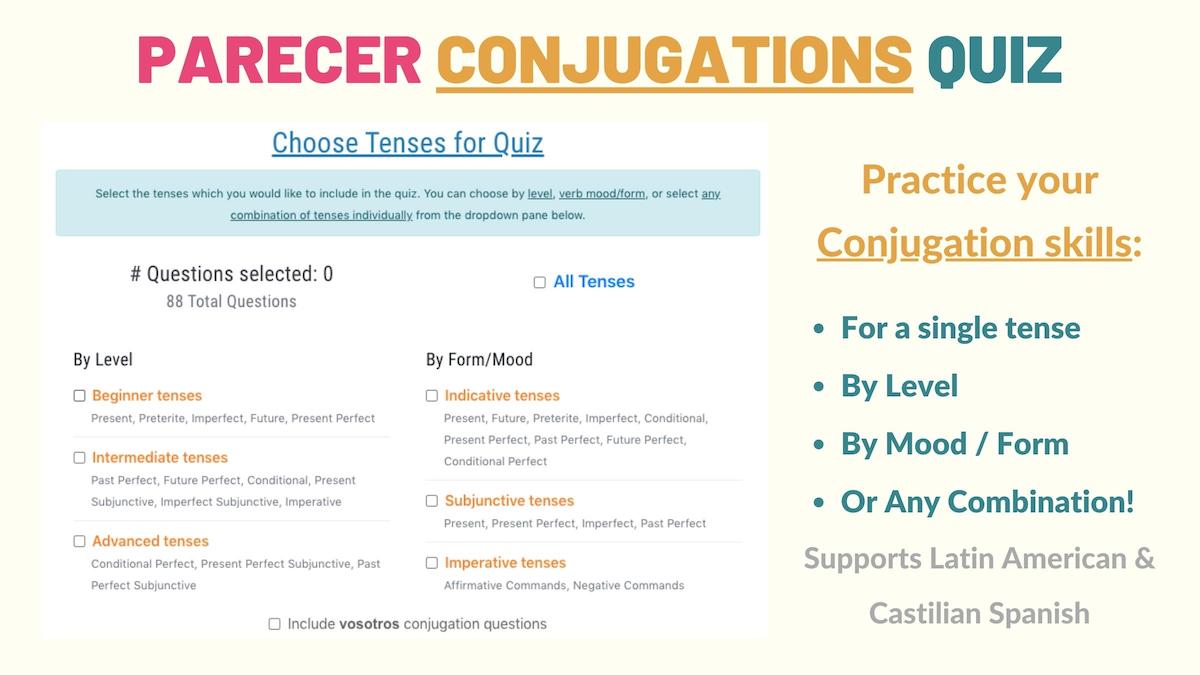
Congratulations! You now know how to conjugate one of the most common -ER verbs. Now you can take the parecer conjugation practice quiz to test your knowledge of all its regular and stem-changing forms.